
Promo code GET25Claim it now

OpenAI release: July 9, 2026

GPT-5.6 Sol, Terra and Luna: which model should you choose?

OpenAI has launched three models within one generation. Sol targets the hardest work, Terra balances quality and cost, and Luna prioritizes speed and high-volume processing. Access differs substantially across ChatGPT, Work, Codex and the API.

Official OpenAI GPT-5.6 Sol artwork featuring the Sun
GPT-5.6 Sol
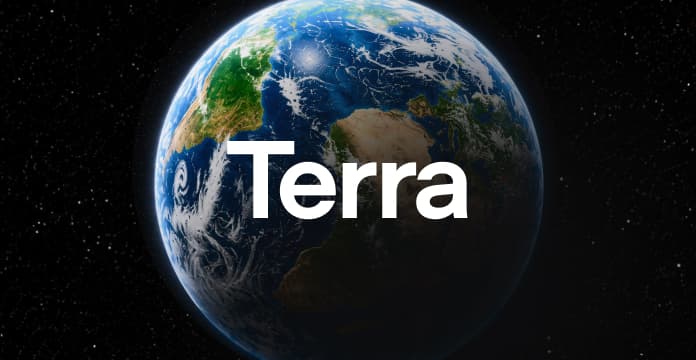
Official OpenAI GPT-5.6 Terra artwork featuring the Earth
GPT-5.6 Terra
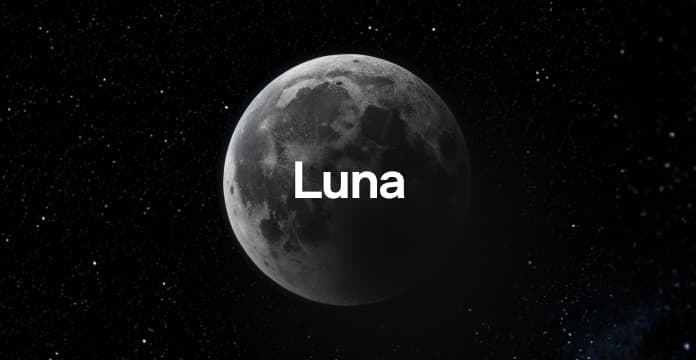
Official OpenAI GPT-5.6 Luna artwork featuring the Moon
GPT-5.6 Luna
The GPT-5.6 family now separates maximum capability, balanced everyday work and large-scale efficiency into three clear tiers.
general availability
July 9
OpenAI announced general availability of the GPT-5.6 family on July 9, 2026.
Sol, Terra, Luna
3 models
Three lasting tiers designed around capability, balance and volume.
API context window
1.05M
All three API model pages list a 1,050,000-token context window and a 128,000-token maximum output.
API token pricing
$1 to $30
Depending on the model and token direction: from $1 Luna input to $30 Sol output per million tokens.

At a glance

GPT-5.6 is not one model with three nicknames

Sol, Terra and Luna are separate capability and cost tiers. The right choice depends less on the prestige of a model name than on the difficulty of the work, the volume involved and the OpenAI product you use.

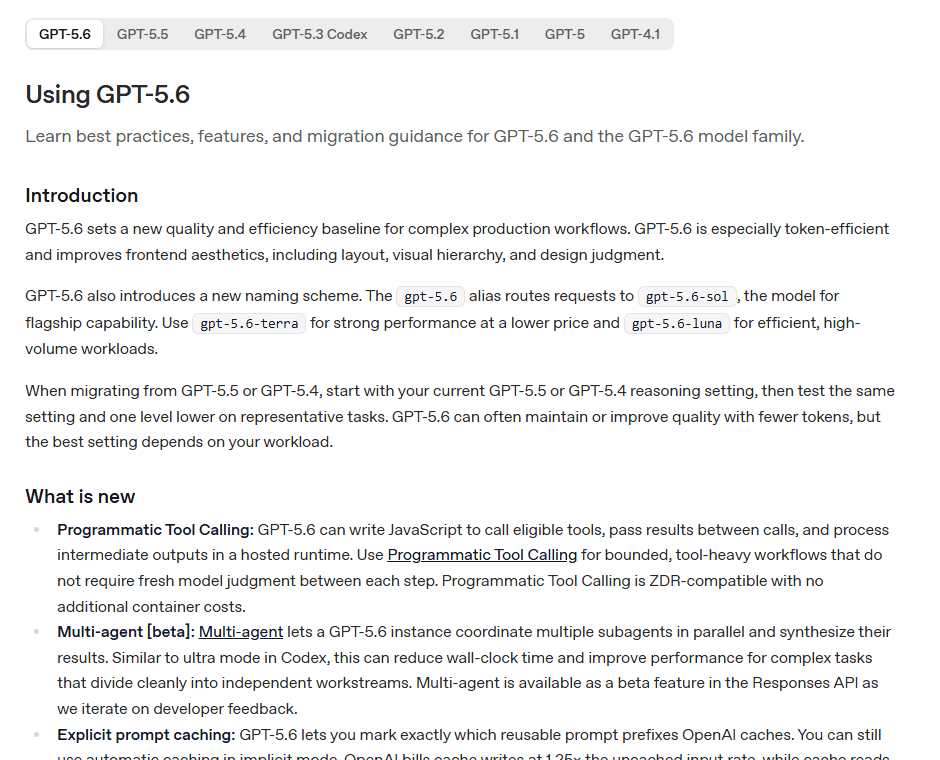
Sol is the flagship model in the GPT-5.6 generation. It carries the highest reasoning levels and is designed for complex professional work, coding, research, design and long tool-using tasks. In the API, the gpt-5.6 alias routes to gpt-5.6-sol.

Terra retains the modern capabilities of the family at half the API price of Sol. It is the natural candidate for everyday production where quality still matters but each request must remain economically sensible.

Luna is the fastest and least expensive model in the family. It is built for repeated processing, classification, extraction, variants, triage and high-volume pipelines. It is not positioned as the strongest model overall, but as the model that makes GPT-5.6 easier to deploy at scale.

Three tiers

Sol, Terra and Luna address three different operating needs

All three models share a very large context window, reasoning, text and image input, and the main tools of the Responses API. Their biggest differences are maximum capability, speed and price.

gpt-5.6-sol (gpt-5.6 alias)

GPT-5.6 Sol

The flagship model for difficult work

Sol is intended for tasks where a mistake costs more than a few extra seconds or dollars: software architecture, professional analysis, deep research, demanding documents, computer use, defensive cybersecurity and coordination across multiple tools.

$5 input / $0.50 cached / $30 output

  • Complex coding and debugging
  • Multi-step research and analysis
  • Demanding documents, presentations and interfaces
  • Long-running tasks with tools or agents

Its output price is five times Luna's. Use Sol where the added capability can materially improve the outcome.
gpt-5.6-terra

GPT-5.6 Terra

The quality-cost balance for everyday work

Terra is aimed at teams that want modern GPT-5.6 quality without paying for Sol on every request. It suits business assistants, document processing, editorial production, routine agents and coding tasks with controlled complexity.

$2.50 input / $0.25 cached / $15 output

  • Regular professional production
  • Internal assistants and operations
  • Document analysis and summaries
  • Routine coding with human review

Terra remains a powerful model. Real savings also depend on token volume, retries and tool calls, not only the listed token price.

gpt-5.6-luna

GPT-5.6 Luna

The fast model for high-volume processing

Luna prioritizes throughput and cost. It becomes attractive when the same task must run hundreds or thousands of times: ticket classification, field extraction, normalization, short variants, catalog enrichment or an initial pass before a more demanding review.

$1 input / $0.10 cached / $6 output

  • High-volume classification and extraction
  • Short variants and enrichment
  • Triage before Terra or Sol
  • Cost- and latency-sensitive applications

Luna can be the best economic choice without being the best qualitative choice for a complex case, a sensitive decision or a long design task.

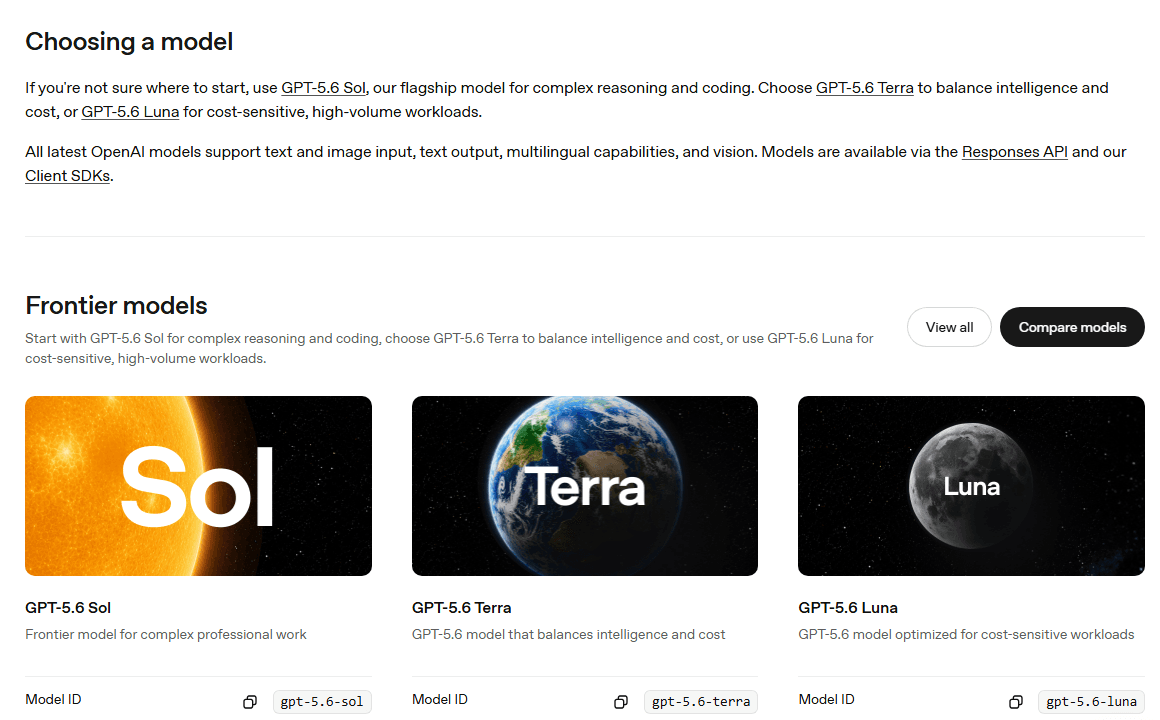
OpenAI Developers catalog showing GPT-5.6 Sol, Terra and Luna
The OpenAI Developers catalog presents Sol as the flagship model, Terra as the intelligence-cost balance and Luna as the option optimized for cost-sensitive volume.Open the OpenAI model catalog

GPT-5.6 Sol vs Terra vs Luna comparison

The prices below are OpenAI API rates per million tokens. They are not ChatGPT subscription prices. Figures checked on July 12, 2026.

GPT-5.6 Sol

Positioning

Maximum capability

Input / cached / output

$5 / $0.50 / $30

Context and output

1.05M / 128K

Logical use

Complex work, code, research, design and demanding agents

GPT-5.6 Terra

Positioning

Quality-cost balance

Input / cached / output

$2.50 / $0.25 / $15

Context and output

1.05M / 128K

Logical use

Everyday production, documents, operations and routine coding

GPT-5.6 Luna

Positioning

Speed and volume

Input / cached / output

$1 / $0.10 / $6

Context and output

1.05M / 128K

Logical use

Extraction, classification, variants and large-scale pipelines

Requests above 272,000 input tokens are billed with higher multipliers according to the model pages. The final cost also depends on tool calls, caching, reasoning and retries.

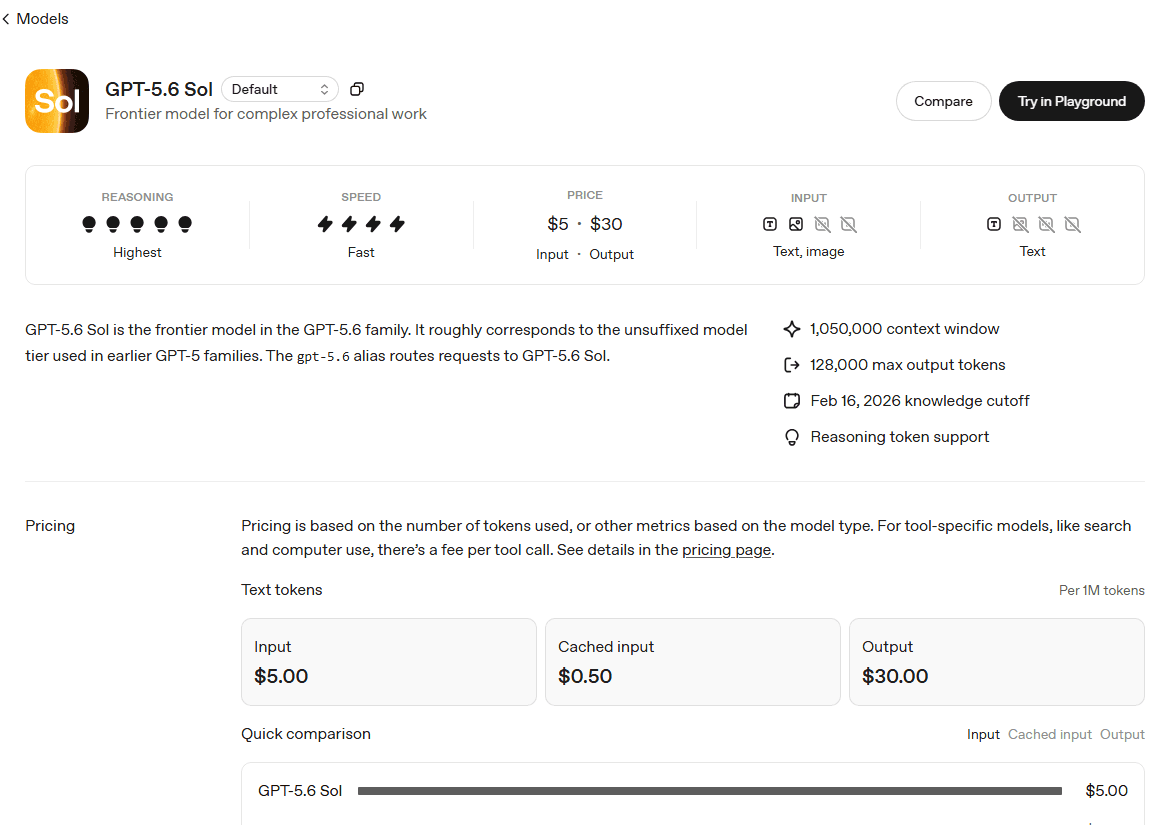
OpenAI API page for GPT-5.6 Sol showing pricing and context window
The Sol API page confirms the price, context window, maximum output, image input and flagship positioning.Official OpenAI source

Where is GPT-5.6 actually available?

A general release does not mean that all three names appear everywhere. The standard ChatGPT model picker, Work, Codex and the API expose the family in different ways.

Standard ChatGPT

Plan

Free and Go

GPT-5.6 access

No GPT-5.6 Sol in standard conversations

What to understand

GPT-5.5 Instant remains the base model; the Go Thinking option does not use Sol.

Standard ChatGPT

Plan

Plus

GPT-5.6 access

Sol in Medium and High

What to understand

Extra High and Pro are not included according to OpenAI Help.

Standard ChatGPT

Plan

Pro

GPT-5.6 access

Sol in Medium, High, Extra High and Sol Pro

What to understand

Pro targets the hardest tasks and long-running work.

Standard ChatGPT

Plan

Business and Enterprise

GPT-5.6 access

Sol in Medium, High, Extra High and Pro

What to understand

Administrators can control which models are available in the workspace.

ChatGPT Work

Plan

Plus, Pro, Business, Enterprise

GPT-5.6 access

Sol, Terra and Luna

What to understand

All three variants can be selected in Work depending on the plan and workspace settings.

Codex

Plan

Free and Go

GPT-5.6 access

Terra

What to understand

OpenAI positions Terra as the entry GPT-5.6 access in Codex.

Codex

Plan

Plus, Pro, Business, Enterprise

GPT-5.6 access

Sol, Terra and Luna

What to understand

Max is available; ultra is announced from Plus upward in Codex.

OpenAI API

Plan

Eligible API account

GPT-5.6 access

Sol, Terra and Luna

What to understand

All three model identifiers are listed in the API model catalog.

GPT-5.6 is not visible yet?

OpenAI describes a gradual rollout. Check your plan, the active workspace, administrator settings and your Codex version before treating the model as unavailable.

Instant, Medium, High, Extra High, max, ultra and Pro

Model names and effort levels overlap. Keeping them separate prevents a higher button from being mistaken for a completely different model variant.

Instant

Still uses GPT-5.5 Instant for fast everyday answers in ChatGPT.

Medium

Uses GPT-5.6 Sol with standard reasoning effort on eligible plans.

High

Allocates more reasoning effort to GPT-5.6 Sol for harder requests.

Extra High

Pushes Sol further; available on Pro, Business and Enterprise in standard ChatGPT.

Pro

Uses GPT-5.6 Sol Pro, the highest-capability option for difficult and long tasks when the plan includes it.

max and ultra

Max increases effort in Work and Codex. Ultra orchestrates several parallel workstreams where that option is available.

Ultra is not GPT-5.6 Ultra

OpenAI presents ultra as an orchestration setting for highly complex work. Sol, Terra and Luna remain the three model tiers in the family.

What's new

GPT-5.6 focuses on tool-driven work and finished deliverables

The release is about more than higher scores. OpenAI highlights changes intended for applications, agents and professional deliverables.

Programmatic Tool Calling

The model can write and execute a small in-memory program to coordinate tools and process intermediate results, with announced Zero Data Retention compatibility.

Multi-agent beta

One instance can distribute subtasks across several agents and combine the results. This mode is aimed at work that divides cleanly into independent streams.

Explicit cache breakpoints

Developers can place cache breakpoints. Cached reads keep a large discount, while cache writes are priced above uncached input.

Very long context

Sol, Terra and Luna list a 1.05-million-token context window and up to 128,000 output tokens in the API.

Original-dimension images

The family accepts images with original or automatic detail, which helps with interfaces, documents and fine-grained visual inspection.

Design and computer use

OpenAI emphasizes the ability to inspect a render, refine interfaces, produce presentations and turn source material into more polished documents.

OpenAI GPT-5.6 guide with model naming and new agent features
The OpenAI Developers guide summarizes the naming structure and the Programmatic Tool Calling, multi-agent and explicit caching features.Official OpenAI source

What do OpenAI's published benchmarks show?

These figures indicate a direction; they do not guarantee performance on your own work. The official results below illustrate differences among the three variants and GPT-5.5.

Agents' Last Exam

Sol

52.7%

Terra

50.4%

Luna

50.3%

GPT-5.5

46.9%

What it measures

Long-running professional and agentic work

Terminal-Bench 2.1

Sol

88.8%

Terra

87.4%

Luna

84.7%

GPT-5.5

85.6%

What it measures

Complex terminal tasks in real repositories

BrowseComp

Sol

90.4%

Terra

87.5%

Luna

83.3%

GPT-5.5

84.4%

What it measures

Difficult agentic web research

OSWorld 2.0

Sol

62.6%

Terra

50.2%

Luna

45.6%

GPT-5.5

47.5%

What it measures

Computer use

GPQA Diamond

Sol

94.6%

Terra

92.9%

Luna

92.3%

GPT-5.5

93.6%

What it measures

Expert-level science questions

Luna does not beat GPT-5.5 on every test, and Terra does not automatically replace Sol. Use a representative evaluation set from your own activity, measuring quality, latency and cost together.

Which GPT-5.6 model should you choose?

Start with task difficulty and the cost of an error. Move up to Sol when the added quality changes the decision; move down to Luna when volume dominates and the task is tightly defined.

Software architecture or difficult debugging

Starting choice

Sol

Why

Reasoning, code and tools are central to the work.

Check to perform

Test on a real incident and review every change.

Everyday document production

Starting choice

Terra

Why

Its quality-price ratio is better suited to repeated professional work.

Check to perform

Compare a set of deliverables with Sol using the same instruction.

High-volume extraction or classification

Starting choice

Luna

Why

Cost and speed matter more than maximum depth.

Check to perform

Measure errors on rare cases before scaling.

Complex research across several sources

Starting choice

Sol High or Extra High

Why

Synthesis, tools and verification require more reasoning.

Check to perform

Review sources and conclusions separately.

Cost-constrained API pipeline

Starting choice

Luna, then Terra

Why

Difficulty-based routing avoids sending every request to Sol.

Check to perform

Escalate ambiguous cases and track total cost per valid result.

Standard ChatGPT conversation

Starting choice

Sol through Medium or High

Why

Terra and Luna cannot be selected in this context.

Check to perform

Check the plan and the displayed reasoning allowance.

Move from GPT-5.5 to GPT-5.6 without choosing blindly

OpenAI recommends testing GPT-5.6 at your current reasoning level and then one level lower on representative tasks. A serious migration should also compare total cost and the number of retries.

  1. 1

    Keep a reference set

    Select easy, medium and difficult tasks, plus a few rare cases for which you already know the correct outcome.

  2. 2

    Test Sol at equivalent settings

    First compare GPT-5.6 with your current GPT-5.5 setup without changing several parameters at once.

  3. 3

    Try lower effort

    If quality remains stable, a lower reasoning level may reduce time, tokens and cost.

  4. 4

    Compare Terra and Luna

    Reserve Sol for cases where it materially improves success; route stable tasks to Terra or Luna.

  5. 5

    Measure valid outcomes

    Track reviewed quality, latency, tokens, tool calls and retries, not only the listed price.

  6. 6

    Design an escalation path

    Ambiguous or sensitive requests should be able to move to a more capable model or human validation.

What does this release mean for Spybox users?

OpenAI's announcement does not prove that a ChatGPT access offered by a third-party platform immediately switches to GPT-5.6. The exact model name, reasoning level, available credits and interface limits remain the points to check.

If Sol appears in the ChatGPT access you use with Spybox, it can strengthen workflows already built around PiPiAds, Kalodata, PPSPY, Winning Hunter, RankerFox or Perplexity: analyze real material, structure a decision, then produce content or a test plan.

Terra and Luna matter primarily for Work, Codex and the API. Their availability should not be inferred from a generic ChatGPT button. For sensitive or confidential work, compare the official Business, Enterprise and API frameworks against your governance requirements.

Limits and precautions

  • The rollout is gradual: a model may be announced before it appears on every eligible account.
  • ChatGPT limits depend on the plan and workspace; they may change independently from API pricing.
  • A 1.05-million-token context window does not guarantee perfect recall of every detail in a very large corpus.
  • Benchmarks use specific setups and do not replace evaluation on your own documents, tools and criteria.
  • Long API inputs, tool use and reasoning can change the real cost of a request substantially.
  • Stronger safeguards for high-risk biological or cyber requests may lead to refusals or additional checks.

Frequently asked questions about GPT-5.6

Is GPT-5.6 available in ChatGPT?

Yes. GPT-5.6 Sol is rolling out in ChatGPT on eligible plans. Medium and High use it; Extra High and Pro depend on the plan.

Can Terra or Luna be selected in a standard ChatGPT conversation?

No, according to OpenAI Help. Terra and Luna are available depending on the plan in ChatGPT Work, Codex and the API, but not as direct choices in a standard conversation.

Which GPT-5.6 model is the most powerful?

Sol is the flagship model. Sol Pro and higher effort levels target the hardest tasks when the product and plan provide them.

Which GPT-5.6 model is the least expensive?

Luna is the least expensive in the API: $1 per million input tokens, $0.10 for cached input and $6 for output as of July 12, 2026.

Is Sol Pro a fourth model?

No. Sol, Terra and Luna are the three family tiers. Sol Pro is a highest-capability option available in certain products and plans.

What does ultra mode mean?

Ultra is an orchestration level for highly complex work, with several parallel streams or agents depending on the product. It is not a model called GPT-5.6 Ultra.

Is GPT-5.6 already available in Spybox?

The official release does not establish availability for every third-party access. Check the exact model name, level and limits shown in the Spybox interface when you use it.

Does GPT-5.6 replace GPT-5.5 Instant?

No. OpenAI says GPT-5.5 Instant remains the fast default model in ChatGPT, while GPT-5.6 Sol powers eligible reasoning levels.

Connect GPT-5.6 to real work

Before choosing the strongest model, start with the work to be done, the volume and the cost of an error. The Spybox ChatGPT guide then places that access within a broader suite of AI, ecommerce, ad intelligence and SEO tools.