

Winning Hunter with Spybox
An ad catches your eye, but does the product deserve a test? Winning Hunter brings together ads, stores and competitor research to compare the offer, its distribution and how it changes over time.
Public features and pricing checked on October 2, 2026.
Winning Hunter pricing: direct plans and Spybox
The official subscription page, set to monthly billing and displayed in euros, lists Basic at EUR 49, Standard at EUR 79 and Premium at EUR 249. Differences include filters, tracked brands and TikTok Shop allowances.
BasicEUR 49/month
- Main differences
- Meta/Facebook, limited filters, 2 tracked brands, Magic AI, Store Explorer and 200 TikTok Shop searches/day. API/MCP: 100 API credits/month.
StandardEUR 79/month
- Main differences
- Facebook, TikTok Ads and Pinterest; advanced filters, 30 tracked brands, Trends and 1,000 TikTok Shop searches/day. API: 20,000 credits/month.
PremiumEUR 249/month
- Main differences
- Facebook and TikTok Ads, 200 tracked brands, TikTok Shop searches advertised as unlimited, weekly guidance and 20,000 API credits/month.
SpyboxEUR 29.99/month; EUR 249.99/year annually
- Main differences
- 90+ tools and 100,000 SBC/month in the standard offer. Shared access, separate from direct plans and their allowances.
| Access | Published monthly price | Main differences |
|---|---|---|
| Basic | EUR 49/month | Meta/Facebook, limited filters, 2 tracked brands, Magic AI, Store Explorer and 200 TikTok Shop searches/day. API/MCP: 100 API credits/month. |
| Standard | EUR 79/month | Facebook, TikTok Ads and Pinterest; advanced filters, 30 tracked brands, Trends and 1,000 TikTok Shop searches/day. API: 20,000 credits/month. |
| Premium | EUR 249/month | Facebook and TikTok Ads, 200 tracked brands, TikTok Shop searches advertised as unlimited, weekly guidance and 20,000 API credits/month. |
| Spybox | EUR 29.99/month; EUR 249.99/year annually | 90+ tools and 100,000 SBC/month in the standard offer. Shared access, separate from direct plans and their allowances. |
Public prices checked on October 2, 2026. The marketing website also displays dollar prices and calls its third plan Enterprise; this table follows the subscription page in euros. That page lists extra seats at EUR 20/month.
Official subscription pricesWhat changes with access through Spybox
Winning Hunter is among the product research tools offered through Spybox. Your budget covers several services, so this is not an individual Premium subscription sold at a different price.
- The standard 100,000 monthly SBC are a Spybox allowance, not 100,000 Winning Hunter API credits. Actions consume SBC according to the service and feature.
- Direct allowances for brands, TikTok Shop, API/MCP and seats do not automatically apply to shared access. Choose a plan based on the features actually offered in Spybox.
- Spybox annual access costs EUR 249.99 upfront, equivalent to about EUR 20.83/month. GET25 applies to Spybox: the discount, credits and final amount appear at signup.
Free trial and promo code: two separate offers
Winning Hunter advertises a free trial without a credit card. This is direct access through the provider; duration and features are specified at signup. To compare interfaces, use the same product and record the available filters and data. GET25 applies to Spybox, not Basic, Standard or Premium purchased directly.
Trial announced by Winning HunterWho Winning Hunter is for
Winning Hunter is an ecommerce intelligence tool. Its ad libraries, store tracking and Magic AI let you work back from an ad to competing sellers. It suits merchants researching an offer, brands monitoring their market and media buyers developing new creative concepts.
The benefit is connecting several questions in one investigation: how long has the ad been running, how many variations are visible, which page receives the visitor and who sells a comparable product? A library then becomes a short list of documented leads rather than a collection of videos to reproduce.
Inside Spybox, Winning Hunter complements PiPiAds, PPSPY, Kalodata and ChatGPT. Shared access suits research spread across several tools; a direct subscription is a different option when most of your work happens in Winning Hunter.
- Launching a store: compare a few products, price points and offers already available.
- An established brand: monitor new ads, bundles and pages from close competitors.
- A creative team: collect demonstrations and objections to turn into original concepts.
From an ad to a competitor: five features to understand
These official illustrations present Winning Hunter's features. Their figures are examples, not the current performance of a store. Each image opens in full.
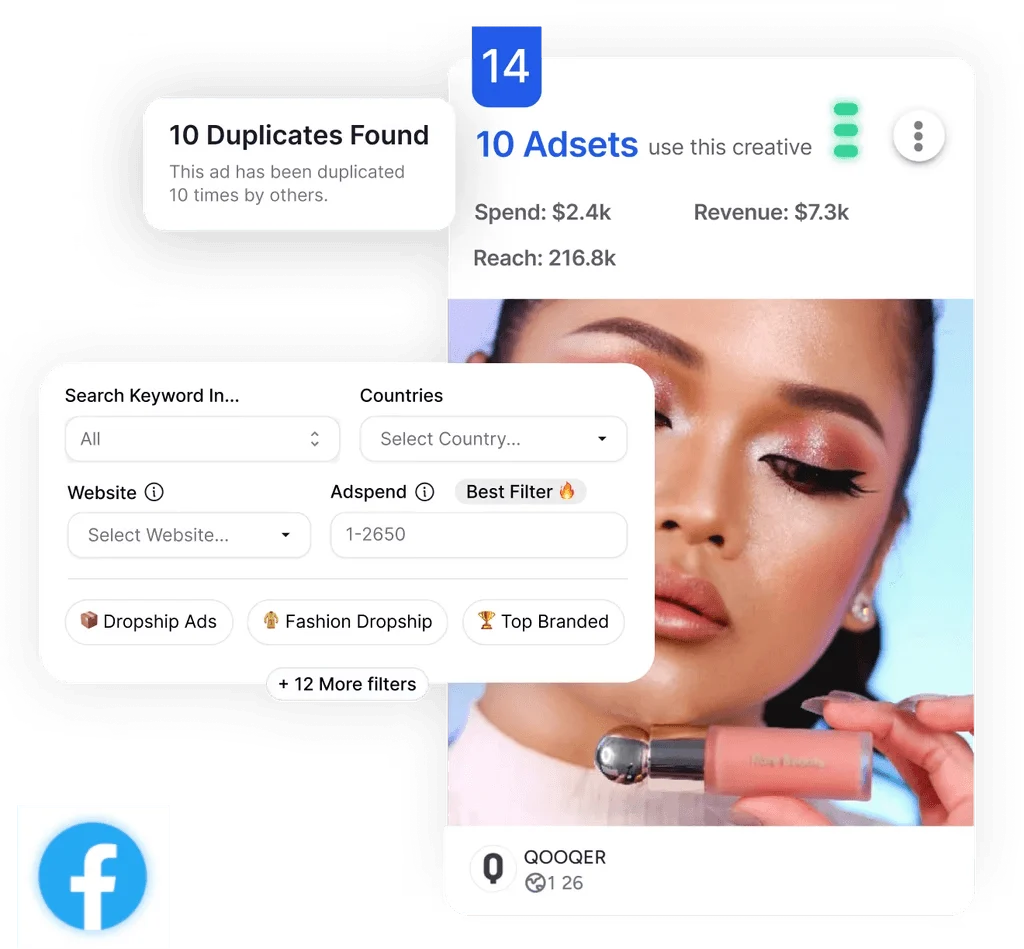
Facebook Ads: compare distribution and variations
The library offers filters including country, website, dates, ad spend and number of ad sets. The illustration connects one creative with 10 ad sets and a duplication counter. These are reasons to examine the message and linked pages, not to increase your budget mechanically.
Source: Winning Hunter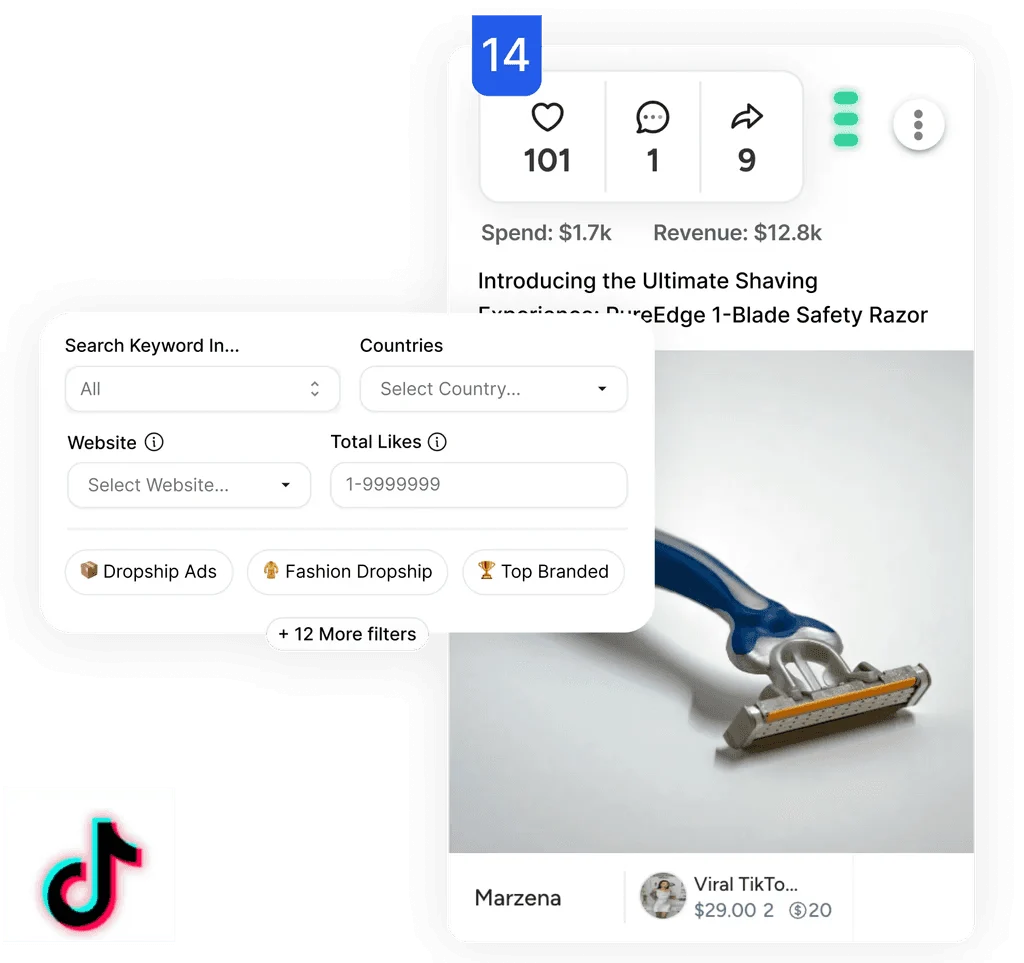
TikTok Ads: separate attention from purchase intent
The likes filter helps find creatives that attract attention. The preview also shows comments and shares. A demonstration may be widely watched without persuading people to buy: record the problem, opening scene and audience questions, then check whether the page addresses the same expectations.
Source: Winning Hunter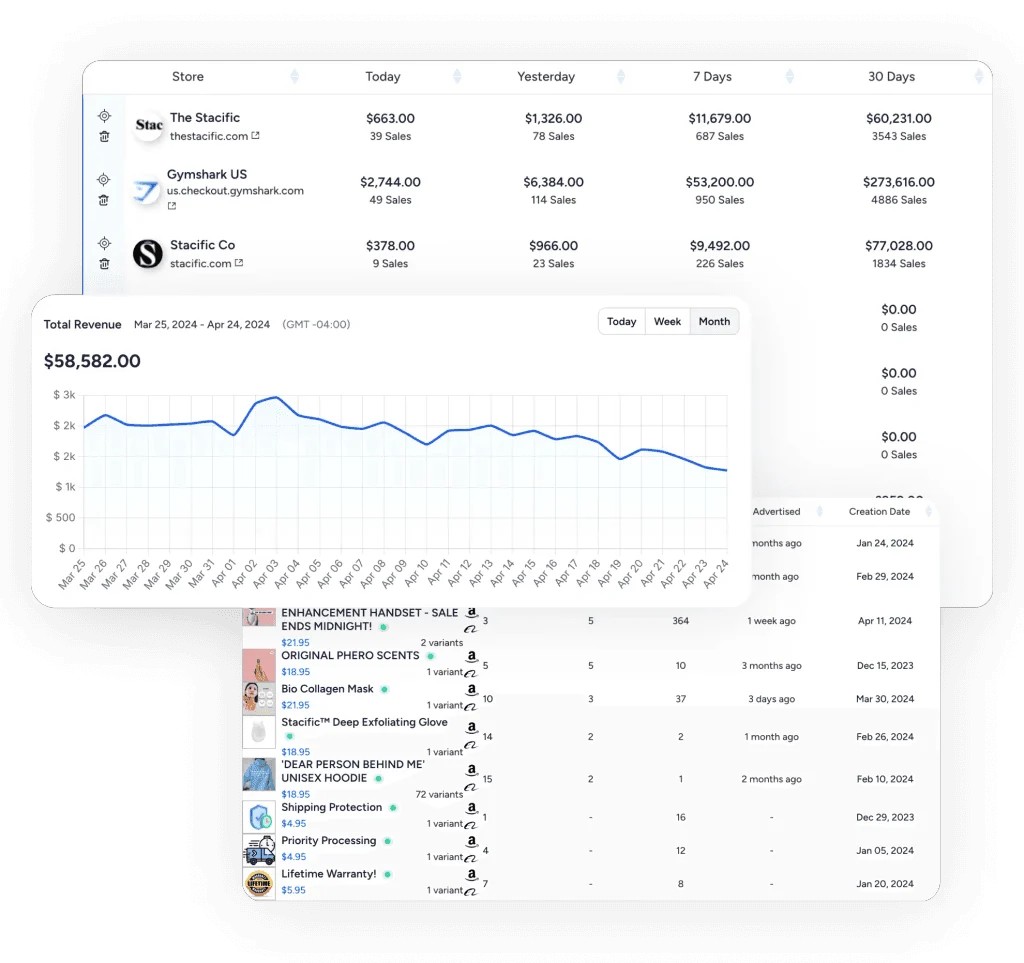
Store Tracker: monitor a store over time
Tracking brings together periods such as today, yesterday, seven days and thirty days, with a chart and products. Compare periods of equal length, then look for catalogue or advertising changes. Competitor revenue remains an estimate; it does not reveal profit or predict your results.
Source: Winning Hunter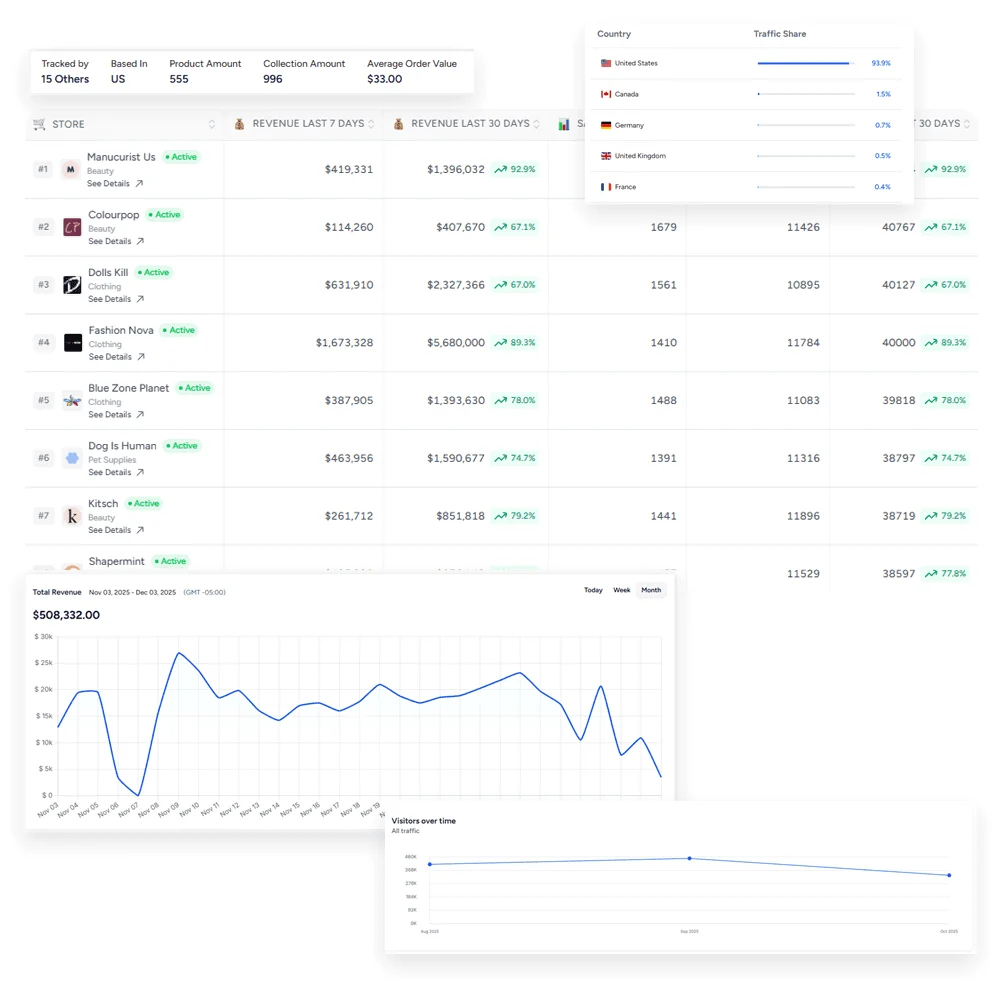
Store Explorer: choose comparable competitors
The illustration shows store rankings, traffic distribution by country and charts. A brand with mainly US traffic is not automatically a good model for selling in France. Compare market, price range, assortment and delivery first; the displayed volume comes afterwards.
Source: Winning Hunter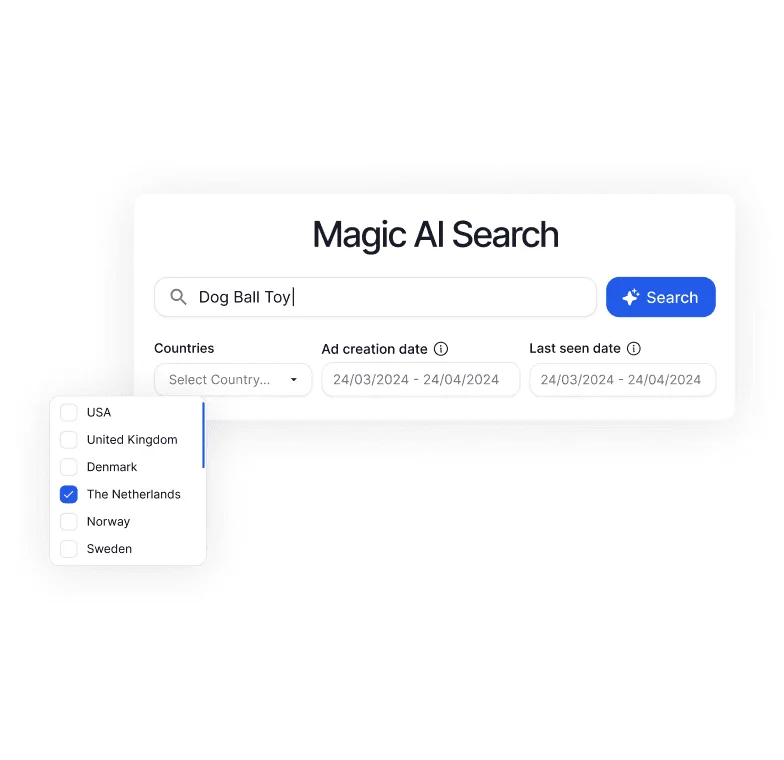
Magic AI: find sellers of a product
Winning Hunter describes keyword or image-based competitor research. The preview below shows text search with country and date filters. For the same item, compare prices, bundles, accessories and delivery promises: the useful question is what you can offer differently, not just how many sellers exist.
Source: Winning HunterWhat does an ad classified as Winning mean?
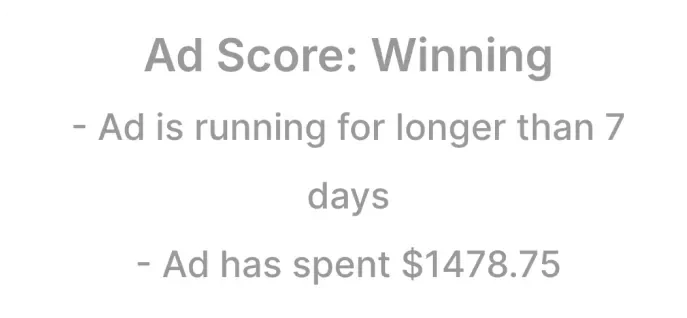
The public illustration below associates this classification with an ad running for more than seven days and USD 1,478.75 in spend. The provider's FAQ describes a score based on spend, running time and how distribution scales.
What the score helps you spot
An ad that is kept running and expanded deserves closer examination. Compare its variations, main promise and route to the store. The score helps prioritise the leads to investigate.
What it does not measure for you
The classification does not disclose the advertiser's margin, returns or full acquisition cost. Nor does it establish that the same offer will sell at the same price in your market.
Where the research goes next
Open the linked offer, identify its price and bundle, find other sellers with Magic AI, and check whether you can source and demonstrate the product properly. That comparison provides a reason to run a test.
The first Facebook illustration also displays USD 2.4k in spend and USD 7.3k in revenue. Dividing those numbers would not produce an audited ROAS: the method, period and attribution are not documented in that image.
Which signals support which decisions?
Several active variationsThe advertiser is exploring or expanding a concept.
- Next check
- Separate genuinely different angles from duplicates and examine the linked offer.
A rising store chartAn interesting change during the tracked period.
- Next check
- Compare complete periods, products and campaigns; do not infer margin.
Many similar sellersA visible, potentially crowded market.
- Next check
- Compare price, delivery and the genuine difference in your offer.
High engagement on TikTokA creative attracts attention.
- Next check
- Read objections and check that demonstration, price and page are consistent.
| Observation | What it suggests | Next check |
|---|---|---|
| Several active variations | The advertiser is exploring or expanding a concept. | Separate genuinely different angles from duplicates and examine the linked offer. |
| A rising store chart | An interesting change during the tracked period. | Compare complete periods, products and campaigns; do not infer margin. |
| Many similar sellers | A visible, potentially crowded market. | Compare price, delivery and the genuine difference in your offer. |
| High engagement on TikTok | A creative attracts attention. | Read objections and check that demonstration, price and page are consistent. |
Practical example: planning a desk accessory test
Consider a fictional example: you are evaluating a cable holder for a desk. From the first ad to the delivered cost, these checks help decide whether the product deserves a small set of tests.
- 1
Define the problem and market
Write one sentence: organise visible cables without drilling into the desk. Choose the French market, a proposed price and the surfaces involved. Search related terms, then narrow by country and dates rather than an arbitrary ad spend threshold.
- 2
Compare three ads, not thirty
Keep an installation demonstration, a before-and-after comparison and a bundle ad. For each, record the opening scene, running time, variations and destination URL. You want three ways to explain the benefit, not three videos to reuse.
- 3
Read each seller's page
Record price, quantity, dimensions, compatibility and delivery. If an ad shows six holders but the displayed price covers one, that matters more than a like count. Also examine how the seller addresses adhesive removal and fragile surfaces.
- 4
Broaden, then filter competitors
Use Magic AI or Store Explorer to find comparable offers. Exclude large catalogues and distant markets when their model differs from yours. Tracking a few stores then helps observe changes without turning estimates into certainties.
- 5
Get a sample and cost the offer
Test grip, removal, cable thickness and adhesive quality. Request a delivered cost for the complete bundle, including packaging and fees. A good ad cannot compensate for a product that damages the desk or a supplier unable to meet the promised delivery time.
- 6
Prepare one creative hypothesis
Film your own installation on a suitable surface. Keep the page and price the same while comparing two opening scenes: tangled cables or immediate installation. Record spend, orders, support requests and refunds before expanding the test.
The calculation before the advertising budget
Entirely fictional figures per order to illustrate the calculation. Sales are stated net of tax; these amounts come from neither Winning Hunter nor a client store.
Sale net of taxEUR 32.00
- Remaining before ads
- EUR 32.00
Product and packaging−EUR 10.00
- Remaining before ads
- EUR 22.00
Delivery covered by seller−EUR 4.00
- Remaining before ads
- EUR 18.00
Payment fees−EUR 1.00
- Remaining before ads
- EUR 17.00
Allowance for returns and defects−EUR 1.50
- Remaining before ads
- EUR 15.50
| Item | Fictional amount | Remaining before ads |
|---|---|---|
| Sale net of tax | EUR 32.00 | EUR 32.00 |
| Product and packaging | −EUR 10.00 | EUR 22.00 |
| Delivery covered by seller | −EUR 4.00 | EUR 18.00 |
| Payment fees | −EUR 1.00 | EUR 17.00 |
| Allowance for returns and defects | −EUR 1.50 | EUR 15.50 |
EUR 15.50 remains before ads and overheads. A hypothetical acquisition cost of EUR 9 would leave EUR 6.50 before subscriptions, working time and other costs. This is not net profit; the calculation sets a test limit consistent with your offer.
Winning Hunter, Minea, PiPiAds or PPSPY?
The right starting point depends on the missing information. There is no need to open every tool: choose the next one to answer a specific question.
An ad and its storeWinning Hunter
- Question to answer
- Which variations, other sellers and changes surround this product?
A TikTok creativePiPiAds
- Question to answer
- Which formats, hooks and advertisers deserve a closer channel-specific comparison?
A Shopify storePPSPY or ShopHunter
- Question to answer
- Which products and catalogue changes deserve tracking?
A product sold on TikTok ShopKalodata
- Question to answer
- What role do creators, videos and livestreams play in observed demand?
Broader advertising researchMinea or Adsparo
- Question to answer
- Does the lead appear in another database, and what messages are brands using on Meta?
| Starting point | Tool to open | Question to answer |
|---|---|---|
| An ad and its store | Winning Hunter | Which variations, other sellers and changes surround this product? |
| A TikTok creative | PiPiAds | Which formats, hooks and advertisers deserve a closer channel-specific comparison? |
| A Shopify store | PPSPY or ShopHunter | Which products and catalogue changes deserve tracking? |
| A product sold on TikTok Shop | Kalodata | What role do creators, videos and livestreams play in observed demand? |
| Broader advertising research | Minea or Adsparo | Does the lead appear in another database, and what messages are brands using on Meta? |
Investigate a TikTok lead without confusing views, engagement and sales.
Start from a Shopify store and the products that structure its catalogue.
Compare products, creators and content when the lead involves TikTok Shop.
Explore other advertising references and compare a product shortlist.
Monitor a brand's messages and the Meta ads it publishes.
Organise observations into a brief and suggest variations from the facts you provide.
Our assessment: useful for investigation, not buying certainty
A good fit for regular research
Connecting ads, stores and competitors avoids relying on one indicator. If you compare several offers every week, filters and tracking give the work continuity. Value comes from leads documented and rejected, not the number of products browsed.
Less urgent when the obstacle is elsewhere
If you already understand your market but lack a reliable supplier or convincing demonstration, another database will not solve that obstacle. Start with the sample, page and offer. A brand with a stable catalogue may prefer focused competitor monitoring to a constant search for new products.
Limits that actually change the decision
- Competitor scores, revenue and spend do not replace your costs and sales data. Keep the period, country and provenance when comparing.
- The library is not an exhaustive market census. Missing results do not prove a lack of competition; databases and filters have their own coverage.
- Observed videos, photos and brands belong to their rights holders. Use them as research references and produce your own creatives.
- Confidential information, API access, team seats or intensive usage may justify a direct subscription rather than shared access.
Frequently asked questions about Winning Hunter
What does Winning Hunter do?
Winning Hunter combines ad research, store exploration, competitor tracking and Magic AI. It helps compare products and offers before an ecommerce test without guaranteeing profitability.
How much does Winning Hunter cost?
The subscription page in euros, checked on October 2, 2026 with monthly billing selected, lists Basic at EUR 49/month, Standard at EUR 79/month and Premium at EUR 249/month. Features and allowances differ; checkout confirms the selected offer.
Does Winning Hunter offer a free trial?
The official website advertises a free trial without a credit card. This is direct access through Winning Hunter, separate from Spybox. Check the trial duration and features at signup.
Is Winning Hunter included in Spybox?
Yes, Winning Hunter is one of the product research tools offered in Spybox. Access is shared and uses Spybox's SBC allowance, not the quotas of a direct Basic, Standard or Premium subscription.
Is GET25 a Winning Hunter promo code?
No. GET25 applies to Spybox, not a direct Winning Hunter purchase. Enter it at signup on Spybox.io; the accepted discount, credits and final amount appear in the summary.
Do revenue estimates and the Winning score prove sales?
They are indicators for prioritising research. The score considers spend, running time and how distribution develops. Public illustrations establish neither competitor profit nor the results of your future test.
Can Magic AI find competitors?
The provider describes keyword or image search to find ads and sellers of comparable products. Compare bundles, prices and delivery afterwards: a visual match does not imply an identical offer.
How does it differ from PiPiAds and PPSPY?
Winning Hunter connects several advertising and store sources. PiPiAds is useful for deeper TikTok Ads research; PPSPY explores Shopify stores and their products. The choice depends on the question you need to answer.
Are direct API credits included through Spybox?
The 100 or 20,000 API credits listed in direct plans are Winning Hunter allowances, separate from SBC. Do not add them to your Spybox allowance when calculating research capacity: available features depend on the access you choose.
Bring product research and creative tools together
With Spybox, compare a lead in Winning Hunter, investigate the channel or store that matters, then prepare your own test. Review pricing and credit allowances before choosing a plan.