
A positioning for performance teams
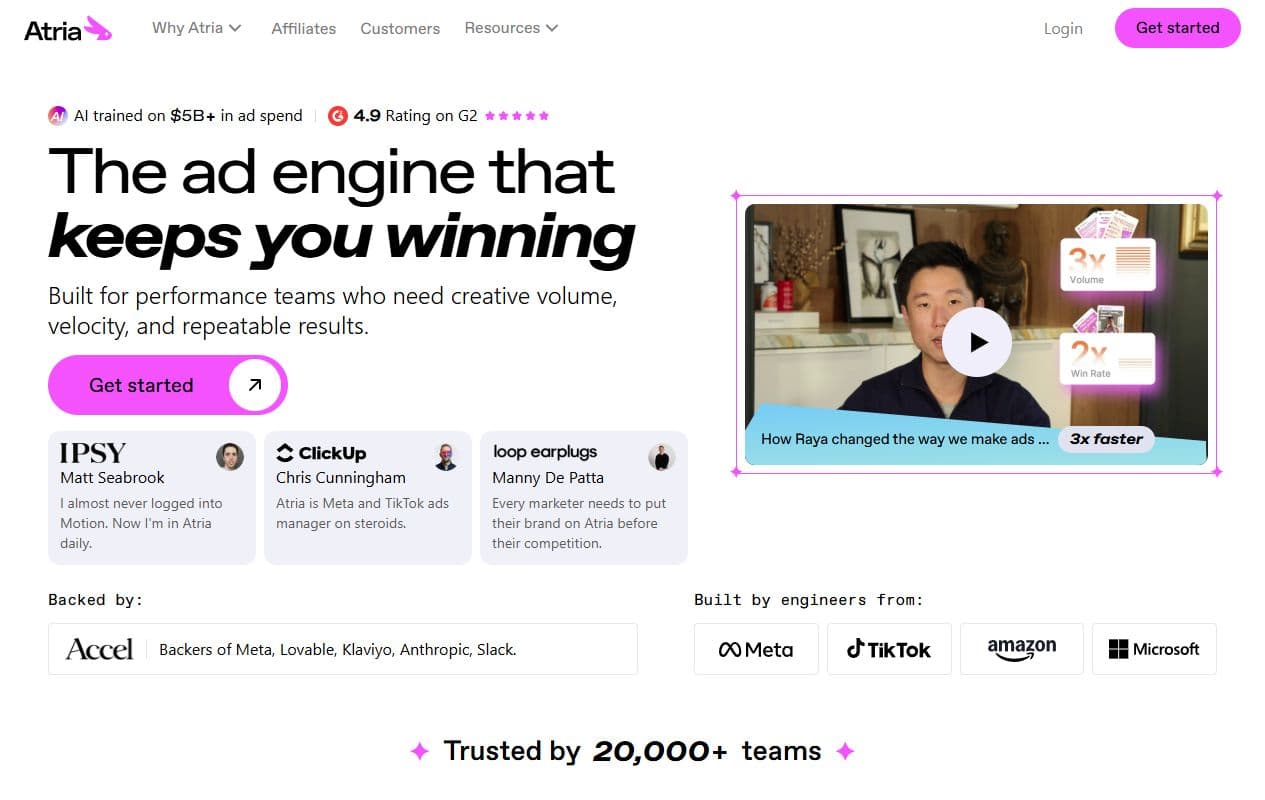
The official page talks about creative volume, velocity and repeatable results. Atria is aimed at teams producing and measuring many ads.
Atria official pageAtria positions itself as a creative engine for paid social teams: ad reading, competitor analysis, the Raya AI agent, brief generation, variants, reporting and decision support. Inside Spybox, its role is to turn ad research into a more disciplined production system, not simply to create more ads without a diagnosis.

Raya & Meta Ads
Atria
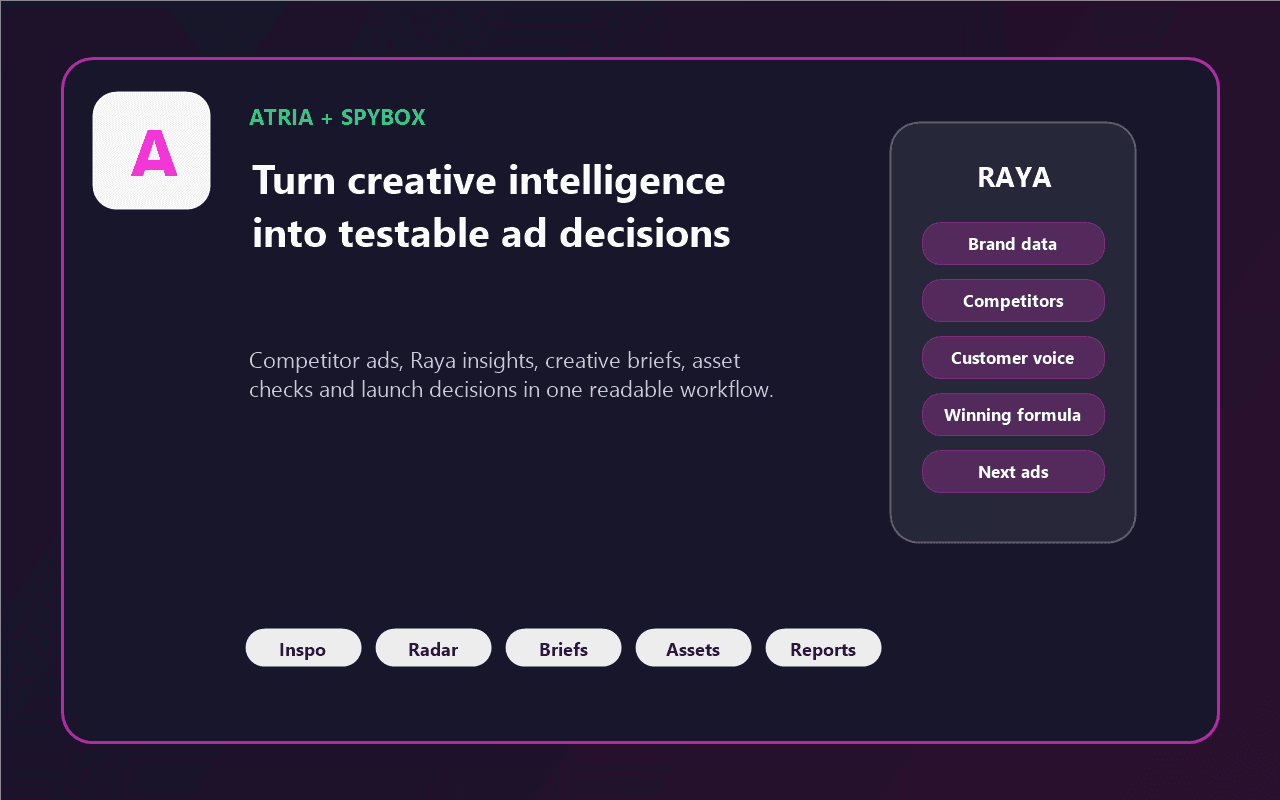
A useful Atria flow in Spybox: start from ads and brand data, understand the hooks, personas and messages that win, produce a clear brief, check assets and decide what to launch, fix or discard.
$5B+
ad spend signal
The official website and help center describe Raya as trained on more than 5 billion dollars in ad spend.
20k+
teams highlighted
The official page says Atria is trusted by more than 20,000 teams, with a strong agency and ecommerce brand positioning.
100 000
SBC credits/month
Inside Spybox at 29,99 €/mois, Atria complements ad spy, creative, AI and product analysis tools.
Atria is not only a place to save ads. Its public promise blends competitor research, creative analysis, new asset production, reporting and an AI assistant. That is exactly why it needs a method: the more transversal the tool is, the easier it is for a team to confuse production speed with decision quality.
For a media buyer, Atria can help identify which hooks, personas, formats or promises keep showing up in a niche. For an agency, it can connect research, brief, production and client reporting. For an ecommerce brand, it can move the discussion away from subjective taste and toward observed signals.
Inside Spybox, Atria becomes stronger when it is paired with Foreplay, Adsparo, Dropispy, Minea, Canva, Creatify, ChatGPT or Runway. The output should not be a gallery of nice ads. It should be a decision: which angle deserves a test, which proof is missing, which asset needs a fix and which message should not be reused.
AI scores, suggestions and reports do not replace brand judgment. Before launching an Atria-generated creative, check the claim, asset rights, landing page fit, real product, target metric and how different the result is from the competitor inspiration.
Atria touches several parts of the creative chain. A short catalogue page would miss the point: the tool helps structure a loop, not just find inspiration.
The help center explains that Raya can monitor competitors and surface hooks, pages, personas and selling propositions.
Atria highlights the path from insight to brief, with winning formulas and new variants to produce.
The documentation mentions tags, asset search, imports and organization. That helps avoid losing useful references.
Radar, reports and metric-based reading help decide what to scale, fix or cut during an ad sprint.
Verified previews
These visuals come from Atria's public website and help center. They show the surfaces worth understanding before adding Atria to a Spybox workflow.
The official page talks about creative volume, velocity and repeatable results. Atria is aimed at teams producing and measuring many ads.
Atria official page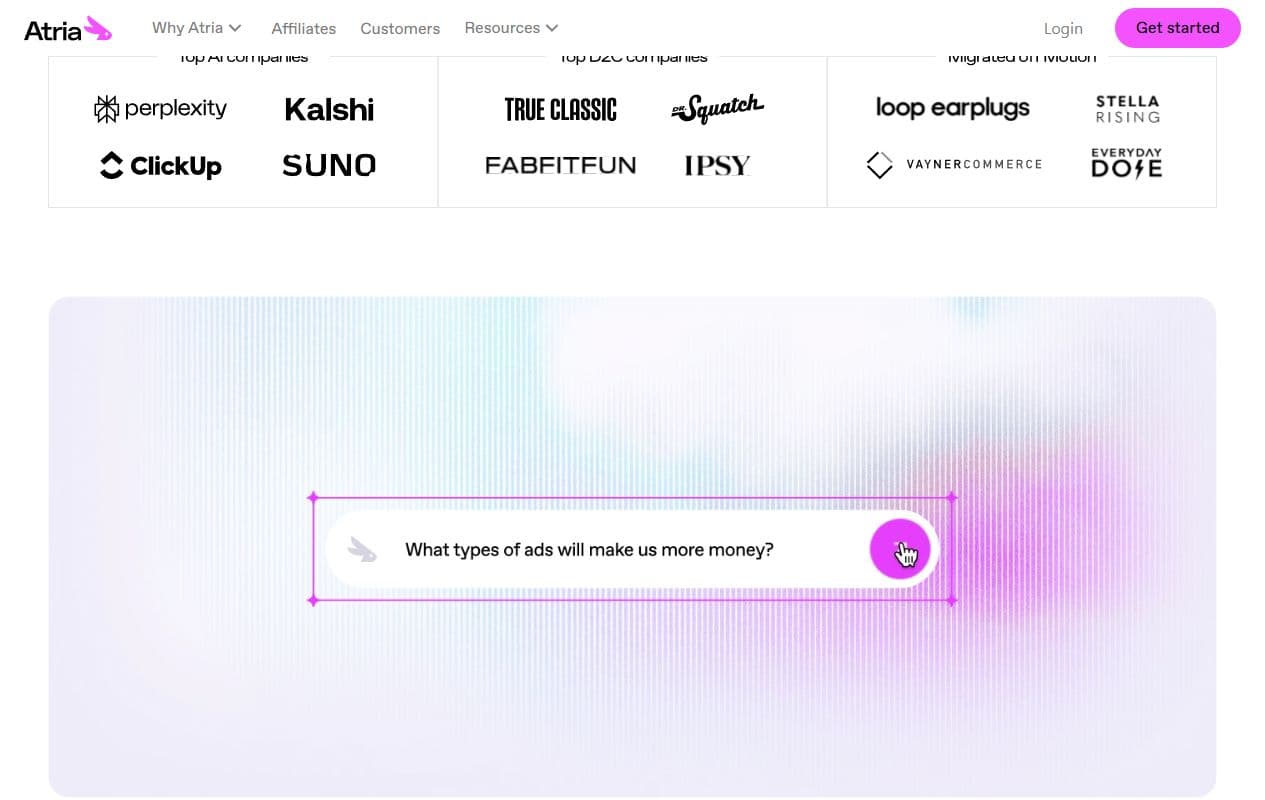
Atria presents Raya as an assistant that starts from brand, competitor and market data to help formulate the next brief.
Atria official page
Public previews describe a loop: know what worked, understand why and turn that formula into new creative assets.
Atria official page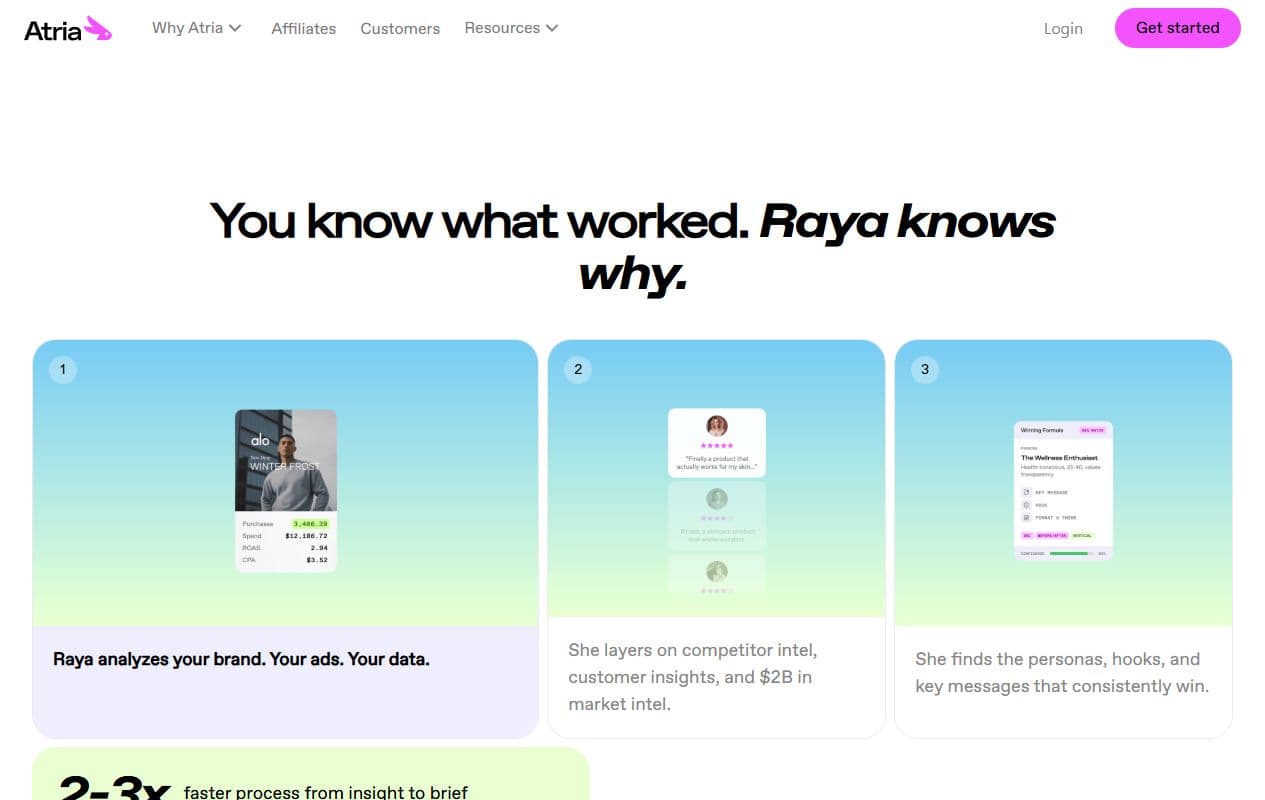
The official page shows upload, launch and winner-reading logic. Inside Spybox, keep a QA step before anything goes live.
Atria official page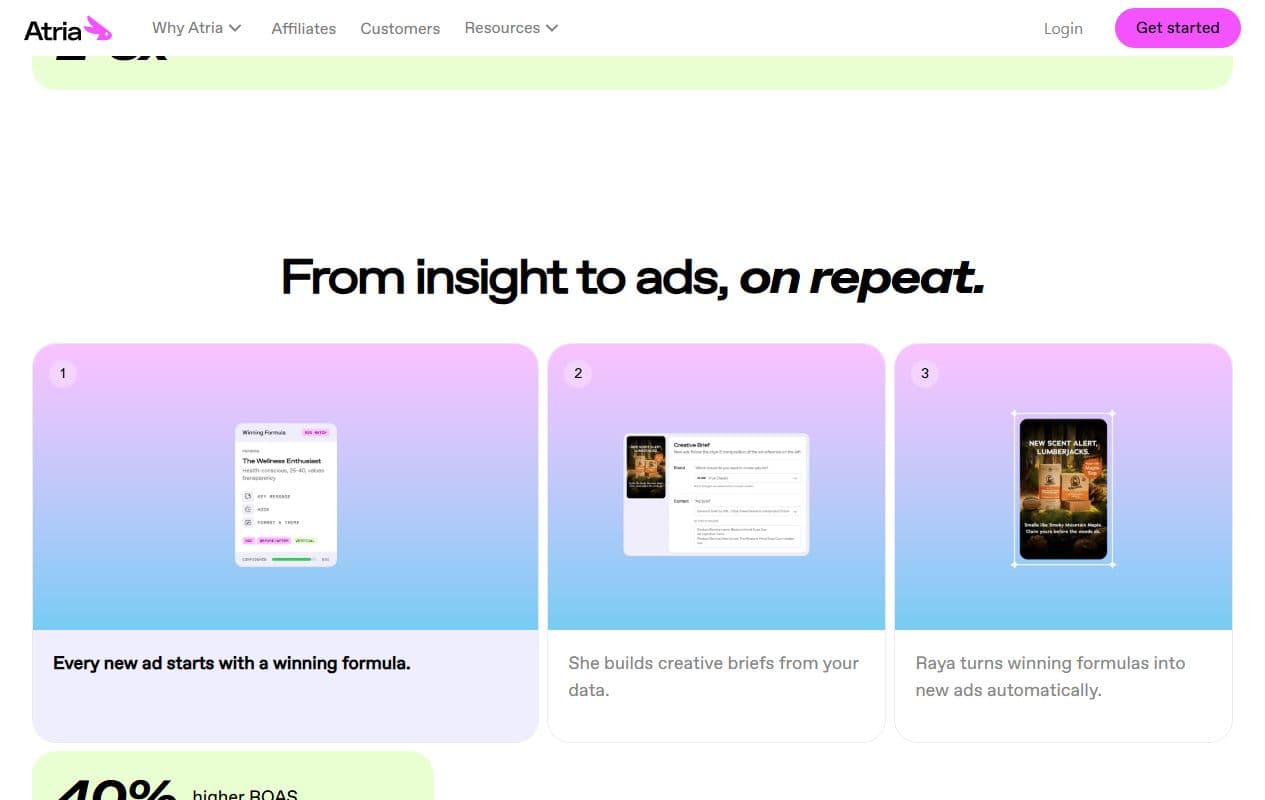
Atria presents Radar as a way to read creatives, identify what needs fixing and keep campaign learnings available.
Atria official page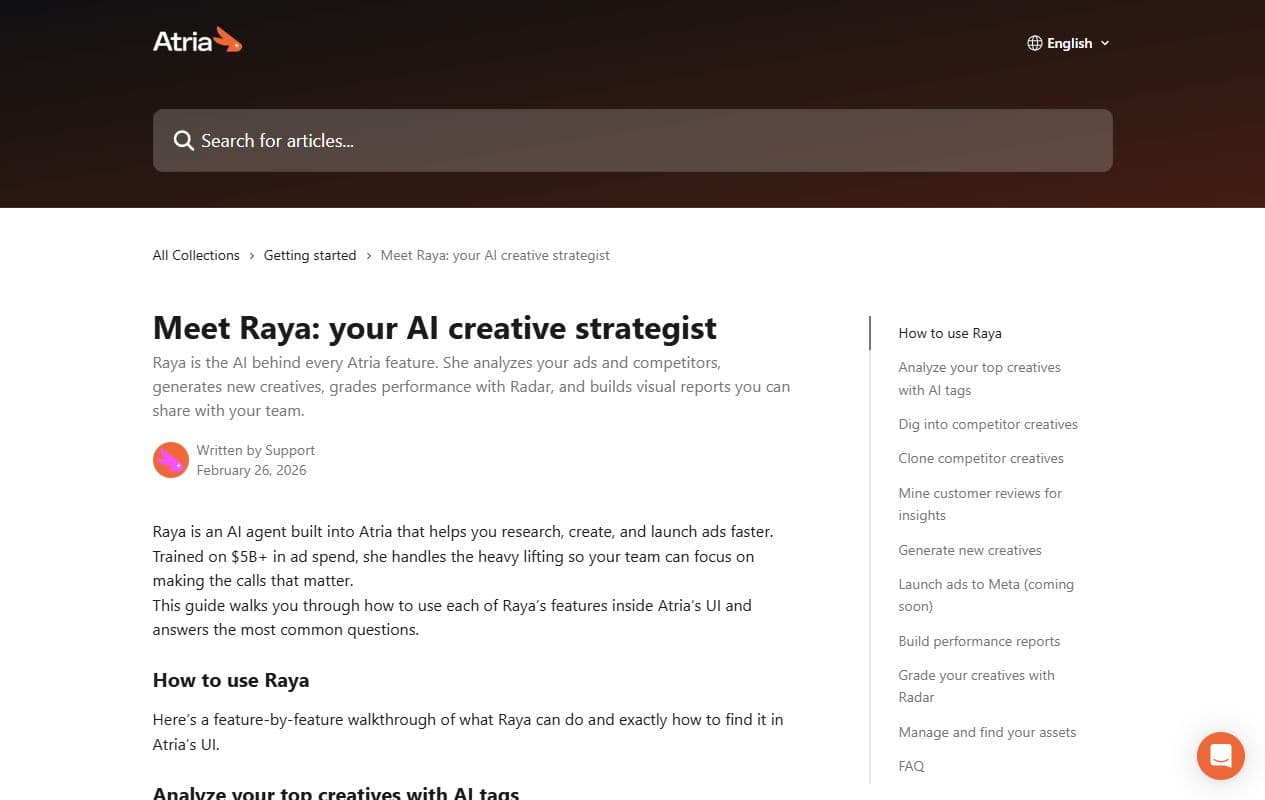
The public documentation says Raya analyzes ads and competitors, generates new creatives, grades performance and builds reports.
Atria Help Center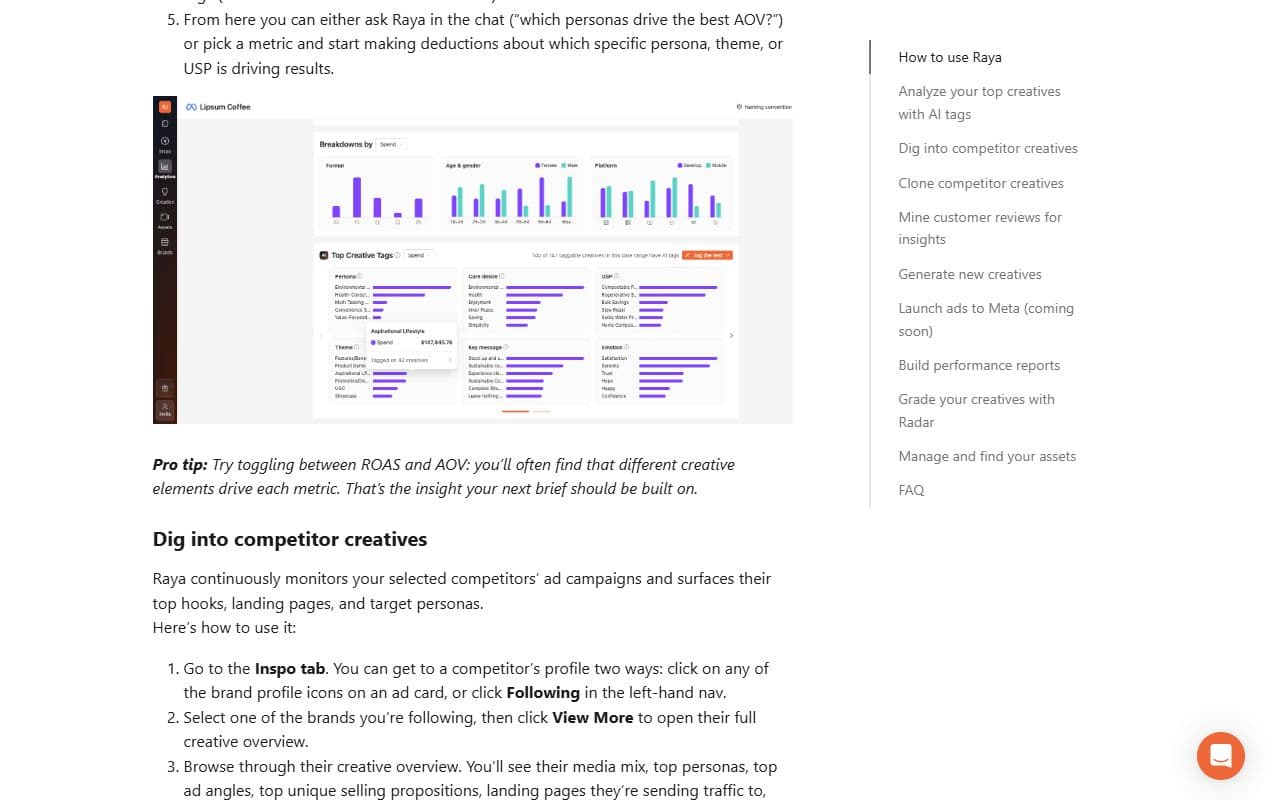
The guide explains how to read competitors, personas, hooks, propositions and landing pages before feeding a new creative series.
Atria Help Center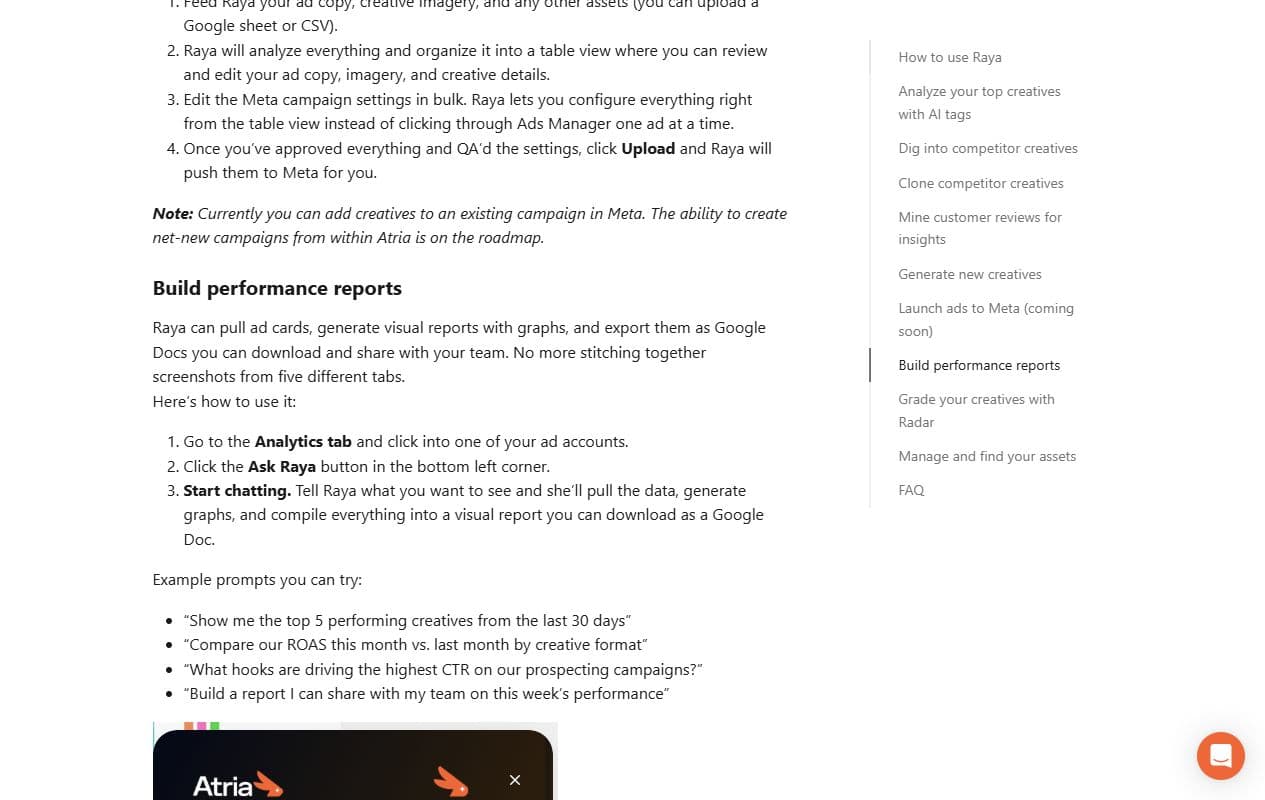
The documentation covers report generation, metric reading and the questions to ask when comparing winning formats.
Atria Help CenterAtria should be used as a short loop. The session starts with an ad signal and ends with a clear action, not an ownerless ideas folder.
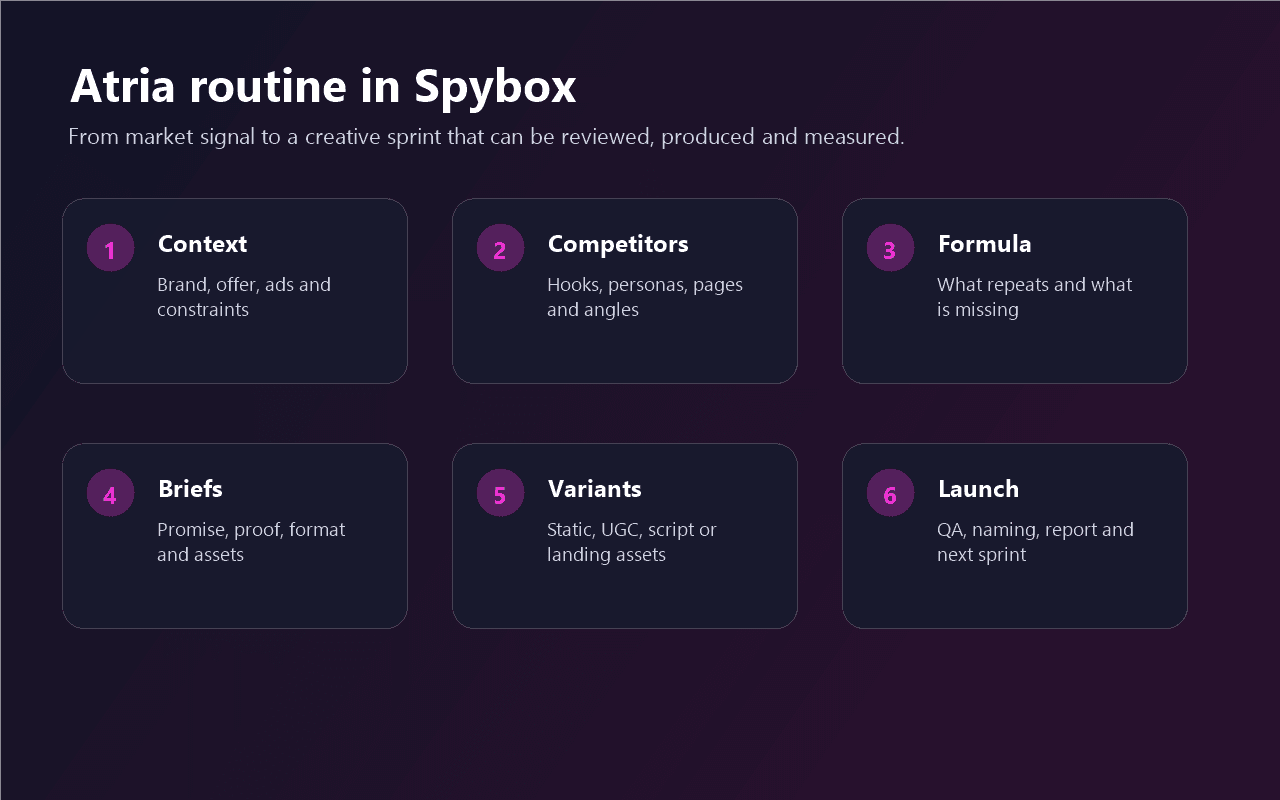
Define brand, offer, product, country, channel, claim constraints, available assets, priority metric and production limits.
Use Inspo and nearby ad spy tools to identify hooks, personas, promises, pages and formats that keep repeating.
Look for the link between audience, pain, proof, visual angle and page. One clear formula is better than ten vague inspirations.
Write what the creative must prove, which format to produce, which assets to use, what to avoid and which test should validate the hypothesis.
Produce several variants without copying the source ad: opening, proof, visual, UGC, script or page structure.
Check rights, fit, page, metric and creative difference. The output should be launch, fix, monitor or discard.
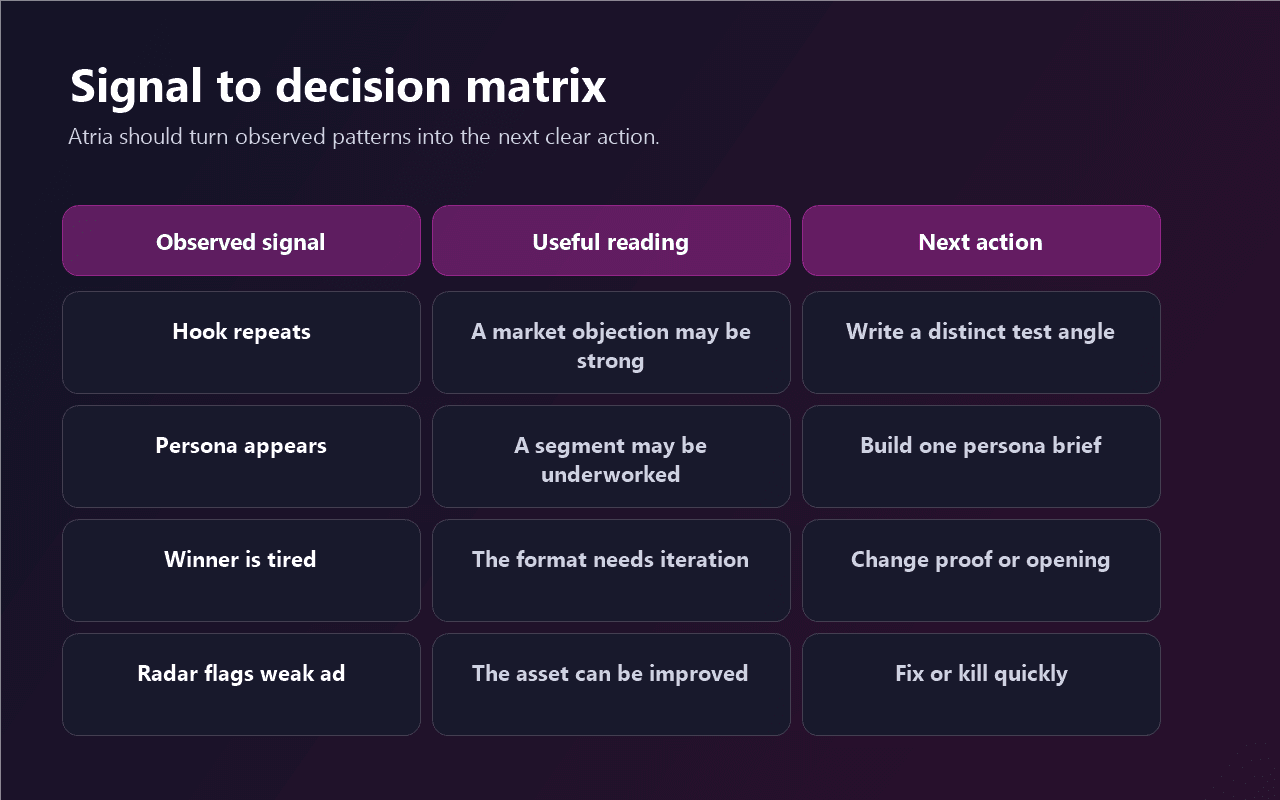
Atria gives many signals. The value comes from sorting them: each observation should lead to a production or measurement action.
Atria is most useful when ad production is recurring. For a very occasional test, simpler tools may be enough.
Connect creatives to metrics, understand what to iterate and prepare the next test without starting from zero.
Turn competitor research into briefs, client reports, recommendations and easier-to-review variant batches.
Move creative debates away from taste and toward hooks, personas, proof and actual results.
Build a research method, prioritize angles, document learnings and feed designers or editors.
Understand what is working in the niche before ordering visuals or launching a new test sequence.
Turn hooks and objections into short scripts, demonstration angles and clearer creator requests.
Atria should not stand alone. The best use cases connect research, assets, copy, video, page quality and measurement.
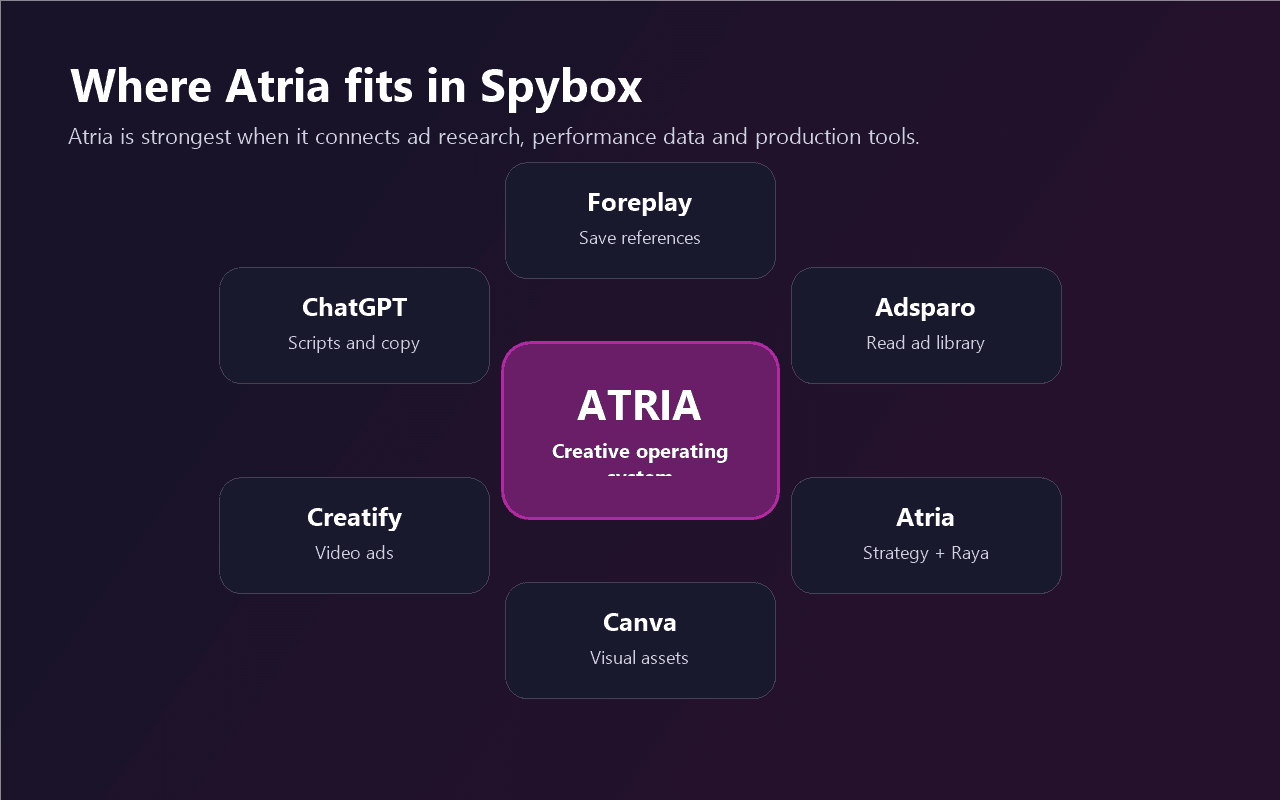
Save and organize creative references before turning them into briefs or reports.
Filter Meta ads, read pages and verify hooks before feeding an Atria sprint.
Cross-check ads with dropshipping signals, stores, pages and visible products.
Produce visuals, variants, static formats and page assets from a brief.
Turn a validated angle into a short video, UGC ad or test-oriented script.
Structure messaging, objections, copy variants and review before production.
An Atria output should pass a short review. That is how a team keeps speed without publishing something incoherent or too close to a competitor.
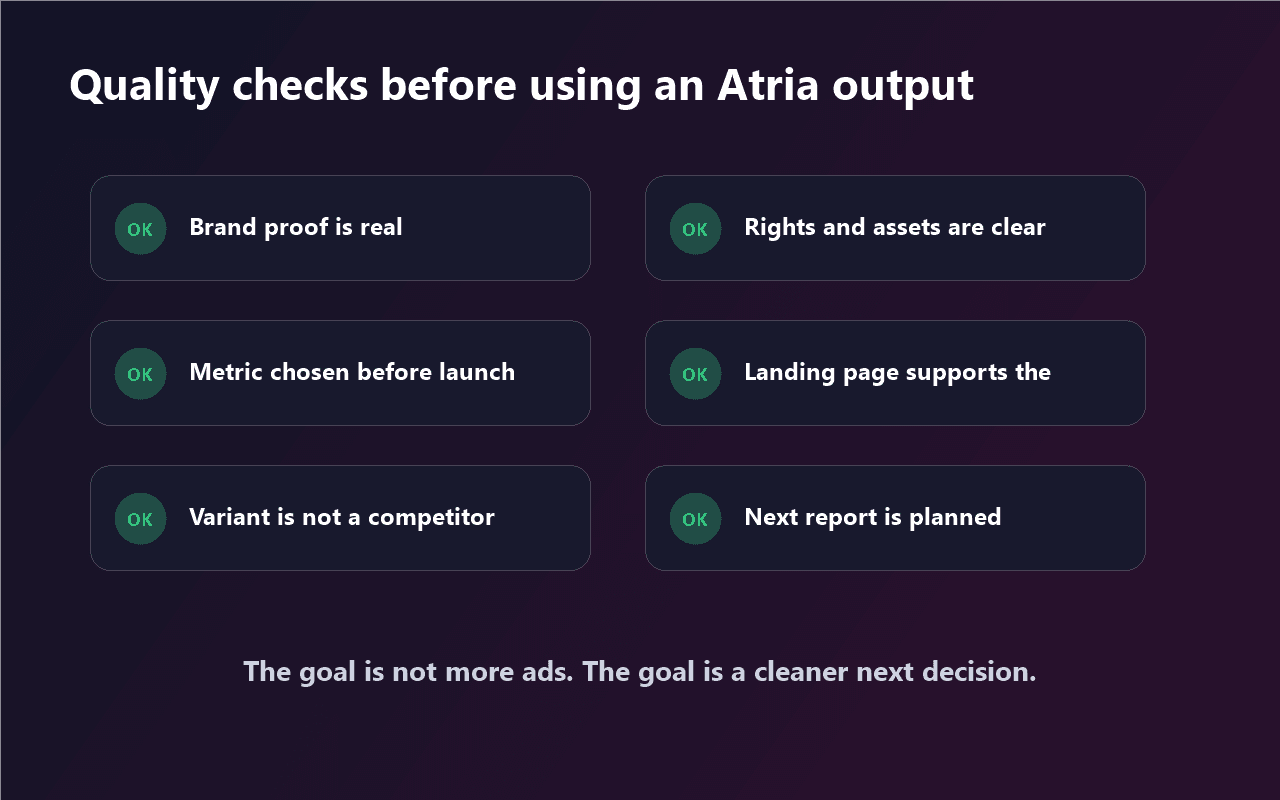
The creative relies on proof your brand can actually defend.
Images, voices, videos, screenshots and assets are cleared for the intended ad use.
The ad promise matches the destination page, the product and the commercial conditions.
The variant is not a direct copy of the competitor that inspired it.
The decision metric is written before launch: CTR, CPA, ROAS, AOV, CVR or qualitative learning.
Naming, campaign structure, report and next action are clear enough to review later.
Both dimensions exist. Atria helps read competitors and creatives, but also turns those signals into briefs, variants, reports and iteration decisions.
Foreplay is very useful for saving, organizing and sharing creative references. Atria goes further on AI assistance, metric analysis, variant generation and reporting.
No. Adsparo and Dropispy help read ads and ad signals. Atria is more useful when those signals need to feed creative strategy, asset batches and test decisions.
Atria can still support research and creation, but its logic becomes stronger when ads, assets, metrics and competitors are connected and named properly.
Atria is listed inside Spybox's ad spy and creative universe. Exact access depends on the dashboard and available offer, with 90+ tools and 100 000 monthly SBC credits announced.
With Spybox, Atria does not remain an isolated interface. It can be paired with ad research, product research, copywriting, design, video and reporting to decide what to produce next.