
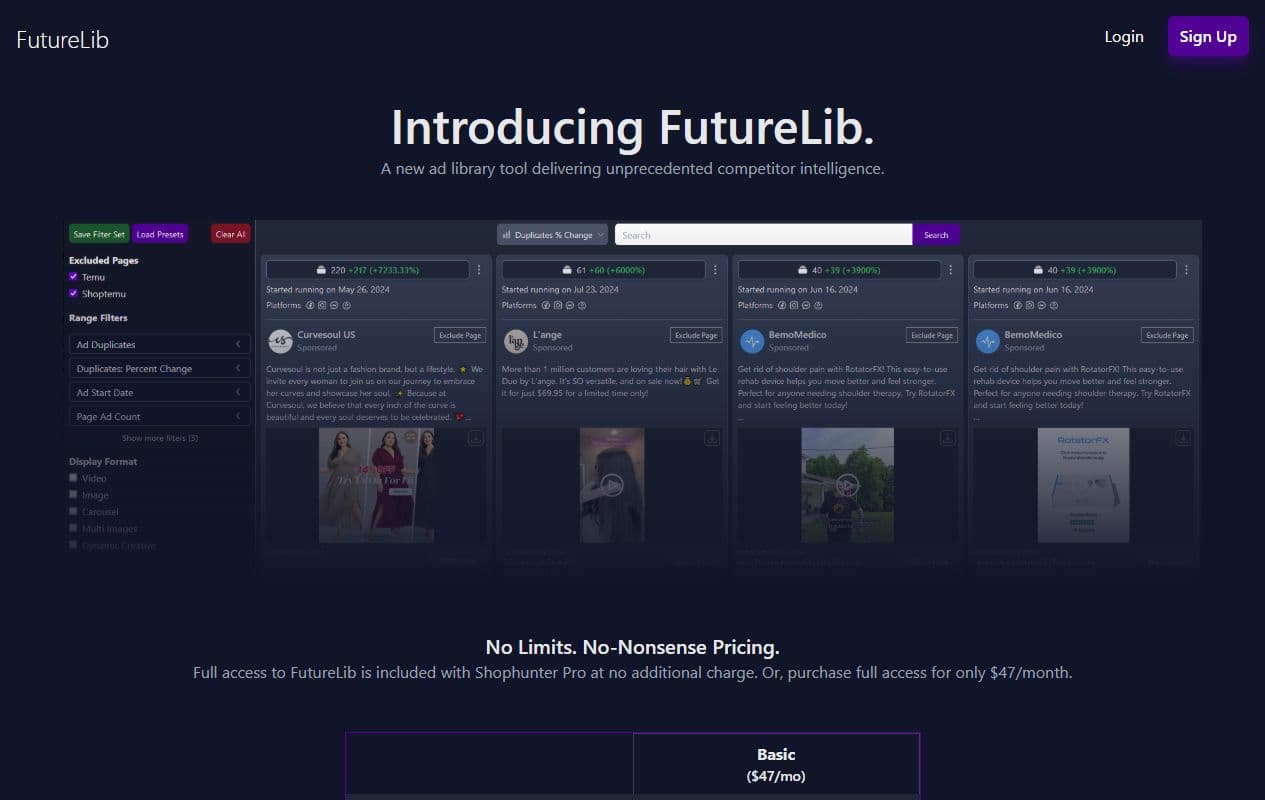
FutureLib as an ad library
The FutureLib page presents the tool as an ad library with competitor intelligence, full access and advanced filters.
FutureLib pageFutureLib is presented as an ad library focused on competitor intelligence. Its public pages also clarify an important point: access is included with ShopHunter Pro, and FutureLib has been merged into the main ShopHunter site through Ads Explore. Inside Spybox, the right way to read it is not as a fully separate tool, but as a trend filter that helps spot products, ads or niches worth verifying.

Ads Explore & ShopHunter
FutureLib
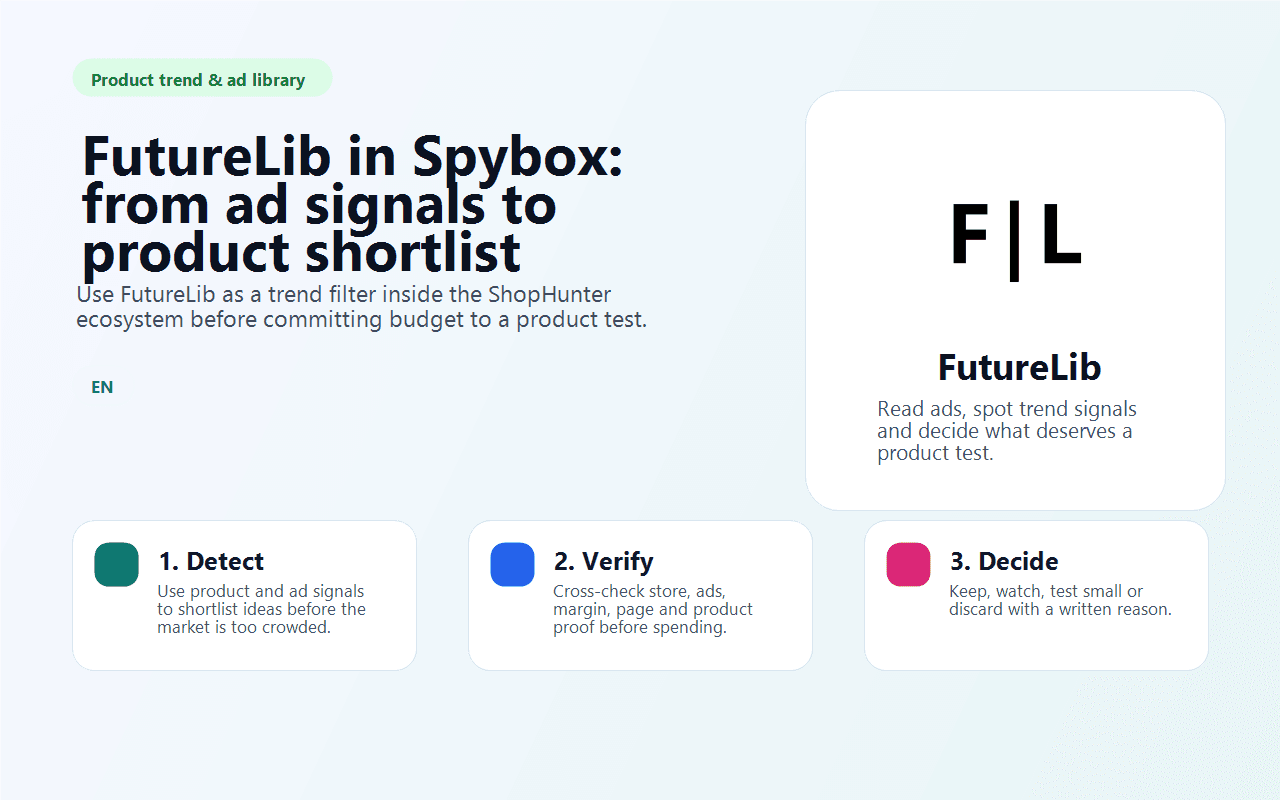
The useful FutureLib routine in Spybox: detect ad movement, read the product, open ShopHunter or a nearby tool, verify store, margin, saturation and page, then decide whether the lead deserves a small test.
$47
direct price shown
The public FutureLib page presents direct access at $47/month while saying full access is included with ShopHunter Pro.
Ads Explore
ShopHunter merge
The futurelib.shophunter.io page says FutureLib has been merged into the main ShopHunter site and links to Ads Explore.
100 000
SBC credits/month
In the Spybox offer at 29,99 €/mois, FutureLib complements product research, ad spy and creative tools.
FutureLib is interesting because it sits between two needs: seeing ad movement and deciding whether a product deserves investigation. An ad library alone can tempt teams to copy a creative. A product research tool alone can make a product look attractive without reading the message. FutureLib should connect both readings.
The merge into ShopHunter also changes how the page should be presented. If FutureLib is described as a totally separate interface, readers may be confused when they land on the official site. This page explains the context: FutureLib existed as a dedicated library, then the experience was attached to the ShopHunter environment.
Inside Spybox, FutureLib becomes useful when it triggers a quick verification: is the product recent or already saturated? Are ads really multiplying? Does the store support the offer? Does margin hold? Does the page provide enough proof? The expected output is not certainty. It is a decision: test small, watch, enrich or drop.
An ad signal is never enough to launch a product. FutureLib can help spot a lead, but the decision must be cross-checked against store, page, price, margin, shipping, reviews, saturation and creative rights.
FutureLib is a good example of a tool that may look narrow but plays an important role in ecommerce work: reducing many signals into a few actionable leads.
The official page shows ads, filters, duplication and competitor intelligence. That is useful for spotting repetition.
FutureLib is not presented as an island anymore: the dedicated page now points to ShopHunter Ads Explore.
The value is a short list: a few products or angles that deserve real checks, not an endless folder.
FutureLib should trigger the right questions before spend: saturation, offer, page, margin, differentiation and proof.
Verified previews
These screenshots show the public context available: FutureLib, its merge into ShopHunter, then ShopHunter surfaces that help cross-check a product lead.
The FutureLib page presents the tool as an ad library with competitor intelligence, full access and advanced filters.
FutureLib page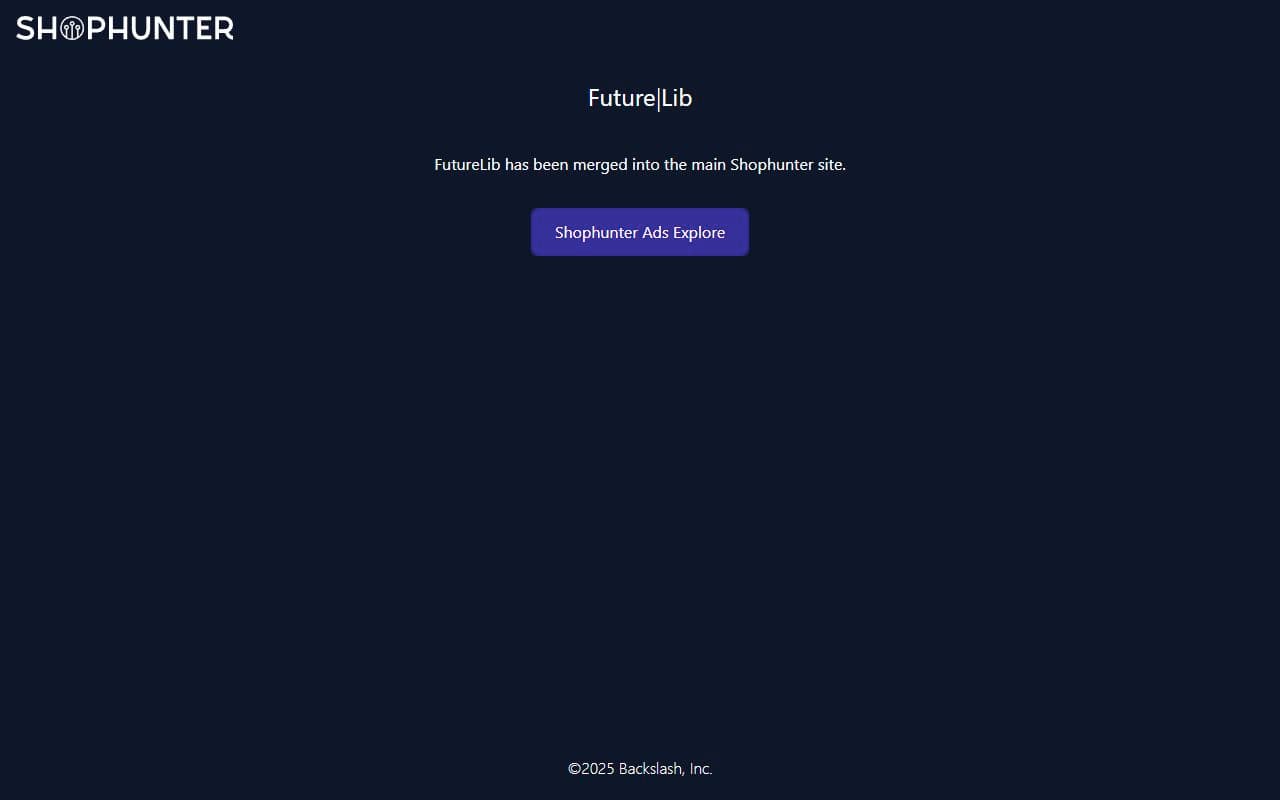
The ShopHunter-linked page clearly says FutureLib has been merged into the main ShopHunter site.
FutureLib at ShopHunter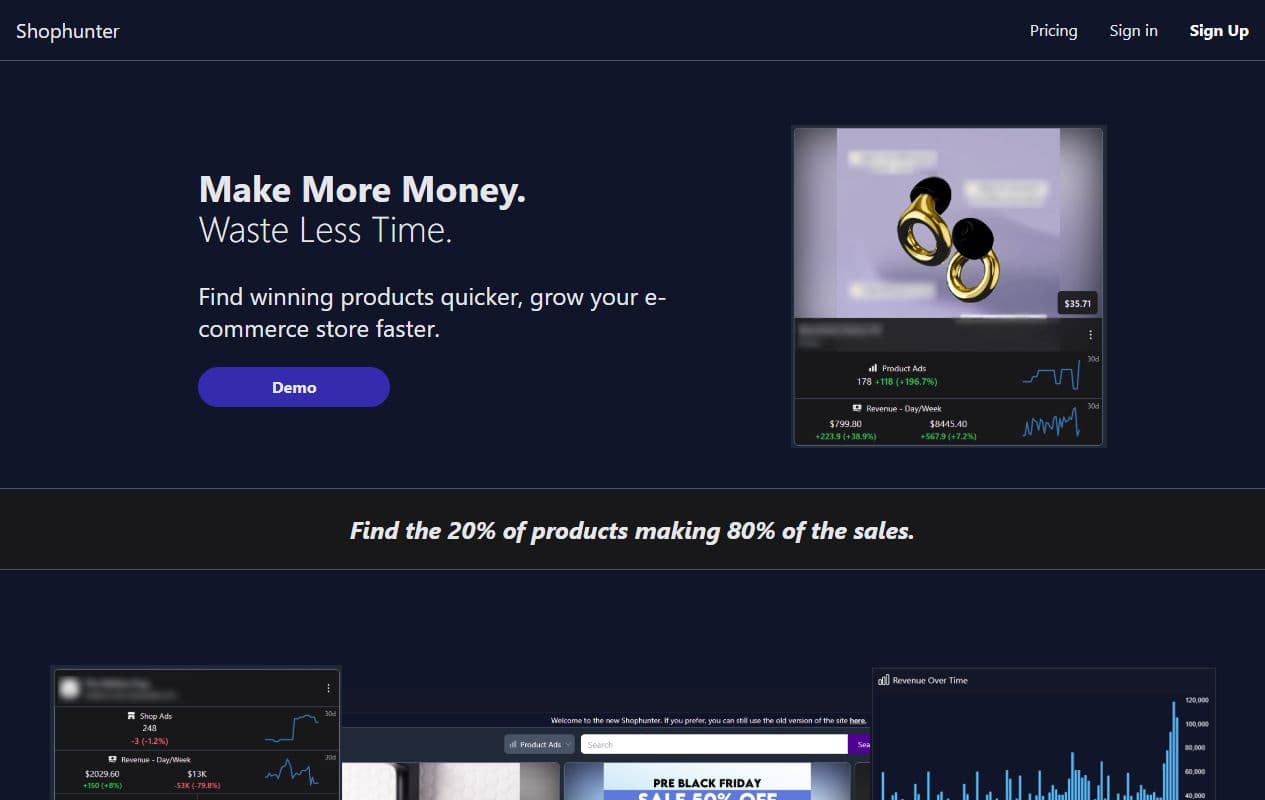
ShopHunter's public page focuses on finding winning products faster. FutureLib makes more sense inside that qualification logic.
ShopHunter page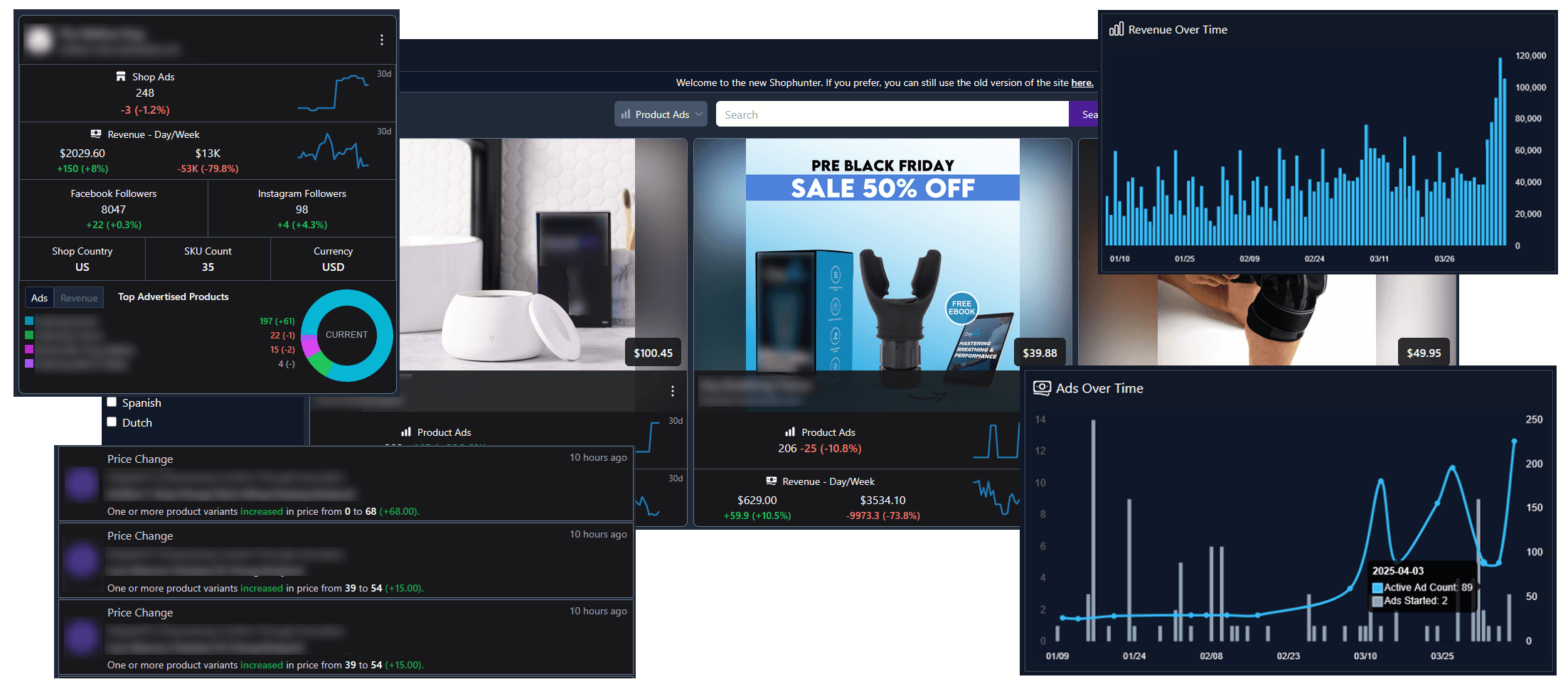
ShopHunter visuals show products, ads, estimated revenue and variations. These signals complete leads found through FutureLib.
ShopHunter Spybox page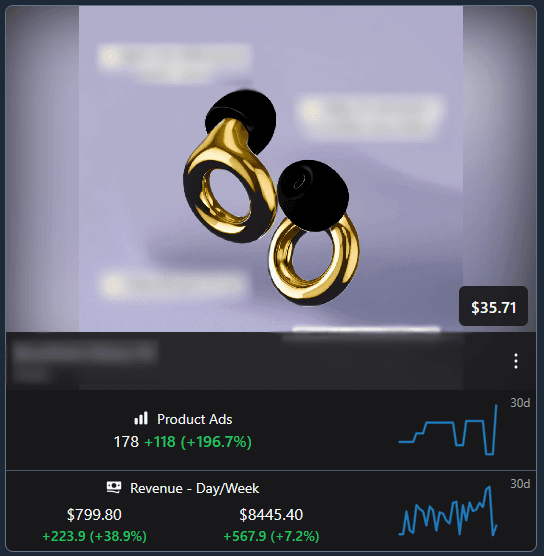
A product lead needs context: price, estimated sales, ads, page and store momentum.
ShopHunter Spybox page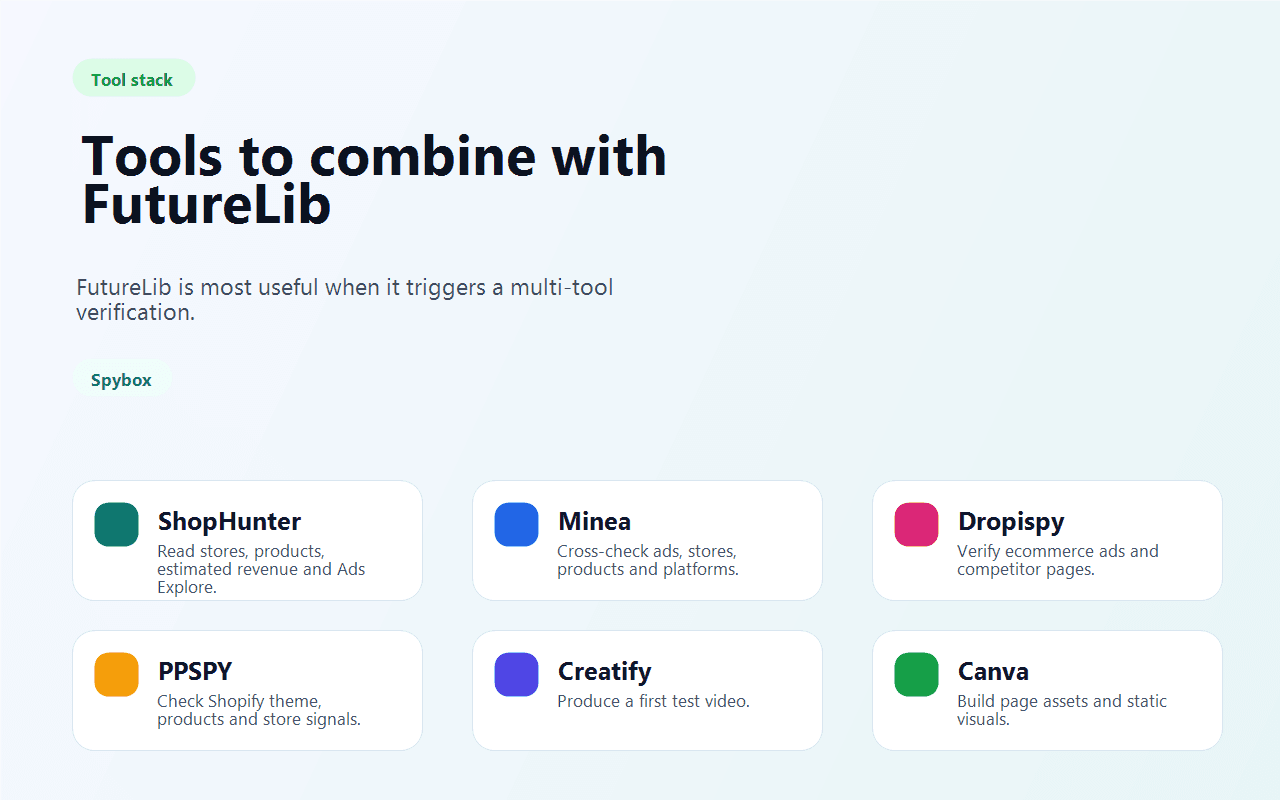
Inside Spybox, FutureLib should feed ShopHunter, Minea, Dropispy, PPSPY, Canva or Creatify depending on the decision.
See the methodA good FutureLib session should produce a usable shortlist. If you leave with twenty screenshots and no decision, research is not done yet.
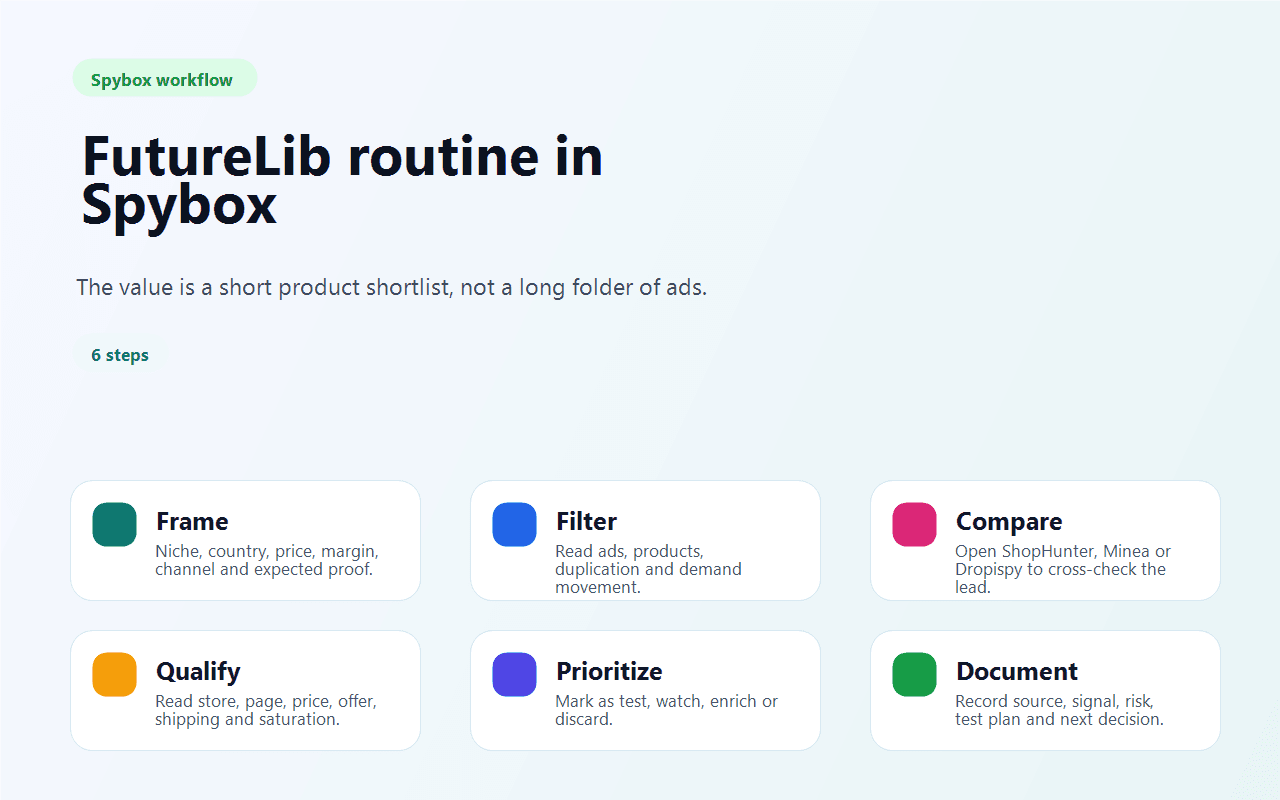
Choose niche, country, target price, minimum margin, acquisition channel and product type. The frame prevents curiosity from looking like opportunity.
Read ads, duplications, variations, formats and recurring pages. Repetition matters more than one attractive ad.
Check store, products, estimated revenue, prices and traction clues. FutureLib gives a lead, ShopHunter helps read it.
Compare with Minea, Dropispy, PPSPY, Dropship.io or Sell The Trend to see whether the product exists elsewhere and how it is sold.
Decide whether the lead deserves a test, monitoring, creative research or deletion. Every lead should have a written reason.
If the lead holds, define page, offer, creative, budget, success metric and stop point before producing assets.
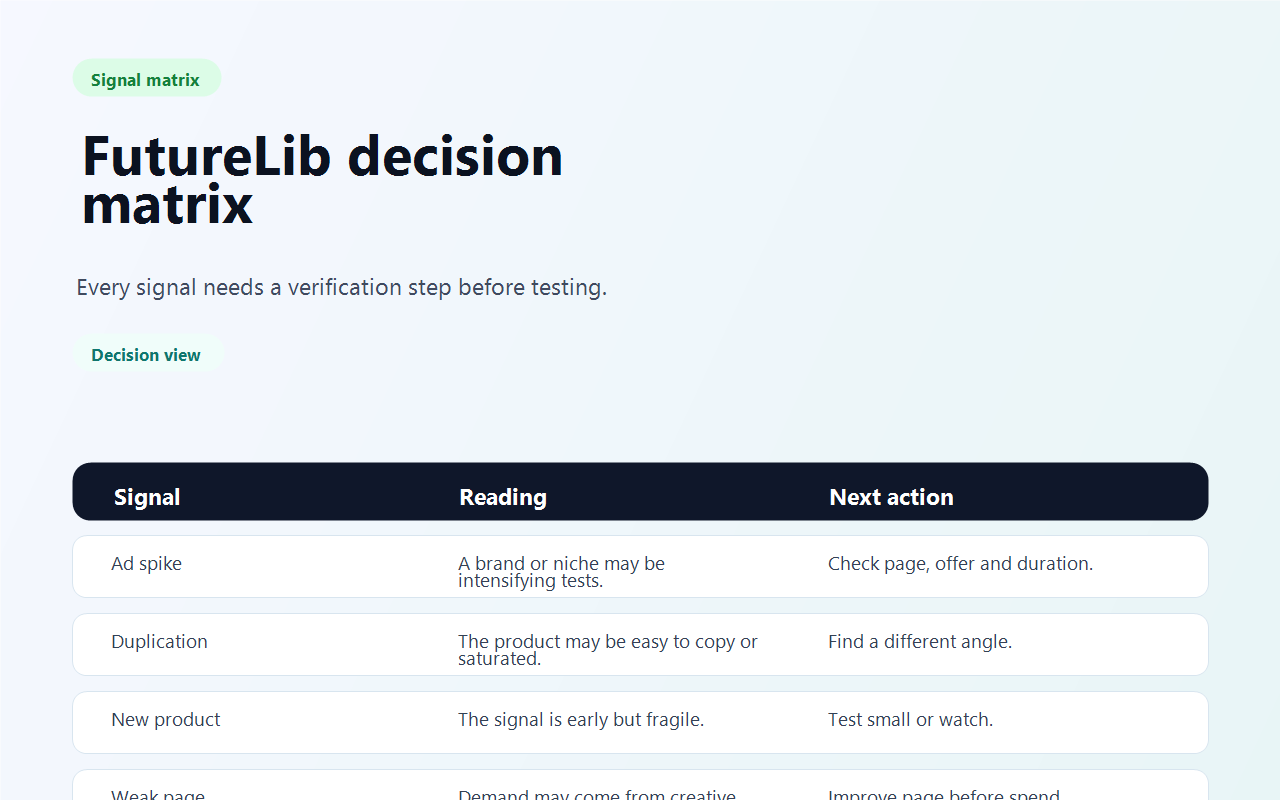
FutureLib becomes more useful when every ad signal is translated into a concrete action. This matrix keeps visible movement from being mistaken for proof of profitability.
FutureLib mainly serves teams looking for products or angles before production. It is less useful if you do not run regular ecommerce tests.
Spot product signals before checking store, page, price, supplier, margin and competition.
Read ad spikes, repeating formats and messages to watch before opening a campaign.
See emerging angles in a niche and decide whether a product or creative variation makes sense.
Prepare a client shortlist with signals, risks, references and test recommendations.
Cross-check FutureLib with ShopHunter, Minea, Dropship.io or PPSPY instead of acting on one signal.
Decide quickly whether to watch a trend, build an offer or drop the idea before mobilizing the team.
FutureLib should not stay isolated. The logical next step is product, store, ad, page and creative verification.
Read Shopify stores, products, estimated revenue, prices and ad signals around a lead.
Compare product, ad, store and platform signals before prioritizing.
Check ecommerce ads, stores and competitor pages linked to the product.
Inspect Shopify stores, themes, products and traffic clues before deciding.
Turn a validated lead into a first ad video or test script.
Prepare static visuals, page sections, comparisons and test assets.
A visible trend must survive a few simple checks. Otherwise it mostly burns production and media budget.
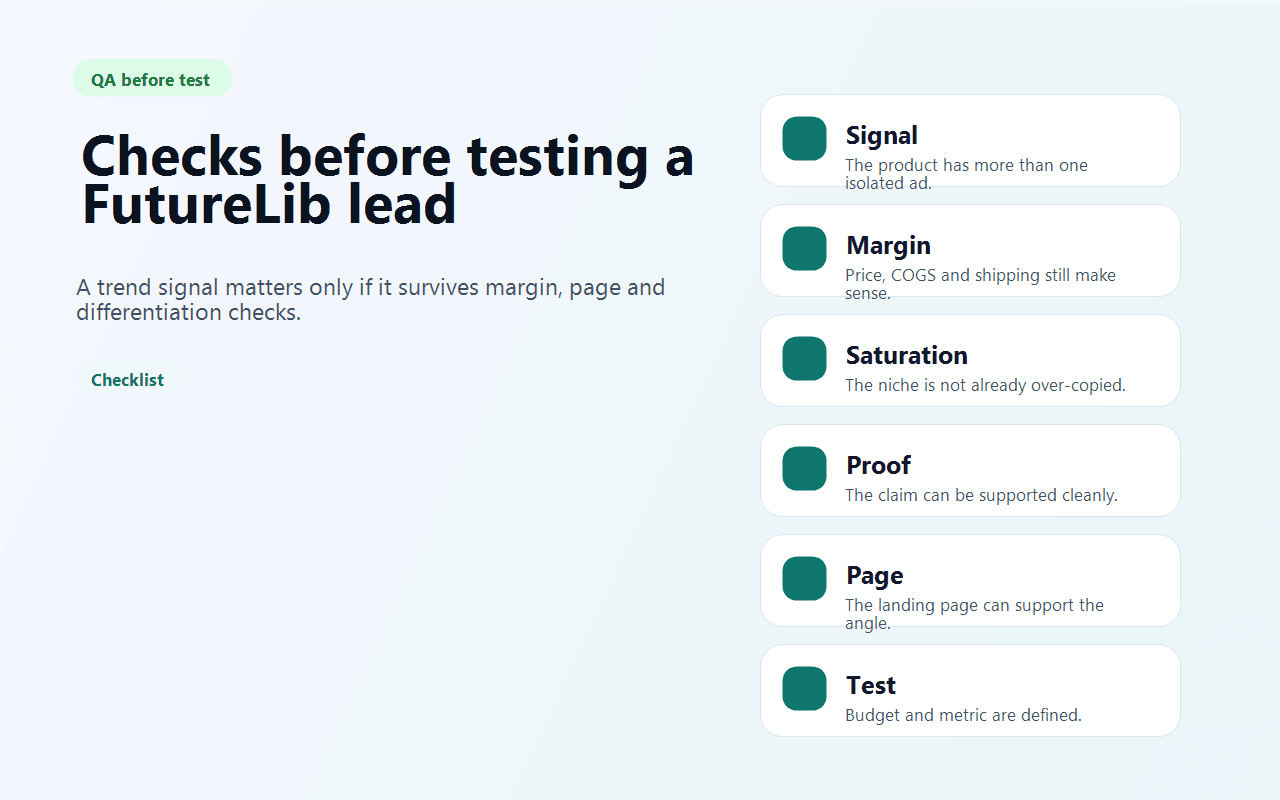
The signal is not based on one isolated ad: there is repetition, an increase or several stores to compare.
Potential margin still works after product cost, shipping, refunds, creative cost, media cost and support.
The landing page can support the ad promise without contradiction or missing proof.
The niche is not already saturated by dozens of undifferentiated clones.
The product can be delivered in the target country with timing and reviews aligned with the promise.
The creative angle can be produced without copying a competitor ad, visual or brand.
The test has one priority metric and a clear stop point before more spend.
The decision is documented: source, signal, verification, risk, action and review date.
Public pages say FutureLib has been merged into the main ShopHunter site, with a link to Ads Explore. It should be read as a component attached to the ShopHunter ecosystem.
It helps spot ad and product signals that deserve verification. The real decision then happens with ShopHunter, Minea, Dropispy, PPSPY or the product page.
No. FutureLib and ShopHunter are linked. FutureLib helps spot a lead, while ShopHunter helps read the store, product and estimated context.
Not directly. First check margin, saturation, page, supplier, delivery time, proof, creative rights and likely media cost.
It sits between both: ads reveal movement, but the useful output is often a product decision or test shortlist.
FutureLib is listed inside Spybox's ecommerce and ad spy universe. Exact access depends on the dashboard and current offer, with 90+ tools and 100 000 monthly SBC credits announced.
Spybox connects FutureLib with ShopHunter, Minea, Dropispy, PPSPY, Canva, Creatify and other tools to move from a signal to a cleaner test decision.