
Find viral products with Spybox
Start with a video or an offer, choose the right research tool and build a short selection. Here is how to move from online attention to a product you can actually test.
Updated 3 October 2026.
Contents
A viral product is, first, a product people share
A demonstration is shared, discussed or recreated: the product attracts attention beyond its first audience. That interest might come from a useful action, a surprising result or an entertaining presentation. It gives you a research lead; it does not tell you how many people will buy your offer at your price and delivery time.
Check three things separately: interest in the content, observed commercial activity and what your own sale can leave after costs. A widely watched accessory may be difficult to ship. A less visible item may answer a regular need. Research helps you understand the difference before you prepare an entire store.
Start with a simple question: what situation do you want to improve for a customer, on which channel and with which product? A specific category, such as cleaning narrow grooves, gives you a more useful search than everything that looks popular. Spybox brings together tools to examine these ideas; the sample, supplier and first orders are then part of the seller's work.
Where should you look for your sales channel?
Discovery and purchasing do not always happen in the same place. A TikTok video may sell through TikTok Shop or send viewers to an independent store. Choose your first search around that destination.
| Starting point | Tool or source | What to examine |
|---|---|---|
| An idea without an identified store | Minea | A category and its product presentations; then open the public offers you keep. |
| A product sold on TikTok Shop | Kalodata | Products, creators and selling formats in the country and period being studied. |
| A Shopify store | PPSPY | Products and estimated activity, then quantities, variants and terms on the store itself. |
| A TikTok ad | PiPiAds | The demonstration, observed dates and the ad's destination. |
| Initial free research | Google Trends and ad libraries | Changing interest and public ads; add actual offers and conversations with potential buyers. |
An idea without an identified store
- Tool or source
- Minea
- What to examine
- A category and its product presentations; then open the public offers you keep.
A product sold on TikTok Shop
- Tool or source
- Kalodata
- What to examine
- Products, creators and selling formats in the country and period being studied.
A Shopify store
- Tool or source
- PPSPY
- What to examine
- Products and estimated activity, then quantities, variants and terms on the store itself.
A TikTok ad
- Tool or source
- PiPiAds
- What to examine
- The demonstration, observed dates and the ad's destination.
Initial free research
- Tool or source
- Google Trends and ad libraries
- What to examine
- Changing interest and public ads; add actual offers and conversations with potential buyers.
You do not need to work through every service in the catalogue. Start with a question and one tool. Add another source if it answers a different point: channel, offer, seasonality or supplier. Two lists based on the same kind of data are not two independent confirmations.
Find a few leads, not an endless list
Search for a use first, then its variants. For cleaning a narrow groove, try the accessory name, the problem and the room where it will be used. Keep descriptions of the same need together, without treating products with different quality, dimensions and prices as comparable.
Google Trends can show seasonality or relative interest. Its 0–100 scale is not a sales count; a zero may also mean search volume is too low. Keep the country, period and term. An isolated spike needs an explanation rather than a stock purchase.
Meta's library and TikTok Creative Center let you examine public references. Look at what is shown, then open the offer when accessible. Minea's product view can help organise that work: keep a few leads you can still explain from memory, not fifty favourites without a specific question.
- Record the need and use being presented.
- Keep the public URL, date and channel observed.
- Identify the quantity actually sold and the variant shown.
- Write down the question still unanswered before contacting a supplier.
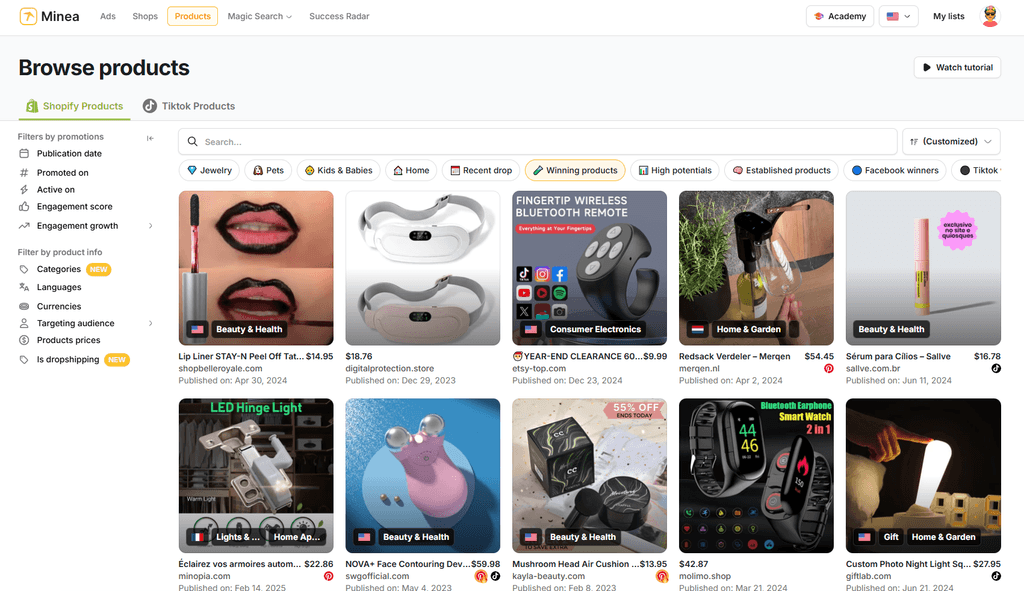
Minea: narrow down a list
The public view brings together varied items, with dates and filters. Choose a category and use before keeping favourites. The visible dates belong to the publisher's demonstration; this image is not a list of current trends.
Compare signals without turning them into certainty
On TikTok Shop, examine the relationship between a product, its creators and its selling formats. Activity concentrated in livestreams is not simply reproduced by a short video. Kalodata helps show that context. Its public-channel data and statistical processing remain separate from the seller's account.
For Shopify, PPSPY presents estimated activity. Also return to the product page: price, bundle, variants, delivery and claims. A store report can aggregate several products; it does not attribute every sale to the accessory you noticed.
Compare periods of similar length and record dates, rather than matching a recent week to an all-time total. A curve may reflect a promotion, an out-of-stock period or a collection change. When data is missing, keep the question open in your notes rather than assigning a number.
| Observed signal | Useful interpretation | Next check |
|---|---|---|
| Several videos show the same action | The use lends itself to a demonstration. | Reproduce it with your sample and check what a viewer understands. |
| Several sellers offer the product | There are offers to compare. | Record bundles, delivered prices and actual differences, not just the number of stores. |
| Estimated activity increases | The lead deserves examination over the same period. | Look at the offer and products concerned; the curve does not establish margin. |
| Viewers ask about size or delivery | The presentation leaves out information. | Prepare an answer based on your sample and logistics. |
| Interest returns in the same season | Timing may matter to the launch. | Compare supply lead times with the time of use. |
Several videos show the same action
- Useful interpretation
- The use lends itself to a demonstration.
- Next check
- Reproduce it with your sample and check what a viewer understands.
Several sellers offer the product
- Useful interpretation
- There are offers to compare.
- Next check
- Record bundles, delivered prices and actual differences, not just the number of stores.
Estimated activity increases
- Useful interpretation
- The lead deserves examination over the same period.
- Next check
- Look at the offer and products concerned; the curve does not establish margin.
Viewers ask about size or delivery
- Useful interpretation
- The presentation leaves out information.
- Next check
- Prepare an answer based on your sample and logistics.
Interest returns in the same season
- Useful interpretation
- Timing may matter to the launch.
- Next check
- Compare supply lead times with the time of use.
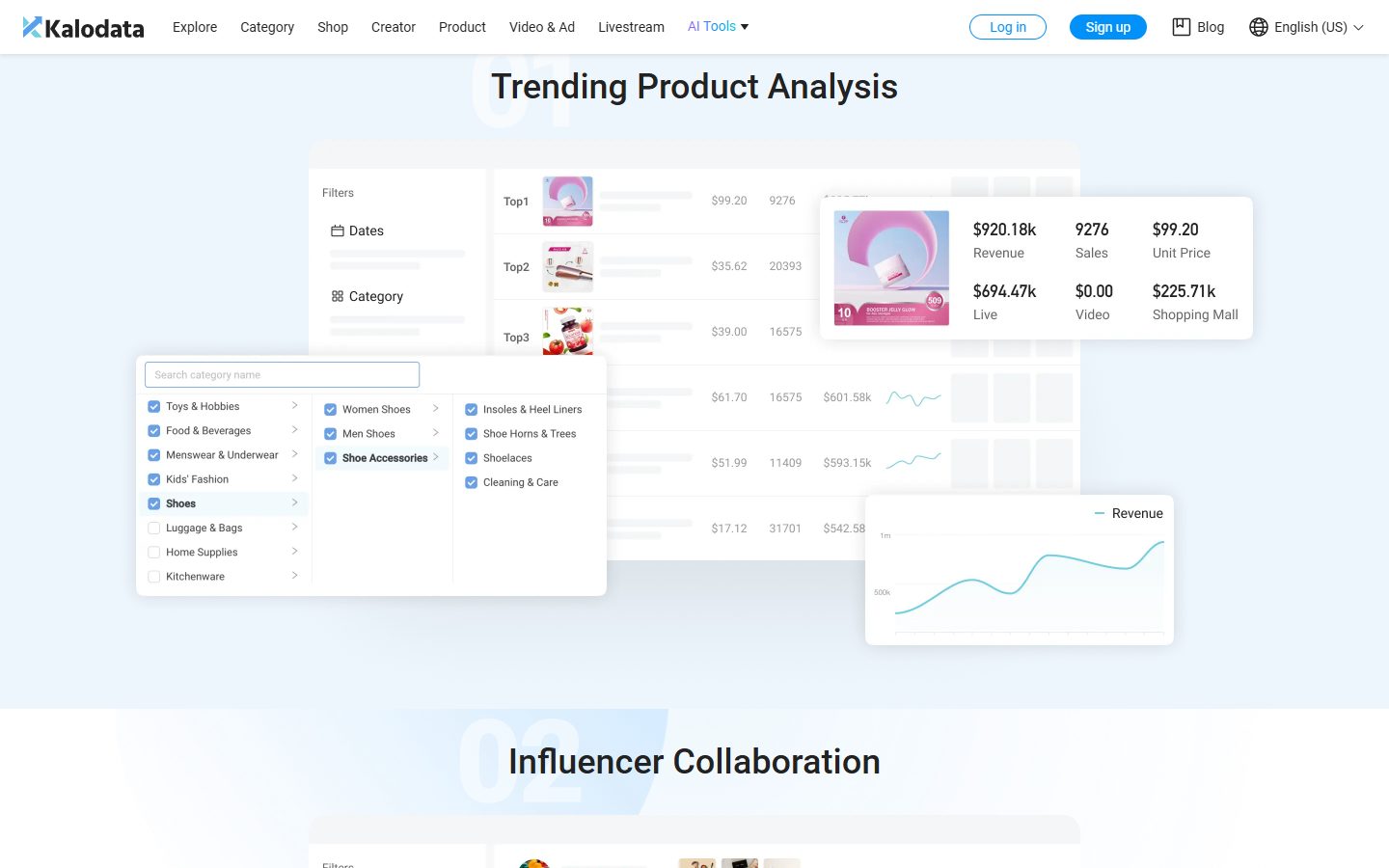
Kalodata: identify the selling format
The live, video and store breakdown helps explain this example's context. Keep the country and period with your own selection. A presentation driven mainly by livestreams may require different work from a short demonstration.
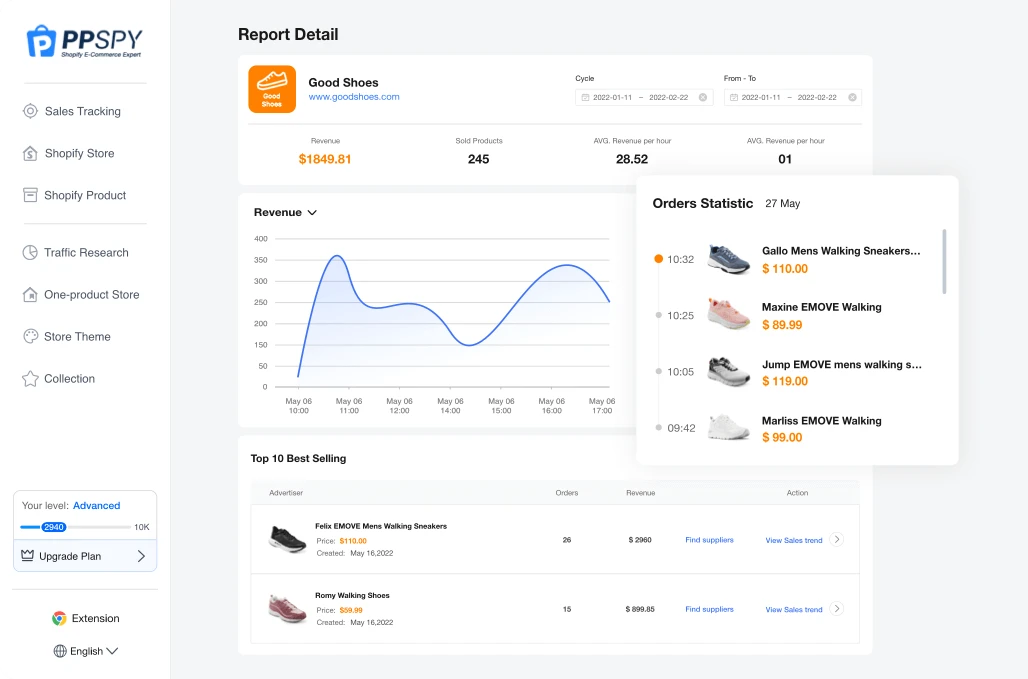
PPSPY: also examine the store's products
The report displays several products and an activity curve. Return to the offers to separate the item you are studying from the rest of the catalogue. The demonstration's amounts show neither the merchant's costs nor their margin.
Read an ad all the way to the offer it sells
Start with the visible product and action. Is this normal use, sped-up editing or a demonstration with a missing step? Record what you could film yourself. A useful reference gives your shoot a question to answer; it does not grant permission to reuse another seller's video.
Next open the destination: is it the same item, quantity and promise? In the PiPiAds illustration below, the ad leads to Shopify. The cost and order ranges are tool estimates, not evidence of profitability. Observed dates or time active are not enough to conclude that the ad works either.
Read accessible questions and objections: dimensions, care, durability, delivery or package contents. They help you prepare your page and demonstration. Likes indicate a reaction to content; judging your sale will require your own orders, expenses and returns.
- Is the main action visible without misleading editing?
- Does the page sell the variant shown in the video?
- Which customer question is unanswered?
- What original sequence could you film to answer it?
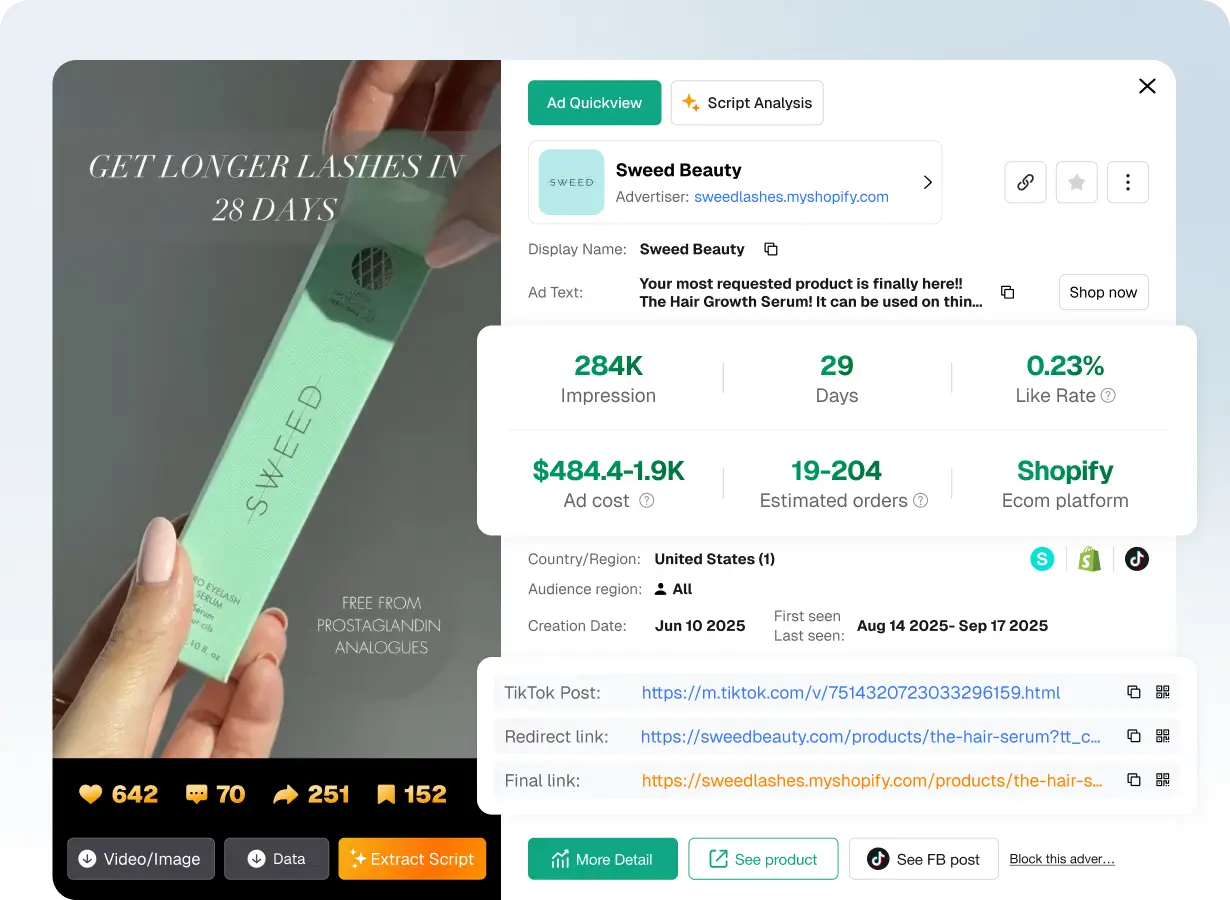
PiPiAds: separate distribution and destination
The example connects a TikTok ad to a Shopify destination and estimated ranges. It helps explain a journey, not the seller's profit. For a cleaning brush, check quantity and use between the video and product page in the same way.
Keep a lead, ask for evidence or reject it
Before calculating a score, separate obstacles that prevent a sale from points you can improve. A supplier unable to explain what they deliver is not a weakness to compensate for with better advertising. A missing dimensions photo, however, can be made with a suitable sample.
Selecting three leads is a practical exercise, not a rule for success. For each one, gather a comparable offer, a reproducible demonstration, a supplier contact and an initial cost estimate. The best candidate is the one you can finish checking, not necessarily the one with the most views.
| Question | What you need | When to pause the lead |
|---|---|---|
| Which problem does it solve? | A specific use and a reason to buy this rather than an object already available. | The benefit rests on a vague claim or cannot be demonstrated. |
| What does the package contain? | Confirmed quantity, dimensions, materials and variants. | The quotation, sample and photos describe different products. |
| Does it meet the promise? | A sample tested under the advertised conditions. | The result requires unrealistic use or damages the surface. |
| Can you deliver and handle a return? | Known costs, timings, tracking and a contact. | Terms are unknown or incompatible with the offer. |
| What is available for acquisition? | Per-order calculations with variable costs and an explicit reserve. | The required price no longer fits your proposition. |
| What must the first test establish? | A hypothesis and a spending limit agreed in advance. | You cannot explain what result would make you continue or stop. |
Which problem does it solve?
- What you need
- A specific use and a reason to buy this rather than an object already available.
- When to pause the lead
- The benefit rests on a vague claim or cannot be demonstrated.
What does the package contain?
- What you need
- Confirmed quantity, dimensions, materials and variants.
- When to pause the lead
- The quotation, sample and photos describe different products.
Does it meet the promise?
- What you need
- A sample tested under the advertised conditions.
- When to pause the lead
- The result requires unrealistic use or damages the surface.
Can you deliver and handle a return?
- What you need
- Known costs, timings, tracking and a contact.
- When to pause the lead
- Terms are unknown or incompatible with the offer.
What is available for acquisition?
- What you need
- Per-order calculations with variable costs and an explicit reserve.
- When to pause the lead
- The required price no longer fits your proposition.
What must the first test establish?
- What you need
- A hypothesis and a spending limit agreed in advance.
- When to pause the lead
- You cannot explain what result would make you continue or stop.
Request a sample of the exact variant. Photograph the received package, both sides of the product and its measurements; carry out the use your future content will show. Keep the necessary safety documents and permissions for the product and content. For a regulated or technical category, have the applicable requirements checked before selling.
Example: a pair of narrow cleaning brushes
This is fictional: it illustrates a decision, not a recommendation for a trending product. You are considering a pair of brushes for joints and narrow grooves. An initial video shows the action, but you still need to check head width, suitable surfaces, bristle retention and the actual package contents.
Compare one brush, a pair and a kit with accessories as separate offers. Record delivered prices and relevant features. With your sample, film a specific area before, during and after use. Do not claim it is scratch-free on every surface based on testing a single material.
The following simulation uses a consistent excluding-tax basis per order. Payment, transport and return expenses are working assumptions, not official rates. Adapt every item to your sale, tax treatment and quotations; do not mix tax-inclusive receipts with excluding-tax costs.
Per-order simulation: before advertising
| Item | Amount | Exercise assumption |
|---|---|---|
| Revenue excluding tax | €24.00 | Revenue from the offer sold. |
| Product delivered to the seller | €6.00 | Two brushes and inbound transport. |
| Shipping to the customer | €4.00 | Assumed delivery cost per order. |
| Payment | €1.00 | Fictional variable charges. |
| Packaging | €0.50 | Package preparation. |
| Expected average return cost | €1.50 | Allocated per order; revise with actual returns. |
| Available before ads and fixed costs | €11.00 | 24 − 6 − 4 − 1 − 0.50 − 1.50 = €11. |
| Allowable acquisition with the chosen reserve | €8.00 | 11 − 3 = €8; the €3 still has to cover fixed costs and earnings. |
Revenue excluding tax
- Amount
- €24.00
- Exercise assumption
- Revenue from the offer sold.
Product delivered to the seller
- Amount
- €6.00
- Exercise assumption
- Two brushes and inbound transport.
Shipping to the customer
- Amount
- €4.00
- Exercise assumption
- Assumed delivery cost per order.
Payment
- Amount
- €1.00
- Exercise assumption
- Fictional variable charges.
Packaging
- Amount
- €0.50
- Exercise assumption
- Package preparation.
Expected average return cost
- Amount
- €1.50
- Exercise assumption
- Allocated per order; revise with actual returns.
Available before ads and fixed costs
- Amount
- €11.00
- Exercise assumption
- 24 − 6 − 4 − 1 − 0.50 − 1.50 = €11.
Allowable acquisition with the chosen reserve
- Amount
- €8.00
- Exercise assumption
- 11 − 3 = €8; the €3 still has to cover fixed costs and earnings.
The €11 available before advertising and fixed costs is not net profit. Setting aside €3 per order to contribute to fixed costs and earnings leaves €8 for acquisition in this simulation. The reserve is a choice within the exercise; your business may need more.
The next table changes only acquisition cost. The product, price and other assumptions remain the same. It shows why an actual sale can still be insufficient, even when the content attracts attention.
If acquisition cost changes
| Acquisition per order | Left after advertising | Interpretation with a €3 reserve |
|---|---|---|
| €5.00 | €6.00 | The chosen reserve is covered; reconcile the remaining expenses. |
| €8.00 | €3.00 | The reserve is just met, with no extra safety margin. |
| €12.00 | -€1.00 | Contribution is negative even before fixed costs. |
€5.00
- Left after advertising
- €6.00
- Interpretation with a €3 reserve
- The chosen reserve is covered; reconcile the remaining expenses.
€8.00
- Left after advertising
- €3.00
- Interpretation with a €3 reserve
- The reserve is just met, with no extra safety margin.
€12.00
- Left after advertising
- -€1.00
- Interpretation with a €3 reserve
- Contribution is negative even before fixed costs.
- Have the pair confirmed before ordering a sample.
- Prepare a measured photo and a demonstration on the tested surface.
- Replace fictional costs with your quotations before spending.
- Review results after delivery, cancellations and returns, not only payment.
Run a first test you can interpret
Use a short hypothesis: 'People trying to clean a groove understand the difference between this narrow brush and their usual brush.' It guides a consistent video and page. ChatGPT can help draft text from verified facts; Canva or Submagic then help with images or editing your own demonstration.
Place a test order before running ads. Check the variant, final price, payment, confirmation and advertised terms. If that journey breaks, the advertising results will not answer your product question. The store, advertising account and supplier remain separate from the Spybox subscription.
Set an amount your cash flow allows you to lose and a review rule. There is no universal budget here that guarantees a conclusion. With few orders, average cost and returns remain unstable. Keep spending and the number of orders actually delivered, then reconcile them with costs from the same period.
- Keep the same product and offer during the comparison.
- Change only one demonstration question at a time.
- Check that visits, baskets and purchases are tracked correctly.
- For clicks without purchases, examine the page and checkout before changing the product.
- For costly sales, recalculate what remains after acquisition.
- Pause the lead if quality, delivery or costs prevent you from selling properly.
When is Spybox useful for this research?
One-off research can start free with public offers, ad libraries and Google Trends. Access to several tools becomes useful when you regularly compare products, stores and ads, then prepare associated content. Choose it for that recurring work, not because a trend pressures you to buy.
The offer presented on this site includes 90+ tools and 100 000 SBC credits per month, at €29.99/month or €249.99/year. Pricing reference: 4 August 2026. Code GET25 applies to Spybox; check its application and the final amount before paying.
SBC credits belong to Spybox access: they are not each publisher's direct credits. Compare available tools, functions, quotas and access terms with your work. If you need an API or specific team features, also examine a direct subscription. Software costs do not include samples, your store, shipping or advertising spend.
Viral product research questions
How can I find viral products for free?
Start with public demonstrations, Google Trends and Meta or TikTok ad libraries. Record the need, country, period and offer sold. Those leads still need a sample, costs and a test; a popular list is not enough to choose a product.
Should I choose Kalodata, PPSPY or PiPiAds?
Kalodata helps examine TikTok Shop context. PPSPY applies to Shopify product and store analysis. PiPiAds helps read ads, including TikTok ads. Your first choice depends on what you are studying and where purchasing happens, not a general ranking.
Is a viral product necessarily profitable?
No. Content reactions reveal neither your delivered cost, acquisition cost nor returns. Calculate what each order leaves with your offer and expenses before expanding the test.
How do I know whether competition is too strong?
Compare accessible offers: quantities, delivered prices, features, service and demonstrations. If your proposition adds no useful difference at the price needed to cover costs, the lead needs a different offer or should be rejected. Ad count alone does not set a saturation threshold.
How many views should a product have to be shortlisted?
This method has no universal threshold. Views depend on the content, audience and distribution. Prefer a lead whose need, offer, sample and costs you can check, then measure your own test.
Can I reuse a competitor's video?
A public video is not automatically royalty-free. Use it to understand a question or demonstration, then create your own content with the necessary permissions. Do not remove a watermark to reuse it.
Why should I order a sample?
A sample lets you check the variant, dimensions, package contents and use you will film. Also confirm supply and delivery terms: a good sample does not, on its own, guarantee every subsequent order.
What advertising budget should I set for the first test?
Set an amount your cash flow can afford to lose and a review based on your offer, tracking and costs. The €8 allowable acquisition cost in the example is calculated for that fictional case, not a recommended advertising budget or a threshold for every product.
Does Spybox provide the store and supplier?
Access to research and creative tools does not replace your store, advertising account or supplier agreements. Samples, supply, logistics and advertising have their own costs and conditions.
Public sources and tools
Reference pages consulted on 3 October 2026. Images are publishers' public demonstrations, not results achieved through Spybox.