
Ecommerce market research with Spybox
Understand demand, compare competing offers and choose what to test before launching a product. With Google Trends, Kalodata, PPSPY and Minea.
Public sources and features consulted on October 3, 2026.
Contents
Research a market, not just a product
A product that appears frequently in ads can provide an initial idea. Before deciding to sell it, you still need to understand the customer, the solutions they already use and the conditions under which they would buy yours. Market research connects these questions; product discovery covers only part of the work.
Start with a specific sentence: 'I want to offer a watering kit to people who leave a few indoor plants during a short absence.' That gives you a use case and people to interview. 'Selling gardening accessories' mixes needs, budgets and purchasing habits that can be very different.
Bpifrance Creation distinguishes the market, demand, supply and the project's environment. For ecommerce, Spybox tools mainly help explore products, stores and their messaging. Customer interviews, sample testing, supplier costs and product-specific constraints complete that research.
- What specific problem should the product solve, and in what situation?
- Who chooses, who pays and who uses the product?
- Which country, language and channel will you start with?
- What solution does the customer already use, even without buying this type of product?
- Which missing information affects the decision: demand, quality, delivery, cost or understanding the offer?
Understand demand before examining stores
Start with the customer's words. For watering, 'water plants on holiday', 'watering wick' and 'plant water reservoir' describe different questions or mechanisms. Results can mix advice, tutorials and shopping pages. That mix helps explain the journey, but every search is not a purchase intention.
Google Trends compares relative interest in a country and time period. Its scale runs from 0 to 100: 100 is the highest level within the selected comparison, not a hundred searches or buyers. Keep the settings consistent when comparing terms. A zero can also reflect search volume too low to display.
Use a long period to look for seasonality, then a shorter period to understand recent changes. A holiday-related peak is not enough to predict a full year's sales. Record associated phrases as well: they may reveal installation, compatibility or usage-duration questions to investigate.
Complement the curves with conversations with the people concerned. Ask how they handled their last absence, what bothered them and what they tried. An answer about an actual experience is more useful than simply asking whether they would buy the product. Keep answers that challenge your initial idea too.
- Record the terms, country, period and consultation date.
- Separate information searches, solution comparisons and purchase searches.
- Distinguish seasonal increases from year-round interest.
- Compare online questions with experiences described by customers.
Choose a tool for the question you need to answer
You do not need the entire catalogue for every study. Choose the relevant channel, then a complementary tool if a question remains unanswered. A Shopify store, a TikTok Shop category and a Google query describe different parts of a market.
| Your question | Starting point | What to do |
|---|---|---|
| Does interest change with the season? | Google Trends | Compare terms within the same country and period; record variations rather than treating the index as sales volume. |
| What is happening in a TikTok Shop category? | Kalodata | Compare categories, products and sales channels in the covered market; examine concentration around a few products or creators. |
| Which Shopify stores offer something comparable? | PPSPY | Find stores and products, then verify bundle contents, price and delivery on their public pages. |
| How are products presented in ads? | Minea | Connect discovered products with ads and stores; record demonstrated uses and unanswered questions. |
| Which competing messages should I examine on Meta or TikTok? | Ad research guide | Start with free libraries or select PiPiAds, Adsparo and AdSpy for the particular search. |
| Which queries and competitors should I study for SEO? | Rankerfox guide (French) | Explore keywords and competing pages when Google is part of your acquisition. This guide is currently in French. |
Does interest change with the season?
- Starting point
- Google Trends
- What to do
- Compare terms within the same country and period; record variations rather than treating the index as sales volume.
What is happening in a TikTok Shop category?
- Starting point
- Kalodata
- What to do
- Compare categories, products and sales channels in the covered market; examine concentration around a few products or creators.
Which Shopify stores offer something comparable?
- Starting point
- PPSPY
- What to do
- Find stores and products, then verify bundle contents, price and delivery on their public pages.
How are products presented in ads?
- Starting point
- Minea
- What to do
- Connect discovered products with ads and stores; record demonstrated uses and unanswered questions.
Which competing messages should I examine on Meta or TikTok?
- Starting point
- Ad research guide
- What to do
- Start with free libraries or select PiPiAds, Adsparo and AdSpy for the particular search.
Which queries and competitors should I study for SEO?
- Starting point
- Rankerfox guide (French)
- What to do
- Explore keywords and competing pages when Google is part of your acquisition. This guide is currently in French.
These illustrations come from the publishers' public pages. They show filters and ways to read the data. Their dates and counters belong to the examples shown, not a current measurement of your market.
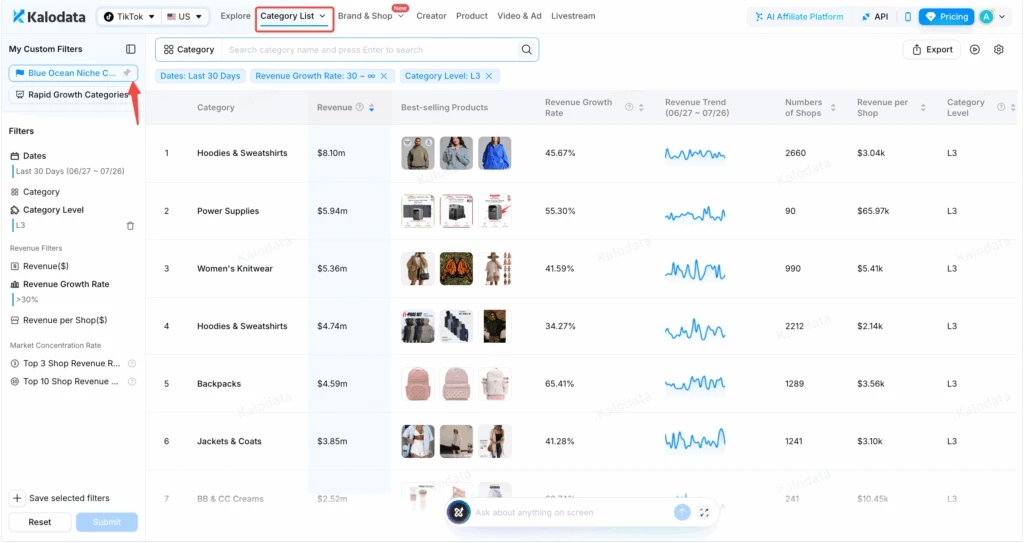
Kalodata: turn a category into a question
The illustration shows the US market, a thirty-day period and a growth filter. Check those settings before comparing rows: a growing category in this market may be less relevant to the country where you intend to sell.
Next, examine store counts, represented products and the curve. Growth driven by one product needs a different interpretation from activity spread across several offers. Open products to understand price and the contribution of videos, livestreams or product listings.
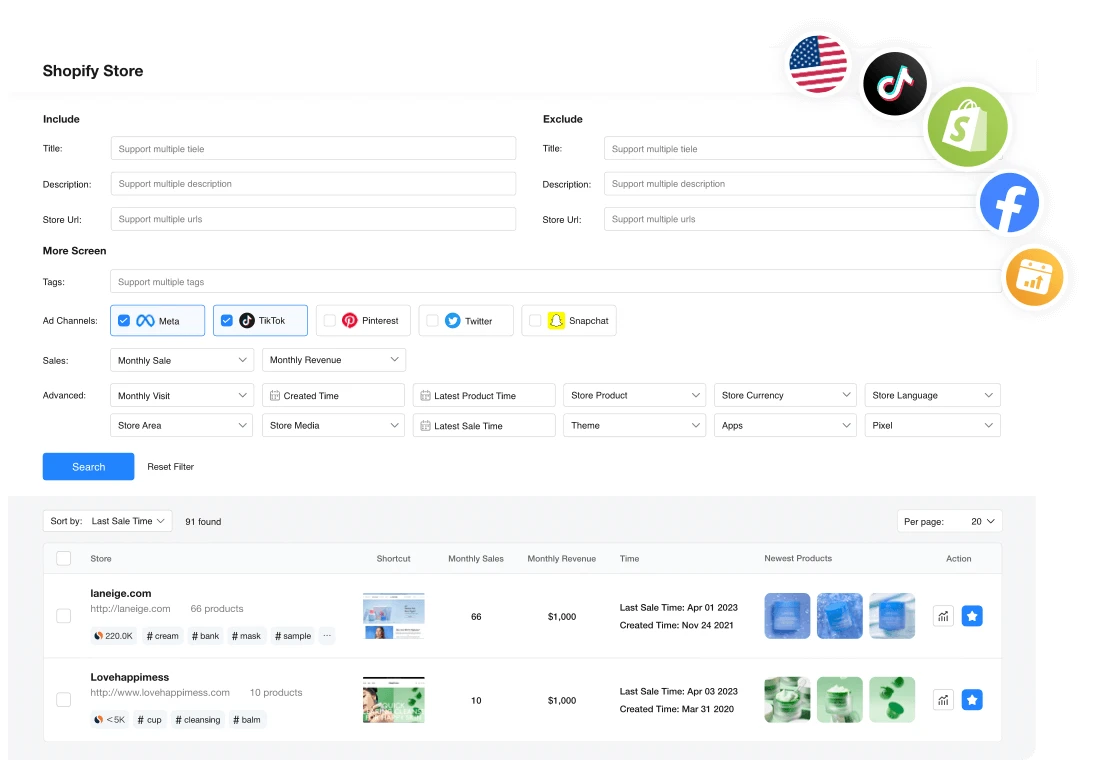
PPSPY: find genuinely comparable stores
Filters combine keywords, language, region and store attributes. Start with a few criteria and narrow the search afterwards. A very high revenue filter may leave only large retailers whose resources and offers differ from yours.
For each selected store, record what matters to your customer: bundle contents, accessories, stated delivery time and installation guidance. PPSPY's predicted sales help direct research; your costs and orders need separate measurement.
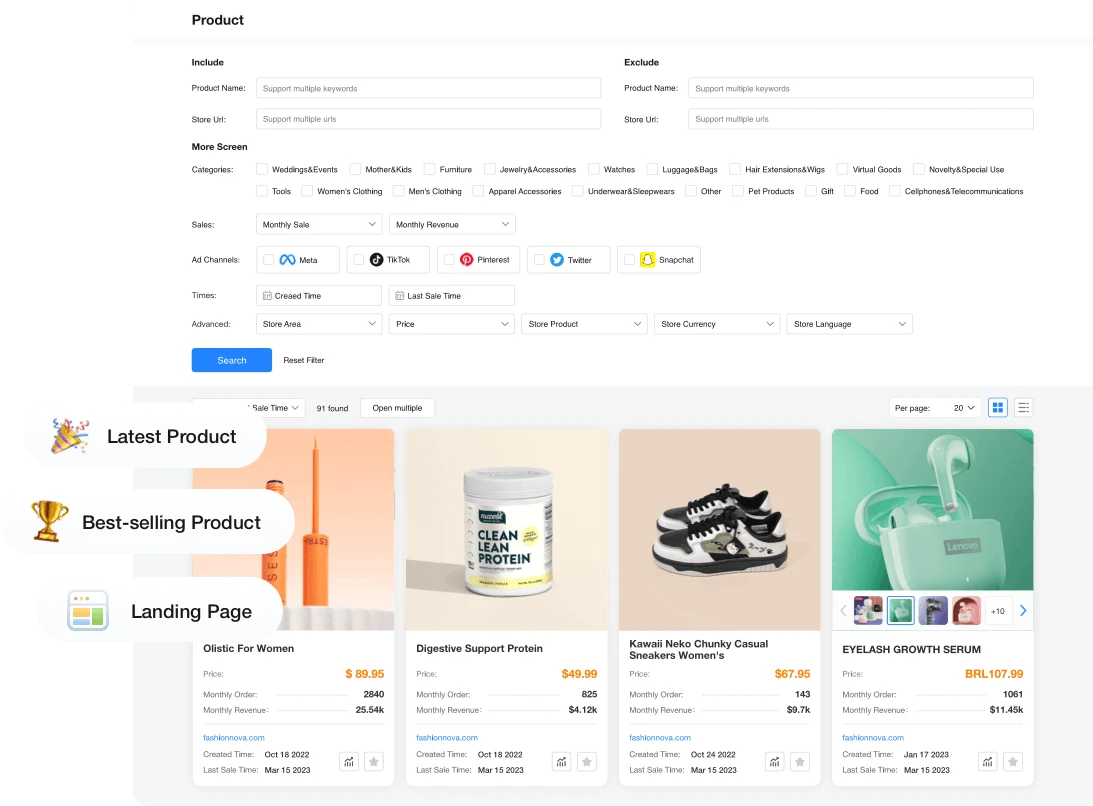
PPSPY: compare products beyond the displayed price
The product view brings together price, category and monthly estimates. Two cards may nevertheless represent one item and a bundle, or different currencies. Open their destinations before deciding which offer is cheaper.
Record unit counts, variants and essential items sold separately. If several stores sell the same object, look for differences in the offer and service. The result count alone does not describe every competitor in the market.
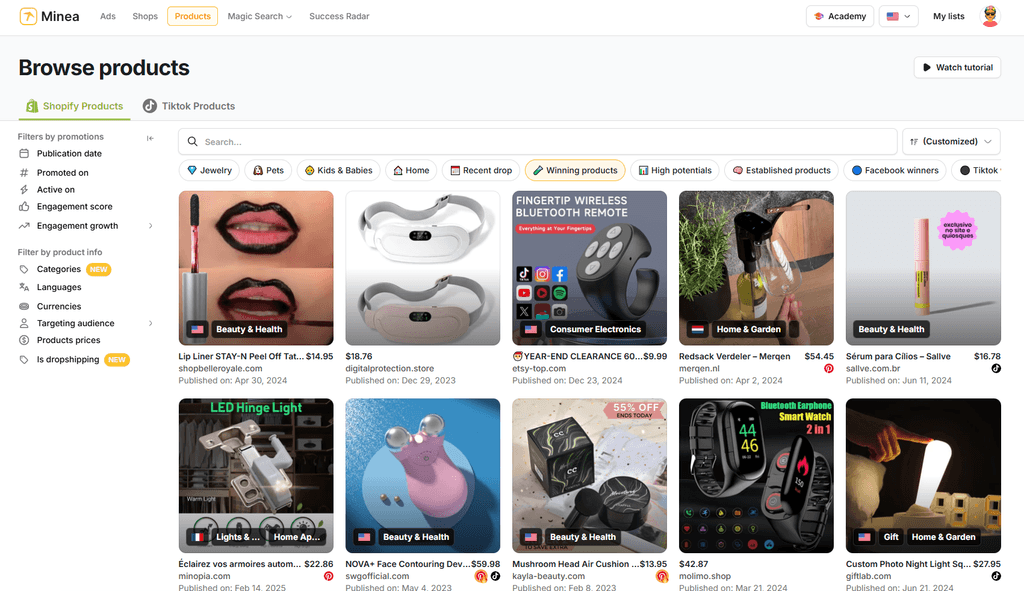
Minea: examine the use shown to the customer
This screen groups promoted products with publication and engagement filters. Use it to find different presentations of a need. A video showing installation may provide different information from a video focused on the final result.
Follow the store link and compare its promise with the delivered product. For our watering kit, the questions concern preparation, compatible pots and water flow. An engagement counter does not answer these technical questions.
Read every metric within its scope
Keep the source, country, period and type of number in your notes. Cross-checking tools helps only if you know what they observe. Different numbers may concern different channels; similar numbers may depend on the same underlying source.
| Data | Useful reading | What still needs checking |
|---|---|---|
| Google Trends index | Changes in relative interest for the selected search. | Purchase intent, volume and availability of the offer in your country. |
| Third-party revenue or order figures | Estimated activity for the stated scope and period. | Method, coverage, returns and costs; the figure does not reveal the merchant's margin. |
| Visible ads and variations | Uses, messages and offers highlighted by a brand. | Delivered product, selling conditions and the results of your own campaign. |
| Reviews or comments | Questions and difficulties expressed by some people. | How often the problem occurs, its usage context and other customers' answers. |
| Few stores found | Few results within the search you performed. | Filters, synonyms, tool coverage and alternative solutions. |
Google Trends index
- Useful reading
- Changes in relative interest for the selected search.
- What still needs checking
- Purchase intent, volume and availability of the offer in your country.
Third-party revenue or order figures
- Useful reading
- Estimated activity for the stated scope and period.
- What still needs checking
- Method, coverage, returns and costs; the figure does not reveal the merchant's margin.
Visible ads and variations
- Useful reading
- Uses, messages and offers highlighted by a brand.
- What still needs checking
- Delivered product, selling conditions and the results of your own campaign.
Reviews or comments
- Useful reading
- Questions and difficulties expressed by some people.
- What still needs checking
- How often the problem occurs, its usage context and other customers' answers.
Few stores found
- Useful reading
- Few results within the search you performed.
- What still needs checking
- Filters, synonyms, tool coverage and alternative solutions.
Worked example: research an indoor plant watering kit
Fictional exercise: a store is considering a kit for two to four pots during a short absence. The three offers and prices below are invented to explain the comparison. No sales figures or customer results are claimed.
| Fictional offer | Contents and price | Question before comparing |
|---|---|---|
| A: wick kit | 4 wicks, EUR 14.90; container not included. | Does the customer have a suitable container, and how should they place the wicks? |
| B: bundle with supports | 8 wicks and their supports, EUR 24.90; container not included. | Do the supports actually simplify installation for two to four pots? |
| C: dedicated reservoir | 1 reservoir and 4 outlets, EUR 34.90. | Which pots are compatible and what adjustment is needed? |
A: wick kit
- Contents and price
- 4 wicks, EUR 14.90; container not included.
- Question before comparing
- Does the customer have a suitable container, and how should they place the wicks?
B: bundle with supports
- Contents and price
- 8 wicks and their supports, EUR 24.90; container not included.
- Question before comparing
- Do the supports actually simplify installation for two to four pots?
C: dedicated reservoir
- Contents and price
- 1 reservoir and 4 outlets, EUR 34.90.
- Question before comparing
- Which pots are compatible and what adjustment is needed?
Bundle B is not simply a more expensive version of kit A: it contains more items. Offer C uses a dedicated reservoir. Compare the problem solved, contents and installation before reducing each offer to a price per piece. Then add shipping charges and delivery time to the same record.
Indirect competitors matter too: a self-watering pot, help from someone nearby or a plant-sitting service can meet the need. This comparison explains why someone might choose a kit, but also why they might prefer not to buy anything.
The next step is sample testing. Photograph installation, record pot sizes, growing medium and room conditions, then observe moisture and water flow. A supplier's stated autonomy needs checking under the conditions you will show customers. Prepare instructions based on that test.
During customer conversations, ask where their plants are and how they were watered during the last absence. If installation is the main difficulty, your difference might be a complete kit with clear instructions. If the solution does not work with their pots, better advertising does not fix that fault.
Compare the offer with your own costs
To illustrate the calculation, use another fictional amount: EUR 25 revenue per order excluding tax, after discounts. The costs below also exclude tax and are not a supplier quote. The aim is to see what remains before acquisition and fixed overheads, not to set your kit's price.
EUR 25 − 8 product − 4 shipping − 1 payment − 2 returns allowance = EUR 10 before advertising and fixed overheads
- Include the accessories and packaging actually required in product cost.
- Replace the returns allowance with a documented assumption, then your own observations.
- Leave room for fixed overheads and pay: the remaining EUR 10 is not net profit.
- Recalculate when bundle contents, discount, shipping or quality changes.
Turn the research into a test decision
A short dossier is better than a collection of unexplained screenshots. Another person should be able to understand your choice and find the supporting information. Here is what it could contain for the watering kit.
| What to keep | Watering kit example | Possible decision |
|---|---|---|
| Need and audience | People with two to four pots during a short absence. | Exclude outdoor uses or complex installations from this first trial. |
| Demand and context | Searches, seasonality and accounts of previous absences. | Choose timing and questions to investigate; do not invent a market size. |
| Offers and alternatives | Bundles A, B and C, delivered prices and solutions without a kit. | Compare a complete offer and simpler installation. |
| Quality and costs | Sample results, instructions, quotes and calculation before advertising. | Improve the product or bundle before funding a campaign. |
| Next experiment | Installation demonstration on a page showing the exact contents. | Measure understanding, questions and orders against criteria set beforehand. |
Need and audience
- Watering kit example
- People with two to four pots during a short absence.
- Possible decision
- Exclude outdoor uses or complex installations from this first trial.
Demand and context
- Watering kit example
- Searches, seasonality and accounts of previous absences.
- Possible decision
- Choose timing and questions to investigate; do not invent a market size.
Offers and alternatives
- Watering kit example
- Bundles A, B and C, delivered prices and solutions without a kit.
- Possible decision
- Compare a complete offer and simpler installation.
Quality and costs
- Watering kit example
- Sample results, instructions, quotes and calculation before advertising.
- Possible decision
- Improve the product or bundle before funding a campaign.
Next experiment
- Watering kit example
- Installation demonstration on a page showing the exact contents.
- Possible decision
- Measure understanding, questions and orders against criteria set beforehand.
Separate observations, assumptions and future measurements in the dossier. 'Three people struggled to position the reservoir' is an observation if those conversations actually happened. 'Illustrated instructions will reduce the difficulty' is still a hypothesis to test. Here, these situations only explain the method.
Before a commercial test, set your budget, period and expected result in relation to your costs. Keep one main difference between the versions being compared. Changing the bundle, price, video and page simultaneously makes it hard to know what affected the outcome.
Test
The use is understood, the sample meets the need and costs leave room to work. Prepare a small experiment with actual bundle contents and delivery conditions.
Investigate
Information still affects the choice: compatibility, shipping, quality or buying motivation. Find that particular answer before adding another product category to your list.
Reject
The product fails the demonstration, a complete bundle costs too much or an alternative meets the need better. Keep the reason so you do not repeat the same study later.
Revisit the research when the offer or conditions change
Date your records and revisit selected offers before launch. A promotional price, stock shortage or delivery change can make an old comparison misleading. After your first orders, gradually replace returns and customer-understanding assumptions with your own observations.
For an active store, also start with support conversations, returns and repeat purchases. Research tools show the outside view; this internal information explains why your customers keep or return the product. The dossier can then guide an offer improvement instead of constant novelty hunting.
Use research tools through Spybox
Spybox combines 90+ ecommerce, SEO and AI tools. The site's offer is EUR 29.99/month or EUR 249.99/year, with 100,000 SBC credits per month. These are Spybox prices, not the direct subscription prices of Kalodata, PPSPY or Minea.
Shared access is useful when your research needs several tool families. For an initial seasonality question and a few interviews, start free. Add specialist access once you know which research it should enable.
- Check available functions and their consumption in Spybox before paying.
- Distinguish SBC credits from direct subscriptions' allowances or credits.
- Find code GET25 on the pricing page and check the final discount at checkout.
Explore the research by tool
- Kalodata
TikTok Shop categories, products, content and sales channels.
- PPSPY
Shopify stores, bundle contents and limits of sales estimates.
- Minea
Promoted products, ads and comparison of demonstrated uses.
- Ad research
Free libraries, PiPiAds and Adsparo for examining messages.
Other research
Ecommerce market research questions
How does market research differ from product discovery?
Product discovery brings up ideas to examine. Market research connects the audience, demand, competing offers, alternatives and project constraints. It should lead to a decision: test, investigate or reject an offer.
Can I start market research for free?
Yes. Google Trends, public store pages, reviews and customer conversations provide a starting point. Free ad libraries complement the view of messages. A paid tool becomes useful for a particular search, filter or monitoring task.
Does Google Trends show how many people will buy?
No. Trends displays a relative-interest index from 0 to 100, normalised for area and period. It helps compare searches and seasonality. It provides neither a buyer total nor an order count.
Should I choose Kalodata or PPSPY?
Kalodata suits TikTok Shop category and product analysis in covered markets. PPSPY starts with Shopify stores and products. Choose your channel and question first; use both only when their different scopes provide a useful comparison.
Can estimated sales reveal a competitor's margin?
No. Their product costs, shipping, discounts, returns and acquisition are among the missing information. Keep estimates with their source and period, then calculate your own offer using quotes and measurements.
Is a niche with few results necessarily attractive?
Not necessarily. Narrow filters, different wording or limited coverage can explain the result. Also examine alternatives and ask customers how they already solve the problem.
How many competitors should I compare?
There is no universal number. Keep a small set covering genuinely different offers: an entry-level option, a complete bundle and a substitute solution, for example. Add a reference when it changes your understanding, not just to lengthen the list.
Do the watering kit and prices come from an actual study?
No. The kit, the EUR 14.90, 24.90 and 34.90 offers, and the calculation using EUR 25 excluding tax are fictional. They explain how to compare contents and costs. No actual seller or commercial result is presented.
Does Spybox include the same allowances as direct subscriptions?
The monthly 100,000 SBC credits belong to Spybox. They do not automatically match the credits and allowances sold directly by each publisher. Check tool access conditions and Spybox pricing before choosing.