
Updated October 3, 2026
Spybox for dropshipping
Which tools help you find an idea, understand competing offers and prepare a first test? A practical guide from product selection to costs, with a clear distinction between research and order fulfilment.
Contents
What Spybox contributes to a dropshipping store
In dropshipping, the supplier ships the product after a customer places an order. Your work as a retailer is still to choose the offer, describe it accurately and handle the customer relationship. Research tools help decide what to sell and how to present it; they do not resolve quality or delivery on their own.
Spybox brings together product research, ad research, AI and SEO tools. The benefit is being able to move from an ad to a store, compare an offer and prepare your own content. You do not need ten tools for every idea: a specific question and two complementary sources are often enough to start.
For a first store, choose one audience and an easy-to-explain use. If you already have sales, start with your own order data: support questions, refunds, contribution and delivery times. New research becomes useful when it addresses a known problem, not simply because a ranking lists another product.
- One product idea to investigate rather than a catalogue to fill.
- A country and sales channel selected before applying filters.
- A sample and supplier costs before buying ads.
- One offer, one page and a limited test before expanding the range.
Choose tools for a particular task
A Shopify store, a TikTok Shop project and Meta ad research need different data. Pick a starting point, then add a tool only if it supplies different information.
| Your question | Tool or resource | What to do with it |
|---|---|---|
| Which Shopify products and stores should I explore? | PPSPY | Find offers and compare bundle contents, displayed prices and public product pages. |
| Which TikTok Shop product should I investigate? | Kalodata | Explore a covered market and connect categories with products and creators. Research does not replace your seller access. |
| How is a product shown in ads? | PiPiAds | Study TikTok and Facebook: opening scene, demonstration, objections and landing page. |
| How does a page communicate on Meta? | Adsparo | Examine ads and their history to compare messages and variations. |
| What other signals surround a store? | Winning Hunter | Connect ad research with store tracking, keeping the period, country and estimated nature of figures. |
| How can I prepare copy for my offer? | ChatGPT | Organise product information, draft a listing and prepare script variations for review. |
| Who ships orders, checks stock and handles returns? | Your supplier and store | Arrange order fulfilment separately. Research tools are not a delivery service. |
Which Shopify products and stores should I explore?
- Tool or resource
- PPSPY
- What to do with it
- Find offers and compare bundle contents, displayed prices and public product pages.
Which TikTok Shop product should I investigate?
- Tool or resource
- Kalodata
- What to do with it
- Explore a covered market and connect categories with products and creators. Research does not replace your seller access.
How is a product shown in ads?
- Tool or resource
- PiPiAds
- What to do with it
- Study TikTok and Facebook: opening scene, demonstration, objections and landing page.
How does a page communicate on Meta?
- Tool or resource
- Adsparo
- What to do with it
- Examine ads and their history to compare messages and variations.
What other signals surround a store?
- Tool or resource
- Winning Hunter
- What to do with it
- Connect ad research with store tracking, keeping the period, country and estimated nature of figures.
How can I prepare copy for my offer?
- Tool or resource
- ChatGPT
- What to do with it
- Organise product information, draft a listing and prepare script variations for review.
Who ships orders, checks stock and handles returns?
- Tool or resource
- Your supplier and store
- What to do with it
- Arrange order fulfilment separately. Research tools are not a delivery service.
Minea, Dropship.io, Sell The Trend, Niche Scrapper, Peeksta and ShopHunter offer other research starting points. Compare their guides if your first tool does not cover the task. Collecting overlapping results mainly adds sorting work.
An ad's duration, estimated sales and comments can suggest a question. They do not reveal a store's internal costs. Record the exact product, bundle, currency and period before comparing figures; one accessory is a different offer from a four-piece set.
Four previews that explain the research
These illustrations come from publishers' public pages. Some examples are several years old: they explain how to read a screen, not a product's current performance.
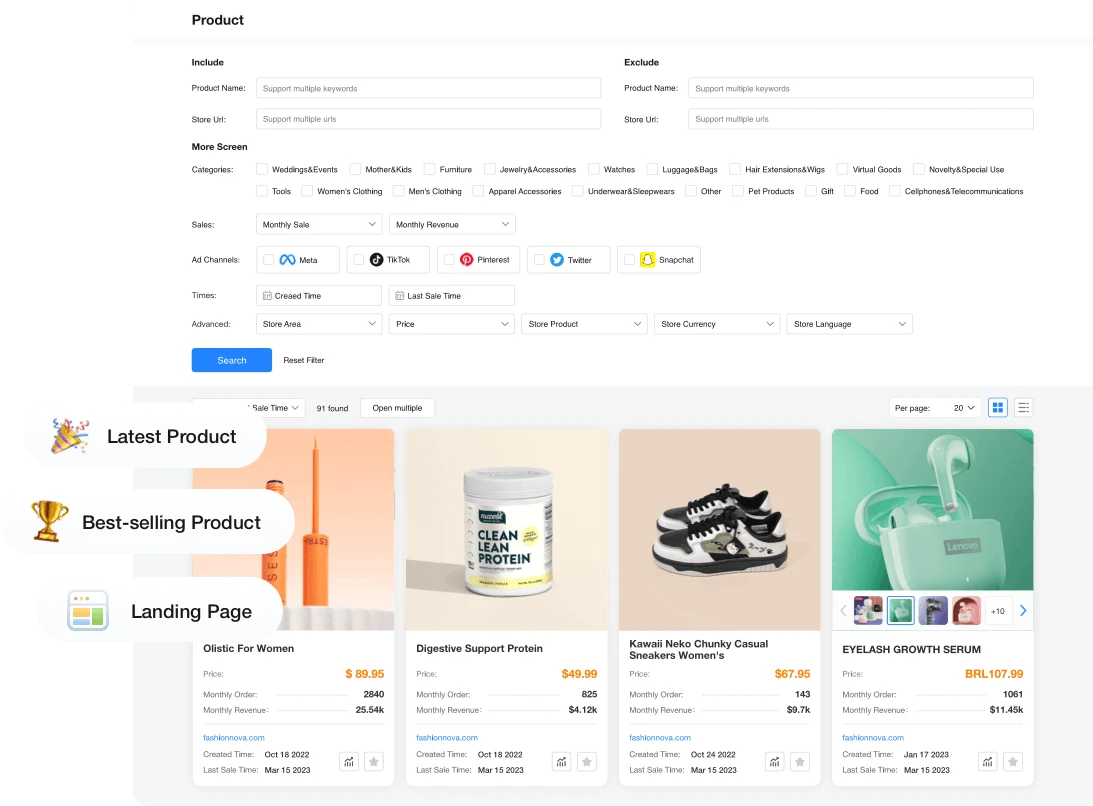
PPSPY: compare offers, not just names
The preview combines filters, prices and product cards. Open the store page and record what is actually included. PPSPY says its order data is predicted by an algorithm: use it to guide research, then calculate the costs of your own offer.
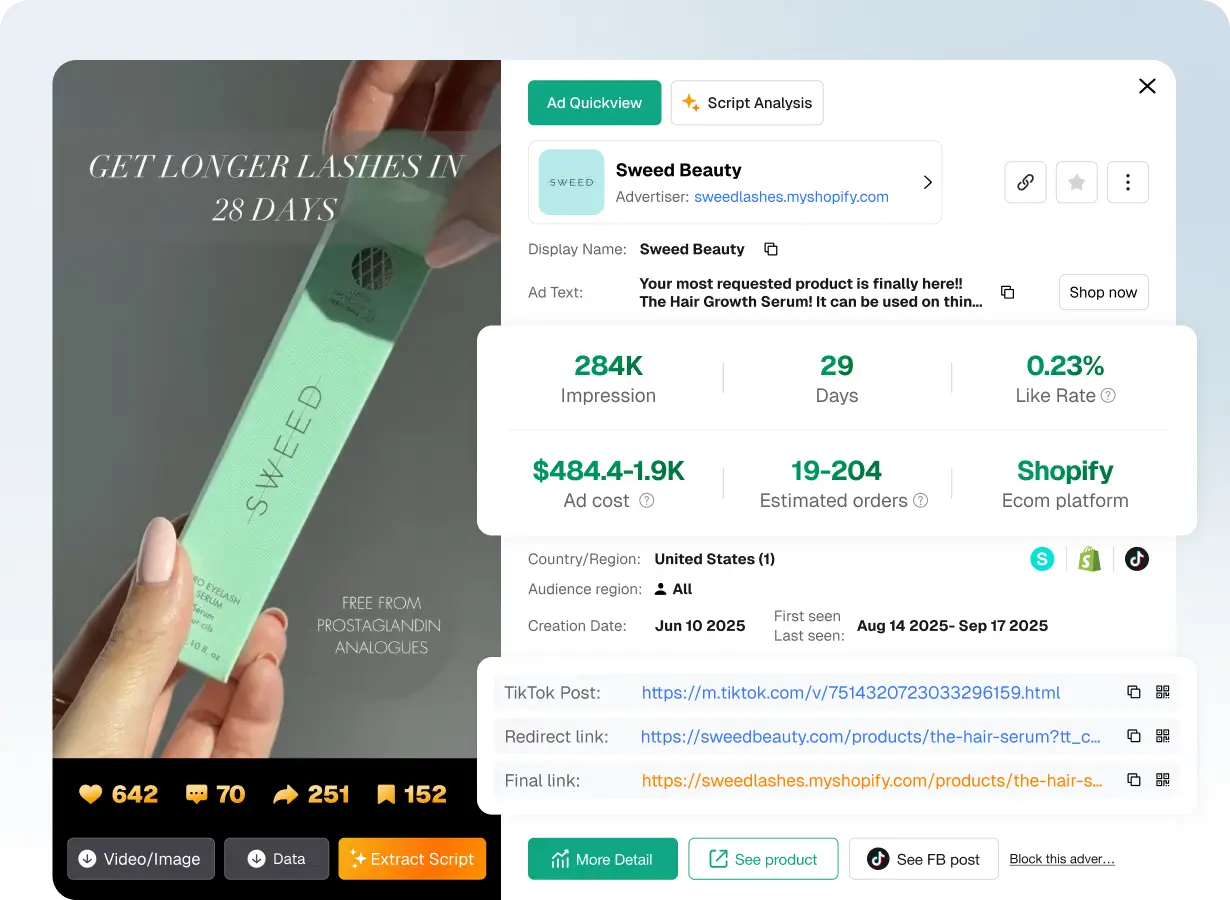
PiPiAds: connect the ad with the offer
This demonstration displays an ad, dates and estimated ranges. Examine the opening scene, the product shown and the destination first. The wide estimates explain why this panel cannot establish profit. The cosmetic product pictured is not our suggested launch product.
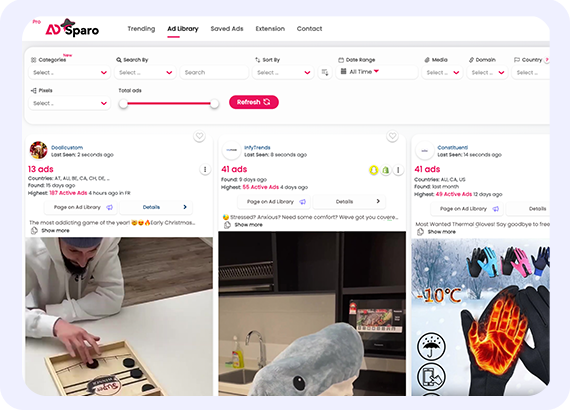
Adsparo: different ways to present an offer
Ads may emphasise very different uses. Record the questions they answer, then choose a demonstration you can film using your own sample. Filters reduce the selection; the Adsparo guide covers working with history and variations.
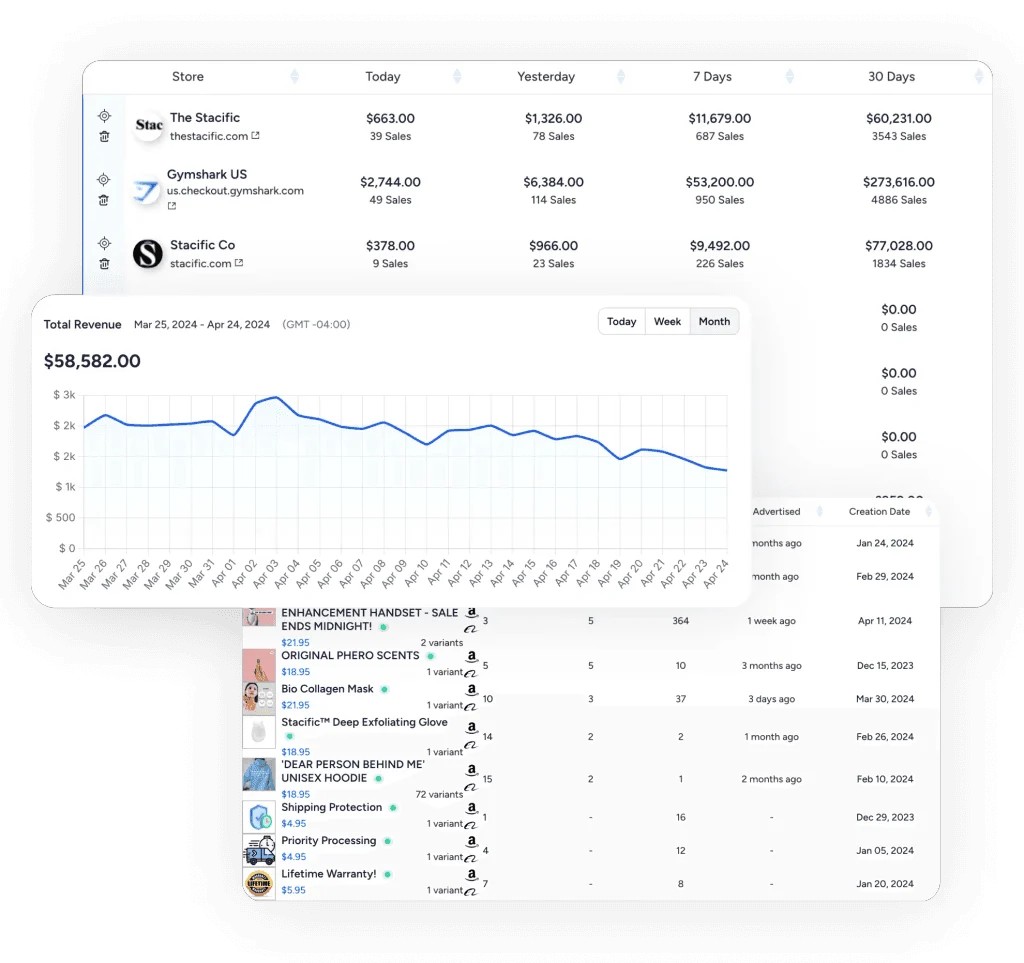
Winning Hunter: keep the period with the figure
This tracking illustration combines different time spans and a historical chart. Keep the period with each observation so you do not compare a day with a month. Even a high figure leaves costs, refunds and supply conditions unknown.
Check the supplier with a sample
A catalogue listing does not tell you how the packaging, material or product will look and work on arrival. Have a sample delivered in your target country and record order, dispatch and arrival dates. Photograph what actually arrives, including instructions and accessories.
Request a quote for the exact item and quantity. A two-piece bundle may cost more if the supplier sends two parcels, changes carrier or charges for particular packaging. Confirm shipping origin, availability and the return address before writing a delivery promise.
A directory, an order-management app and a product research tool have different roles. Shopify's supplier guide explains these categories. If you use an integration, test order transmission and stock tracking separately. Those operations depend on your store and supplier, outside the research work.
- The item, dimensions, material and parcel contents match the quote.
- The product works in the use you intend to show.
- Observed transit time, tracking and condition on arrival.
- The full cost of an order for the target country.
- Procedures for defects, lost parcels and returns.
- Item availability and the supplier's answers to questions.
- Product-specific documents and requirements before selling.
For a store selling in France, the DGCCRF states that the seller remains responsible for quality and delivery even when the supplier ships the parcel. Product information, sales terms and returns therefore deserve as much attention as ad research.
Read the DGCCRF dropshipping guidance (French)Work out what remains before paying for ads
Take a fictional exercise: a two-piece adjustable drawer-divider set sold for EUR 36 excluding tax after a discount. Every cost below is invented to explain the calculation; it is not a supplier quote or a store result.
| Item per order | Illustrative amount | What to enter in your calculation |
|---|---|---|
| Revenue after discount, excluding tax | + EUR 36.00 | Revenue retained excluding sales tax, including any delivery amount charged to the customer. |
| Product and packaging | − EUR 9.00 | The exact item and bundle, with applicable purchase or import costs. |
| Shipping | − EUR 5.00 | Delivery cost to a customer in the selected country. |
| Payment | − EUR 1.20 | Percentage and fixed payment-processing fees. |
| Order handling | − EUR 0.80 | Additional variable preparation or service costs. |
| Returns and incident allowance | − EUR 2.00 | An initial assumption to replace with observed order costs. |
Revenue after discount, excluding tax
- Illustrative amount
- + EUR 36.00
- What to enter in your calculation
- Revenue retained excluding sales tax, including any delivery amount charged to the customer.
Product and packaging
- Illustrative amount
- − EUR 9.00
- What to enter in your calculation
- The exact item and bundle, with applicable purchase or import costs.
Shipping
- Illustrative amount
- − EUR 5.00
- What to enter in your calculation
- Delivery cost to a customer in the selected country.
Payment
- Illustrative amount
- − EUR 1.20
- What to enter in your calculation
- Percentage and fixed payment-processing fees.
Order handling
- Illustrative amount
- − EUR 0.80
- What to enter in your calculation
- Additional variable preparation or service costs.
Returns and incident allowance
- Illustrative amount
- − EUR 2.00
- What to enter in your calculation
- An initial assumption to replace with observed order costs.
36 − 9 − 5 − 1.20 − 0.80 − 2 = EUR 18 before ads and fixed overheads.
The EUR 18 is contribution before acquisition. An advertising cost of EUR 18 per order would absorb it completely, before the store subscription, tools, your time and other expenses. Your acquisition target needs to be lower, leaving room for those costs.
Recalculate after a discount, shipping change or refund. If you sell different bundles, keep a separate line for each offer rather than averaging away their differences. Use a consistent tax basis; the tax-exclusive figure in this exercise is not a suggested consumer price.
| Advertising per order | After variable costs and ads | Reading the exercise |
|---|---|---|
| EUR 12 | 18 − 12 = EUR 6 | EUR 6 remains for fixed overheads and compensation; it is not net profit. |
| EUR 18 | 18 − 18 = EUR 0 | Fixed overheads are not covered. |
| EUR 20 | 18 − 20 = −EUR 2 | The order already loses EUR 2 before fixed overheads. |
EUR 12
- After variable costs and ads
- 18 − 12 = EUR 6
- Reading the exercise
- EUR 6 remains for fixed overheads and compensation; it is not net profit.
EUR 18
- After variable costs and ads
- 18 − 18 = EUR 0
- Reading the exercise
- Fixed overheads are not covered.
EUR 20
- After variable costs and ads
- 18 − 20 = −EUR 2
- Reading the exercise
- The order already loses EUR 2 before fixed overheads.
Prepare the offer: two drawer dividers
Continue the same fictional scenario. The audience is organising a desk drawer shared by small items and accessories. The key question is straightforward: does the set adjust to the drawer's dimensions and stay in place for the advertised use? An appealing organisation video does not necessarily answer either point.
In PPSPY or Minea, compare bundle contents and public store pages. In PiPiAds or Adsparo, note whether ads show installation, the finished drawer or an everyday problem. A complementary Winning Hunter observation can help select a store to examine; it does not replace testing the divider.
Keep the final dossier to a page: audience and use, bundle contents, checked dimensions, sample photographs, quote, delivery terms, contribution calculation and demonstration idea. Treat missing information as a question to resolve rather than filling the listing with a plausible specification.
What the sample should let you check
- Measure its actual adjustment range and the drawer used in the demonstration.
- Test stability during intended use without inventing a durability period.
- Check contact surfaces, finish and removal of the divider.
- Photograph the complete set and packaging received.
- Record buyer-relevant limits: dimensions, compatibility and quantity.
Build the listing and ads from your own information
ChatGPT can organise the dossier into a short description, specifications, FAQs and scripts. Supply measured dimensions and confirmed terms. During review, remove any unsupported materials, certifications, compatibility or delivery claims it adds; persuasive wording cannot replace product information.
For this set, film three possible demonstrations: a drawer before and after organisation, installation with visible measurements, and choosing the two-piece bundle. Change one question at a time so you can understand what the test teaches you. Canva can handle text and formats; Submagic can edit a short subtitled video. Another brand's media remains its content, not your advertising material.
Keep the same offer in the ad, listing and cart. If the video shows two pieces, the buyer needs to understand they are ordering that set and know the full price. Main photographs show the product received; a generated image must not add a capability or accessory that is missing.
- An opening scene showing the use instead of an abstract promise.
- Bundle contents, dimensions and limits visible on the page.
- Delivery and return terms available before ordering.
- A mobile test order to check the cart, payment and messages.
Run a test you can interpret
Before launch, write down the question, maximum budget and stop conditions. For example: ‘Do the intended customers understand the two-piece bundle and whether it fits their drawer?’ That helps you interpret hesitation and support questions, not just clicks.
Use your ad accounts and store data to measure your campaigns. PiPiAds, Adsparo and Winning Hunter help prepare competitor research. Launch ads and follow their results through your own advertising account and store orders.
| What you observe | Question to investigate | Possible action |
|---|---|---|
| Clicks but few cart additions | Does the listing match the ad scene? Are the price and bundle clear? | Review the offer and mobile journey before changing the whole product. |
| Cart additions but few payments | Fees, delivery, trust or a payment error? | Place a test order and examine where visitors stop. |
| Orders but insufficient contribution | Discounts, basket contents, acquisition cost or variable fees? | Recalculate per order; reduce or pause the test when its agreed budget is reached. |
| Returns or complaints after delivery | Compatibility, quality, description or transit time? | Resolve the product or supplier issue before increasing traffic. |
Clicks but few cart additions
- Question to investigate
- Does the listing match the ad scene? Are the price and bundle clear?
- Possible action
- Review the offer and mobile journey before changing the whole product.
Cart additions but few payments
- Question to investigate
- Fees, delivery, trust or a payment error?
- Possible action
- Place a test order and examine where visitors stop.
Orders but insufficient contribution
- Question to investigate
- Discounts, basket contents, acquisition cost or variable fees?
- Possible action
- Recalculate per order; reduce or pause the test when its agreed budget is reached.
Returns or complaints after delivery
- Question to investigate
- Compatibility, quality, description or transit time?
- Possible action
- Resolve the product or supplier issue before increasing traffic.
A few orders provide limited evidence, especially before delivery and returns. Keep results with dates and distinguish paid, dispatched, delivered and refunded orders. A promising advertising start can still become a poor offer if incidents accumulate later.
Before continuing, look for contribution that leaves room for overheads, delivery matching your promise and customers who understand the product. An unsuccessful test can explain a confusing page, unsuitable bundle, excessive cost or quality issue. Adding another research tool does not resolve those problems on its own.
A tools subscription is only part of the budget
Separate Spybox from the expenses needed to operate a store. Distinguish recurring fees, per-order costs and the research or testing allowance.
| Expense | When | What to allow for |
|---|---|---|
| Research and creation with Spybox | Subscription | EUR 29.99/month or EUR 249.99/year, depending on the chosen offer. |
| Store, domain and apps | Recurring | Your selling platform and services actually used; not included in the Spybox price. |
| Samples and test delivery | Before launch | Obtain and test the product, possibly from several suppliers. |
| Advertising or content production | During the test | A separate allowance, even if you prepare content using the tools. |
| Product, shipping and payment | For each order | Variable costs to enter in your calculation. |
| Returns, support and incidents | After the sale | Cash and time available for handling orders and refunds. |
Research and creation with Spybox
- When
- Subscription
- What to allow for
- EUR 29.99/month or EUR 249.99/year, depending on the chosen offer.
Store, domain and apps
- When
- Recurring
- What to allow for
- Your selling platform and services actually used; not included in the Spybox price.
Samples and test delivery
- When
- Before launch
- What to allow for
- Obtain and test the product, possibly from several suppliers.
Advertising or content production
- When
- During the test
- What to allow for
- A separate allowance, even if you prepare content using the tools.
Product, shipping and payment
- When
- For each order
- What to allow for
- Variable costs to enter in your calculation.
Returns, support and incidents
- When
- After the sale
- What to allow for
- Cash and time available for handling orders and refunds.
Selling without stock does not eliminate spending before revenue or timing gaps between paying a supplier, receiving a store payout and refunding a customer. Prepare a simple cash-flow record alongside the per-order calculation. An annual subscription requires a different upfront outlay from monthly payment.
To compare Spybox with direct subscriptions, list only tools you would actually use, with their current prices and conditions. Do not total maximum-tier plans you would never buy. Shared access and a personal direct subscription can also differ in allowances and available functions.
Access the tools through Spybox
The offer displayed on our pricing page provides 90+ tools with 100,000 monthly SBC credits, at EUR 29.99/month or EUR 249.99/year. Consult each tool's access conditions: SBC credits do not automatically reproduce publishers' direct allowances.
You can enter GET25 before payment and review the terms and final amount displayed. Choose the subscription for research and creation; supplier, store and advertising costs remain separate.
Questions about Spybox and dropshipping
Does Spybox build the store and ship orders?
This guide presents Spybox for product research, competitor research and content creation. Arrange your store, supplier, available stock and order handling separately. Research tools are not a shipping service.
Which tools should I start with?
Choose the channel first: PPSPY for Shopify research, Kalodata for TikTok Shop in covered markets, PiPiAds or Adsparo for ads. Add ChatGPT to prepare copy from checked information. You do not need every tool for a first offer.
Can I begin the research for free?
Yes. Public store pages, reviews, Google Trends and ad libraries let you examine an idea. A paid tool becomes useful for a particular filter or tracking task. Samples, the store and delivery remain separate expenses.
Do a store's estimated sales prove a product is profitable?
No. Product costs, fees, discounts, returns and advertising spending are not all known. Keep the source and period, then calculate your own contribution using your offer's costs.
What should I budget for besides Spybox?
Samples, store, domain, useful apps, supplier, payment, delivery, any advertising and returns. The total depends on the offer and channel; Spybox alone is not a complete launch budget.
Where does the EUR 18 in the example come from?
It is fictional: EUR 36 excluding tax minus EUR 9 for the product, EUR 5 shipping, EUR 1.20 payment, EUR 0.80 handling and a EUR 2 allowance gives EUR 18 before ads and fixed overheads. At EUR 12 acquisition cost, EUR 6 remains before overheads, not net profit.
Can I reuse a competitor's videos?
A video visible in a tool remains content requiring appropriate usage rights. Analyse its construction, then create your own demonstration with your product. A generated image must not show features that do not exist.
Is the supplier solely responsible for delivery?
For a store selling in France, the DGCCRF states that the seller remains responsible for quality and delivery even if the supplier ships. Read its guidance on applicable obligations.
Are SBC credits the publishers' credits?
No. The 100,000 monthly SBC credits belong to Spybox. Publishers have their own allowances, plans and rules. Compare access conditions, not just credit totals.