
Updated October 3, 2026
Ad optimisation with Spybox
Your ads attract clicks, but orders are not following? Use campaign results to decide what to improve: the demonstration, offer, page or measurement.
Contents
Which problem should you address first?
A campaign with few sales does not necessarily need another video. Identify where people leave the journey, then check the data before choosing a change.
| What you observe | What to check | Possible first action |
|---|---|---|
| Clicks, but few measured visits | Final URL, loading on a phone and measurement. Clicks and sessions are not the same unit. | Test the link in the delivered format and fix the destination or measurement before remaking the ad. |
| Visits, but people misunderstand the bundle | Consistency between ad and page, package contents, dimensions, price and shipping charges. | Show the object in use and explain what is included, with the same offer on the page. |
| Carts, but few payments | Final total, delivery, payment method and possible checkout problems. | Place a test order and address the obstacle found rather than changing targeting by default. |
| Acquisition cost is rising | Matching period, audience and offer, exposure frequency and creative results. Also check costs and competition. | If the data and feedback point to the message, prepare a specific variant. Rising cost alone does not prove fatigue. |
| ROAS looks good, but cash is falling | Paid orders, cancellations, returns, variable costs, fixed expenses and payment dates. | Reconcile advertising and orders, then calculate what remains before raising the budget. |
Clicks, but few measured visits
- What to check
- Final URL, loading on a phone and measurement. Clicks and sessions are not the same unit.
- Possible first action
- Test the link in the delivered format and fix the destination or measurement before remaking the ad.
Visits, but people misunderstand the bundle
- What to check
- Consistency between ad and page, package contents, dimensions, price and shipping charges.
- Possible first action
- Show the object in use and explain what is included, with the same offer on the page.
Carts, but few payments
- What to check
- Final total, delivery, payment method and possible checkout problems.
- Possible first action
- Place a test order and address the obstacle found rather than changing targeting by default.
Acquisition cost is rising
- What to check
- Matching period, audience and offer, exposure frequency and creative results. Also check costs and competition.
- Possible first action
- If the data and feedback point to the message, prepare a specific variant. Rising cost alone does not prove fatigue.
ROAS looks good, but cash is falling
- What to check
- Paid orders, cancellations, returns, variable costs, fixed expenses and payment dates.
- Possible first action
- Reconcile advertising and orders, then calculate what remains before raising the budget.
Compare the right data over the same period
Start in your advertising account and store. Record the period, country, objective, currency, ads delivered and spending. Note whether the report assigns conversions to the interaction date or purchase date, as well as its time zone. A promotional week and a week without a discount do not isolate the effect of a video.
Account ROAS divides the value attributed to ads by their spending. It depends on the tracked event, its value and attribution rules. Google Ads explains that the conversion window determines how long a conversion can be linked to an interaction. An order can also appear later: this morning's result is not necessarily yesterday's final outcome.
Keep a reconciliation with orders actually paid, followed by their status after delivery and returns. Platforms may claim the same sale under different rules. Do not add their attributed revenue as if each report represented separate orders. Use order identifiers in your own reports without publishing them or putting them in shared access.
| Metric | What it tells you | What to specify |
|---|---|---|
| Clicks and visits | Interactions with the ad and measured arrivals on the page. | Link clicks or all clicks, sessions or people, device and measurement limitations. |
| Click-through rate | The share of impressions producing the chosen type of click. | Matching click definition and format. A click attracted by an ambiguous promise can cost money without helping sales. |
| Cost per attributed purchase | Spend divided by purchases included in the advertising report. | Purchase event, duplicates, test orders, attribution window and reporting delay. |
| Attributed ROAS | Value of attributed purchases divided by advertising spend. | Tax-inclusive or tax-exclusive values, whether refunds are included, currency and value source. |
| Contribution after advertising | Net revenue minus variable costs and advertising for the chosen scope. | Product, shipping, payments, incidents and other variable costs. Fixed expenses still need covering. |
Clicks and visits
- What it tells you
- Interactions with the ad and measured arrivals on the page.
- What to specify
- Link clicks or all clicks, sessions or people, device and measurement limitations.
Click-through rate
- What it tells you
- The share of impressions producing the chosen type of click.
- What to specify
- Matching click definition and format. A click attracted by an ambiguous promise can cost money without helping sales.
Cost per attributed purchase
- What it tells you
- Spend divided by purchases included in the advertising report.
- What to specify
- Purchase event, duplicates, test orders, attribution window and reporting delay.
Attributed ROAS
- What it tells you
- Value of attributed purchases divided by advertising spend.
- What to specify
- Tax-inclusive or tax-exclusive values, whether refunds are included, currency and value source.
Contribution after advertising
- What it tells you
- Net revenue minus variable costs and advertising for the chosen scope.
- What to specify
- Product, shipping, payments, incidents and other variable costs. Fixed expenses still need covering.
For the whole store, you can also compare its net revenue with all advertising spending over the period. This overall ratio includes purchases from other channels; it does not by itself measure sales caused by a campaign. It mainly helps spot a gap between advertising reports and actual business activity.
If measurement has changed, keep the date and the correction. More recorded purchases after repairing an event do not automatically mean more orders. Keep the same measurement method when comparing creative versions.
Worked example: a ROAS of 2.7 can still leave a loss
Fictional exercise, not a customer result: a store sells an insulated lunch bag for €30 excluding tax on one advertising channel. Planned variable cost per order is €18 excluding tax: €10 for the product, €5 shipping, €1 payment and €2 provision for incidents. All amounts below use the same tax-exclusive basis; substitute your actual situation.
The advertising account shows 36 purchases and €1,080 in attributed value for €400 spent. Reconciliation finds six orders cancelled and refunded before shipping; this exercise assumes they incurred no additional variable cost. That leaves 30 orders at €30, or €900 net revenue. Advertising already paid remains an expense.
| Item | Calculation in this exercise | How to read it |
|---|---|---|
| Reported ROAS | €1,080 ÷ €400 = 2.7 | The initial report counts all 36 purchases before cancellations. |
| Orders retained | 36 − 6 = 30 | Paid, uncancelled orders within the scope; review subsequent returns. |
| Net revenue retained | 30 × €30 = €900 | Initial attributed value exceeded this revenue by €180. |
| Variable costs | 30 × €18 = €540 | Product, shipping, payments and the provision absorb part of the revenue. |
| Contribution before advertising | €900 − €540 = €360 | What is available to pay advertising, followed by fixed expenses. |
| Contribution after advertising | €360 − €400 = −€40 | A €40 loss before fixed expenses despite initial ROAS of 2.7. |
| Ratio after reconciliation | €900 ÷ €400 = 2.25 | An adjusted indicator for this exercise, distinct from the initial account figure. |
Reported ROAS
- Calculation in this exercise
- €1,080 ÷ €400 = 2.7
- How to read it
- The initial report counts all 36 purchases before cancellations.
Orders retained
- Calculation in this exercise
- 36 − 6 = 30
- How to read it
- Paid, uncancelled orders within the scope; review subsequent returns.
Net revenue retained
- Calculation in this exercise
- 30 × €30 = €900
- How to read it
- Initial attributed value exceeded this revenue by €180.
Variable costs
- Calculation in this exercise
- 30 × €18 = €540
- How to read it
- Product, shipping, payments and the provision absorb part of the revenue.
Contribution before advertising
- Calculation in this exercise
- €900 − €540 = €360
- How to read it
- What is available to pay advertising, followed by fixed expenses.
Contribution after advertising
- Calculation in this exercise
- €360 − €400 = −€40
- How to read it
- A €40 loss before fixed expenses despite initial ROAS of 2.7.
Ratio after reconciliation
- Calculation in this exercise
- €900 ÷ €400 = 2.25
- How to read it
- An adjusted indicator for this exercise, distinct from the initial account figure.
With these costs, an order leaves €12 before advertising and fixed expenses, or 40% of its tax-exclusive price. A revenue-to-advertising ratio of 30 ÷ 12 = 2.5 covers only variable costs and advertising in this simplified model. That threshold belongs to the exercise: fixed expenses, production and uncovered incidents can require more. It is not a universal target.
The next action depends on why orders were cancelled. If delivery time was misunderstood, first correct the displayed offer and its ad. If the product costs too much to ship, calculate again using another supplier or bundle. Producing another video does not automatically solve these problems.
Use competitive research to answer a specific question
Once you have identified the problem, open PiPiAds or Adsparo with a question: how do comparable offers show the bag's capacity, cleaning or contents? Look for the same use, country and a similar price. Read the destination page; an attractive video may advertise a different bundle from yours.
Describe the scene and message rather than copying an ad. For a lunch bag, starting with a packed lunch answers a capacity question; showing a hand cleaning the inside addresses another objection. Retain what you can film with your product and verified specifications.
Dates, formats and repetition in a library help select examples. They do not reveal your margin or future campaign results. You can also start in a free official ad library; the research guide linked below explains this approach.
- Keep the link, date, country and observed offer.
- Note the objection addressed and the scene that answers it.
- Write your own idea and reason for testing it without reusing unauthorised images.
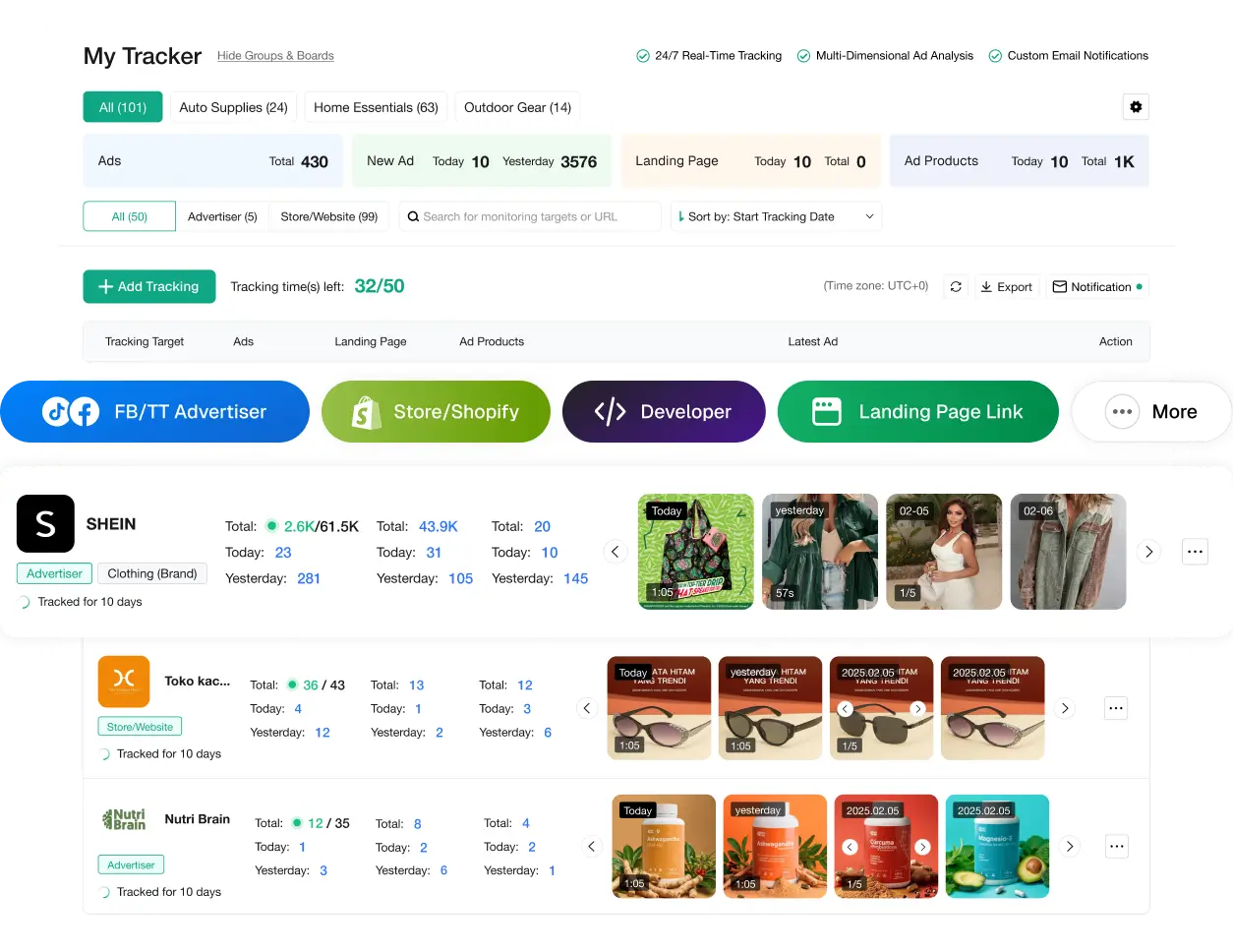
PiPiAds: find comparable variants
This tracking demonstration groups advertisers and creative versions, making messages easier to compare over time. The counters and dates belong to an older public illustration, not results from your advertising account.
Which tool fits each stage?
Your delivery account remains the starting point. Spybox tools then support research, wording or production for the change you have chosen.
| Need | Tool or source | What to prepare |
|---|---|---|
| Understand actual results | Advertising account, site measurement and store orders | A dated comparison of spend, purchases, revenue and costs. |
| Study a competitor's message | PiPiAds, Adsparo or public library | An observation linked to the objection you want to address. |
| Organise creative analysis | Atria | A proposal to review using available information, without assuming every direct-service connection is included. |
| Prepare a new version | ChatGPT or GetHookd | Copy or a variant based on your product, to review and identify clearly. |
| Adapt format and editing | Canva and Submagic | A file readable in the intended placement with corrected text and captions. |
Understand actual results
- Tool or source
- Advertising account, site measurement and store orders
- What to prepare
- A dated comparison of spend, purchases, revenue and costs.
Study a competitor's message
- Tool or source
- PiPiAds, Adsparo or public library
- What to prepare
- An observation linked to the objection you want to address.
Organise creative analysis
- Tool or source
- Atria
- What to prepare
- A proposal to review using available information, without assuming every direct-service connection is included.
Prepare a new version
- Tool or source
- ChatGPT or GetHookd
- What to prepare
- Copy or a variant based on your product, to review and identify clearly.
Adapt format and editing
- Tool or source
- Canva and Submagic
- What to prepare
- A file readable in the intended placement with corrected text and captions.
Atria publicly presents Raya, creative analysis and turning data into a new advertising proposal. Direct-service features requiring account connections, team permissions or ad launching should not be assumed included in Spybox access. Check the usable scope before building your routine around these functions.
For client work, avoid putting identifiable sales records, identifiers or secrets in shared access. An anonymised summary may be enough to discuss a message; detailed reports belong in your company's authorised spaces. AI helps formulate a hypothesis, while the review comes from your data and test.
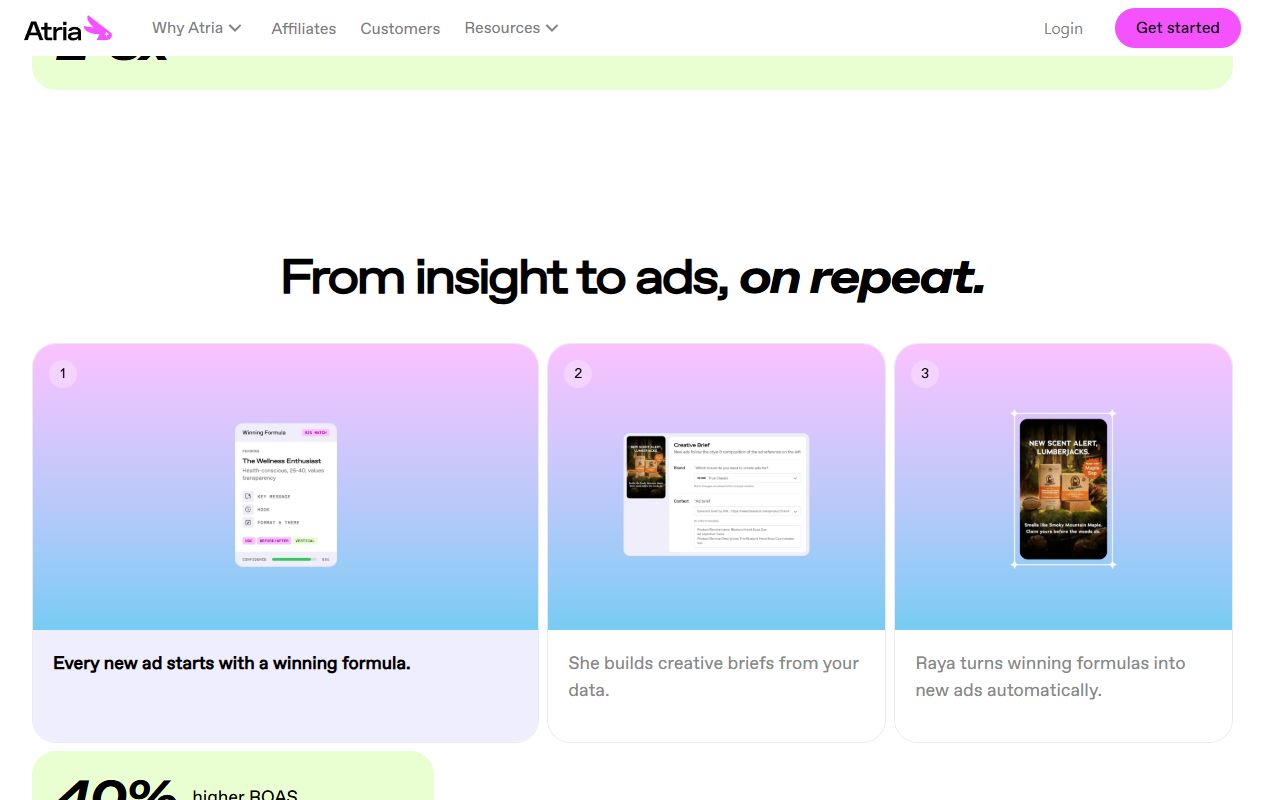
Atria: from analysis to a creative test
The preview connects an observation to preparation and then an ad. Use that progression to request an identifiable change. Commercial expressions and figures shown belong to the provider's demonstration, not results achieved with Spybox.
Prepare a variant you can meaningfully compare
Write a short hypothesis. For example: ‘Visitors cannot see which container fits in the bag. Showing it fully packed in the opening scene might explain the capacity.’ The variant changes the opening; product, price and destination remain the same. You can relate the comparison to that change, within the test's volume and attribution limits.
Film the container actually used, its dimensions and the bag closing. If the container is not sold with the bag, say so in the ad and product page. Avoid a generated image enlarging the interior, a fabricated testimonial or an invented temperature-retention claim. Improving the message should clarify the offer, not turn it into something else.
GetHookd can prepare visual variants and scripts; ChatGPT helps rephrase a demonstration using your information. Select one useful version for the problem rather than launching every proposal. Keep the original, the variant and a note of the difference. Review generated text and check rights to the files used.
Use Canva to adapt the image to the intended placement. For video, check captions in Submagic and watch it silently on a phone. Areas occupied by app controls must not hide the capacity, price or notice of an accessory not included. A correct export does not guarantee a better campaign; it lets you test the message in suitable conditions.
- Name files and ads so you can identify the version delivered.
- Record one main difference: opening scene, explanation, evidence or text.
- Keep the same offer and destination for a creative comparison.
- Check dimensions, package contents, readability, sound, captions and media rights.
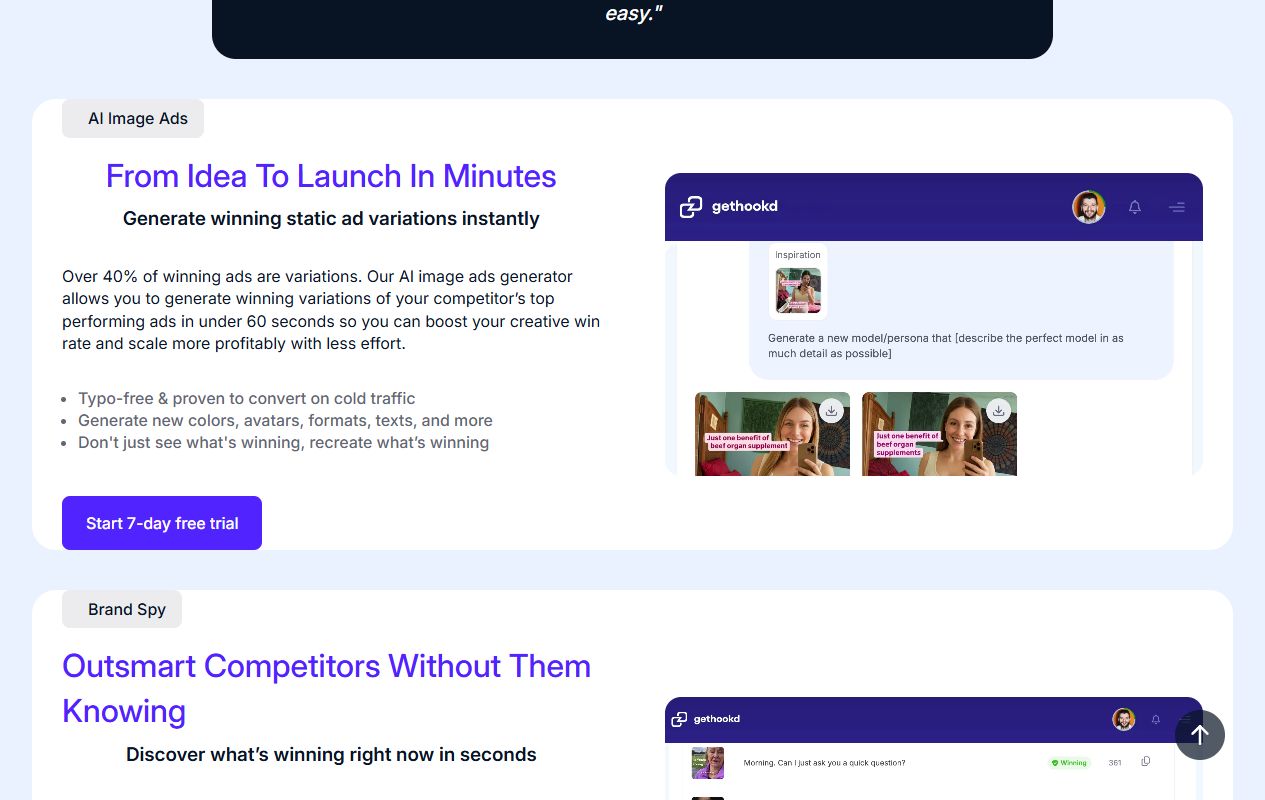
GetHookd: review variants before delivery
The panel shows proposals derived from an image. Compare product accuracy and the difference in message before selecting one. Performance promises in this marketing capture do not replace testing your offer.
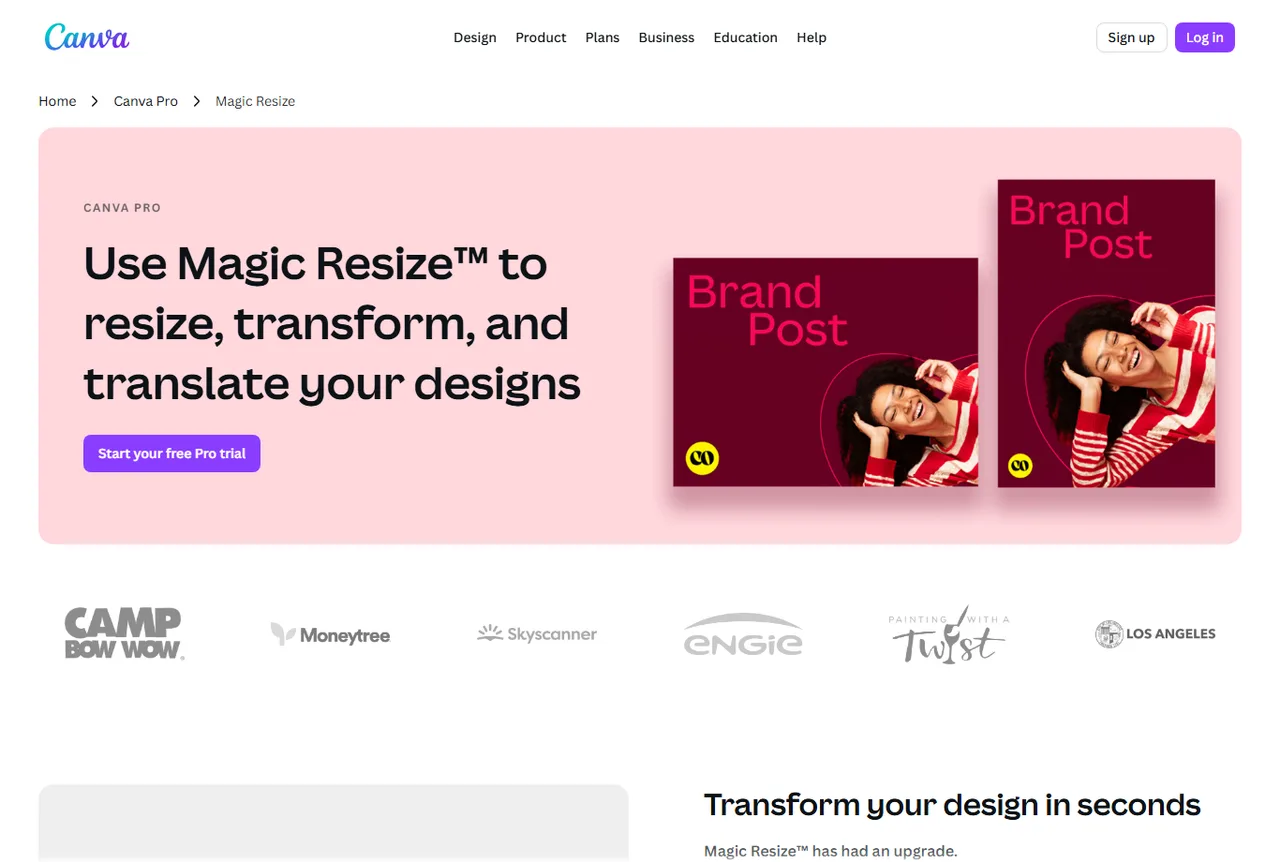
Canva: keep the message when the format changes
Magic Resize shows the same design in different proportions. After adapting, check cropping and text size on a phone. This illustration explains formatting rather than a sales comparison.
Write the test plan before launching
A useful test states what changes, what stays constant and how you will decide what follows. Use your platform's experiment feature when suitable rather than an improvised comparison between very different periods.
1. Define the question
Record the observed problem, variant and main metric. For the bag's capacity, compare clearer explanation while monitoring purchases and cancellations. Higher click-through rate alone does not answer the whole question.
2. Set the scope
Keep the offer, page, country and settings the test needs to hold constant. Document unexpected changes: stock shortage, discount, delay or incident. Two ads freely delivered with automatic allocation are not necessarily a balanced randomised test.
3. Reserve the budget
Choose a ceiling compatible with costs and cash reserves, then check how the platform's budget works. An average daily budget is not always a spending cap for each individual day. Separate funds for orders, tools, content and delivery.
4. Plan the review point
Allow for conversion delay and available volume. A three-day duration does not suit every offer. Check incidents and spending early, but do not name a winner after the first sale. With too few results, the conclusion may remain inconclusive.
5. Write reasons to stop
Failed payments, an inaccurate promise, a stock shortage or reaching the ceiling may require stopping before the review. Otherwise, keep a decision history so you do not credit a variant that barely received delivery.
Review results before changing the budget
Return to the versions actually delivered and their exposure. Compare the metrics specified in the plan, then orders and costs within the same scope. If tracking is incomplete or volume insufficient, note what is missing. An observed difference is not automatically a certain effect of your change.
Creative fatigue also needs diagnosis. An old ad may still suit the offer; a new one may explain it poorly. Consider frequency, cost trends, purchases and customer feedback together over comparable periods. Changes in season, offer or bidding may explain a decline without the video being the problem.
Before raising spend, check contribution after advertising, payment timing and supplier capacity. If changing a bidding target, follow platform-specific recommendations: in Google Ads, an overly high ROAS target can restrict traffic. A target is a delivery setting, not a promise of profit.
- Keep the useful version and specify the observed result and volume.
- Fix the offer or journey if that is where the data points.
- Prepare another test if a different objection remains open.
- Keep ‘inconclusive result’ when the test does not support a decision.
- Stop or reduce the offer if its costs and constraints do not support continuing.
Where Spybox fits in this routine
Spybox brings together 90+ research and creative tools with 100,000 SBC credits per month. Published pricing is €29.99 per month or €249.99 per year, based on pricing information verified August 4, 2026. Consult the final offer and each tool's conditions before payment.
The site's code remains GET25. Compare access cost and scope with the tasks you will perform: research, scripts, formats or editing. The subscription does not include your advertising budget, products or shipping. SBC credits are not funds to spend in Meta, TikTok or Google Ads.
Ad optimisation questions
Does Spybox optimise my campaigns automatically?
This guide uses Spybox for research and content preparation. Delivery, spending and experiments remain in your advertising account. Some direct-service functions may require particular connections or permissions: do not assume they are included in shared access.
What ROAS do I need to be profitable?
The threshold depends on costs, scope and the value used. ROAS does not deduct product, shipping or fixed expenses. In the lunch bag exercise, the simplified 2.5 threshold covers only variable costs and advertising; it does not apply to every store.
Should I check results every day?
Monitor incidents and spend regularly. For performance comparisons, allow for conversion delay, attribution window and volume. ROAS for a recent day may change as later purchases are reported.
Why do I have clicks but no orders?
First check the destination, loading, offer and payment. Clicks may also come from an ambiguous message or an uninterested audience. A page problem and a creative problem need different responses.
Is a long-running ad profitable?
Its duration helps identify an example to study. It does not reveal all of the advertiser's costs, refunds and results. Use it to analyse a scene or offer, then test your own version with your data.
Can I add sales attributed by Meta and Google?
Not as if they were always separate sales. Different attribution rules may count the same order. Reconcile reports with store orders and retain the definition of each measure.
How many variants should I launch?
Prepare as many as your budget and volume can meaningfully compare. One clear variant may be more useful than a series with very little delivery. Not every tool-generated proposal needs publishing.
Can I change price and video in the same test?
You can test a completely new offer, but you will not isolate the video's effect. Keep the same offer for a creative comparison. Document changes to price, bundle or destination.
When can I increase the budget?
After examining results, contribution, delivered orders and cash reserves rather than one isolated sale. Check supplier capacity and platform constraints too. An increase has no guaranteed effect and needs monitoring.
Sources and public illustrations
Pages consulted October 3, 2026. Reused captures may predate this visit; they illustrate functions rather than results from our tests. Direct-subscription connections and capabilities remain distinct from Spybox access.